
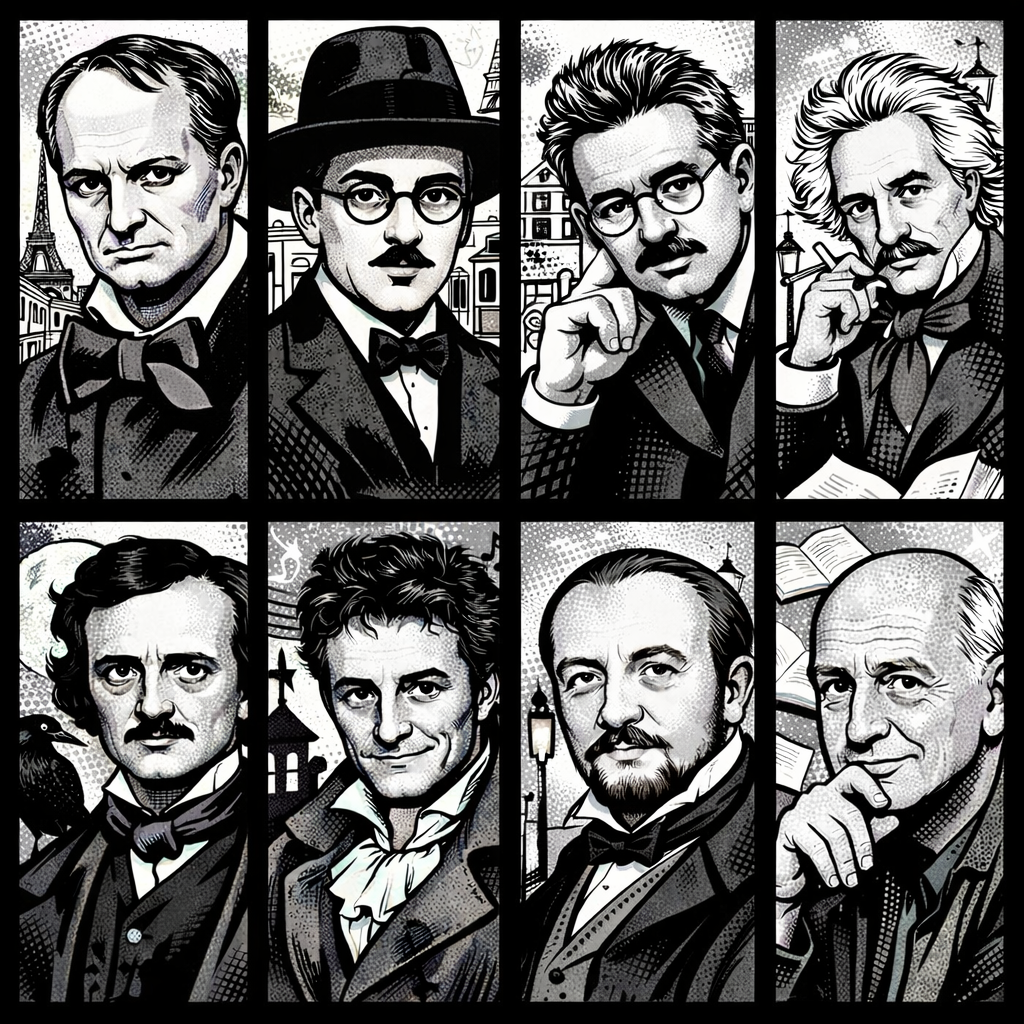
I read Rafael Rojas’s interesting post on Libros del crepúsculo, a topic full of nuances that stirs up ideas.
Rojas suggests that Baudelaire and Pessoa define two styles of criticism. The first, between passion and partiality; the second, the critic of disdain.
For me, it is a binomial.
Of the many currents of literary influence, I lean towards Gérard Genette’s obscure theory. The central idea: every text is hypertext of others through reference plots, quotations, parody… and watch out! Pure coincidence. Every literary framework is due to a cultural framework, and this to another, and so on.
For Genette, no work is completely isolated:
The text message is not mandatory for understanding, much less for declaring its generic validity. The novel is not explicitly designated as a novel, nor the poem as a poem. Even less so, perhaps (since genre is only one aspect of the architect): verse as verse, prose as prose, narration as narration. Ultimately, the determination of the generic status of a text message is not apparent to the reader, the critic, or the public; that is, the status is revealed through the paratext.
Generic status comes from genus, that is, lineage, broad class. The text (novel, poem, essay) does not mark a precise conceptual difference, but rather groups figures under a family resemblance, whether through splitting, spectrality, or multiplicity of the self. Literature functions by thematic kinship, not by theoretical imposition.
Seen in this light, Baudelaire takes from Poe, Nerval, and Hoffmann—a view of the city, spleen, and modernity—and rewrites them in his own style. Pessoa takes up this fragmentary view: Baudelaire via Hoffmann, Poe, etc., internalizes it, applying it to Lisbon and the scattered self of Bernardo Soares.
In Genettean terms, Livro do Desassossego is a paratext of the literary modernity of Baudelaire/Nerval/Hoffmann/Poe.
No one copies; everything is transformed and reinvented.
Let’s see, Pessoa has Baudelairean skin in The Book of Disquiet.
Who instilled the city fever that afflicts Pessoa/Soares? And the love for Poe? And the fixation with T. A. Hoffmann? Synchronic coincidences between two brilliant poets from the same continent separated by less than a century. Pessoa brings the spleen of Paris to Lisbon. Similarly, Walter Benjamin—a Baudelairean nomad—and his fixation on Berlin in The Arcades Project.
The book portrays a ghostly Paris—arcades, the flâneur, the petty bourgeoisie. But Benjamin writes from the Berlin of inflation and the failure of the Weimar Republic between the wars. A Berlin devoid of aura.
Surprise! Another Berlin will reappear as a latent memory in the childhood of the 1900s! Exquisite miniatures: “Corners,” the city as miniature urban thought. “The Wardrobe,” the historical object/archive. And the monument to the city relic: “The Victory Column,” close to Hoffmann’s phantasmagoria.
Benjamin remakes what Baudelaire did with Paris. Reading the city from disenchantment.
Who is writing here, Baudelaire or Pessoa?
Not everyone is given the chance to bathe in the crowd; enjoying the crowd is an art. Only at the expense of the human race can that glut of vitality be given to those whom a fairy breathed into the cradle the taste for disguise and mask, the hatred of home and the passion for travel. Crowd and solitude: equal and interchangeable terms for the active and prolific poet. Those who do not know how to populate their solitude also do not know how to be alone in the busy crowd.
Although it belongs to Baudelaire, the essence will be Pessoanist in the near future.
I was born at a time when most young people had lost their belief in God, for the same reason that their elders had had it: without knowing why. And so, because the human spirit naturally tends to criticize what it feels and not what it thinks, most young people have chosen Humanity as a substitute for God. I belong, however, to that species of men who are always on the margins of what they belong to, who see not only the crowd they are part of, but also the great spaces that lie beside it.
Baudelairean, eighty years after Fleurs du mal.
As Rojas rightly points out, Baudelaire makes it clear in Écrits sur l’art that criticism must be partial, passionate, political, and that is to say, made from an exclusive point of view, but from the point of view that opens up the most horizons.
Passionate? Political? Exclusive… opening up horizons? A quasi-avant-garde program in the middle of the 19th century.
Let’s be daring and implode eras—I hope that Rojas, the historian, doesn’t fail me in this subject.
What predominates in almost 400 pages of Écrits sur l’art (the body of Baudelaire’s criticism) is subtle irony.
This is how he opens the first section of his salon 1846, under “What is the point of criticism?”
What is the benefit? The question grabs the critic by the throat, so to speak, almost from the first step of the first chapter he sets out to write. The artist reproaches the critic for not being able to teach anything to the bourgeois, who is not interested in painting or writing poetry, or even art itself: it is from the womb of art that criticism emerges.
Criticism is a paradoxical activity, as sterile as it is necessary.
Baudelaire transmits via télégramme to Pessoa a negative and reflective experience: spleen —consciousness in état de choc in the face of the ephemeral— reappears stripped of moral drama in Alberto Caeiro. What in Baudelaire is historical malaise becomes an existential condition in Pessoa. Who does not notice the link between Pessoa and Kierkegaard? The paratext is more than a pretext: in both, there is an inner split, the impossibility of coinciding with oneself.
Another Baudelairean aspect: “I sincerely believe that the best criticism is that which is entertaining and poetic.”
Let’s have fun. If Pessoa (following Hoffmann) fragments the subject via splitting, the German author, for his part, captures fragmentary modernity in poetic prose. Extraordinary: if the author of Piezas de fantasía al estilo de Callothad traveled to the future and read the Philadelphia described by Poe, the Berlin of the former would have been different. Fun fact: Hoffman is a composer of ambient music in his time (although they didn’t call it that).
From the flâneur, Baudelaire projects the Paris Nouveau as a mirror of modern consciousness. Pessoa, the Lisbon of aesthetic introspection. Both personify modernity as malaise. Baudelaire and his spleen; Pessoa and his solipsistic weariness.
Let’s talk about degrees of acidity in criticism—Rojas calls it disdain.
Acidity? As nineteenth-century as the bourgeoisie. Baudelaire treasures a master of acidity, almost unknown in our time: Barbey d’Aurevilly.
One need only read a few pages of Les Œuvres et les Hommes to realize that the work establishes an axiological critique of literature: a new position on evil, faith, and modernity. It is the kind of criticism that Rojas equates with that of Pessoa, half a century later.
It is true that mid-19th-century criticism does not represent what it will be almost seventy years later, for Pessoa or Walter Benjamin. Baudelaire, for example, does not see himself as a scholar specializing in criticism. He feels deep contempt for the academic professor juré of the moment. The author of Les Paradis Artificiels is, above all, a journalist at ease (in 1848 he almost debuted in the profession).
It could be said that Baudelaire and Pessoa combine two poles that attract and repel each other: the irony and anomie of the flâneur with the passion of the outdated romantic. Barbey, a master of disdainful criticism, hated the moralistic, humanitarian, and grandiloquent Victor Hugo.
The pairing I mentioned at the beginning consists of combining irony with passion. The maudit poet demonstrates both in Salon de 1846 and the subtitle Critique en vers et contre tous (“criticism against all”).
Here is Pessoa’s passion (under the ironic split of the self): Tenho uma ternura imensa por mim próprio. Tenho pena de mim como de um outro.
Another: Sou, em grande parte, a mesma prosa que escrevo.
Baudelaire conceives of modernity as an irreversible rupture between absolute desire and the fall into the ephemeral. It is the metaphysics of mourning. Pessoa radicalizes the self as practical fiction. Hence, consciousness retreats and multiplies. Pessoa is a skeptic without reason.
For both, modern consciousness is a cul de sac.


