
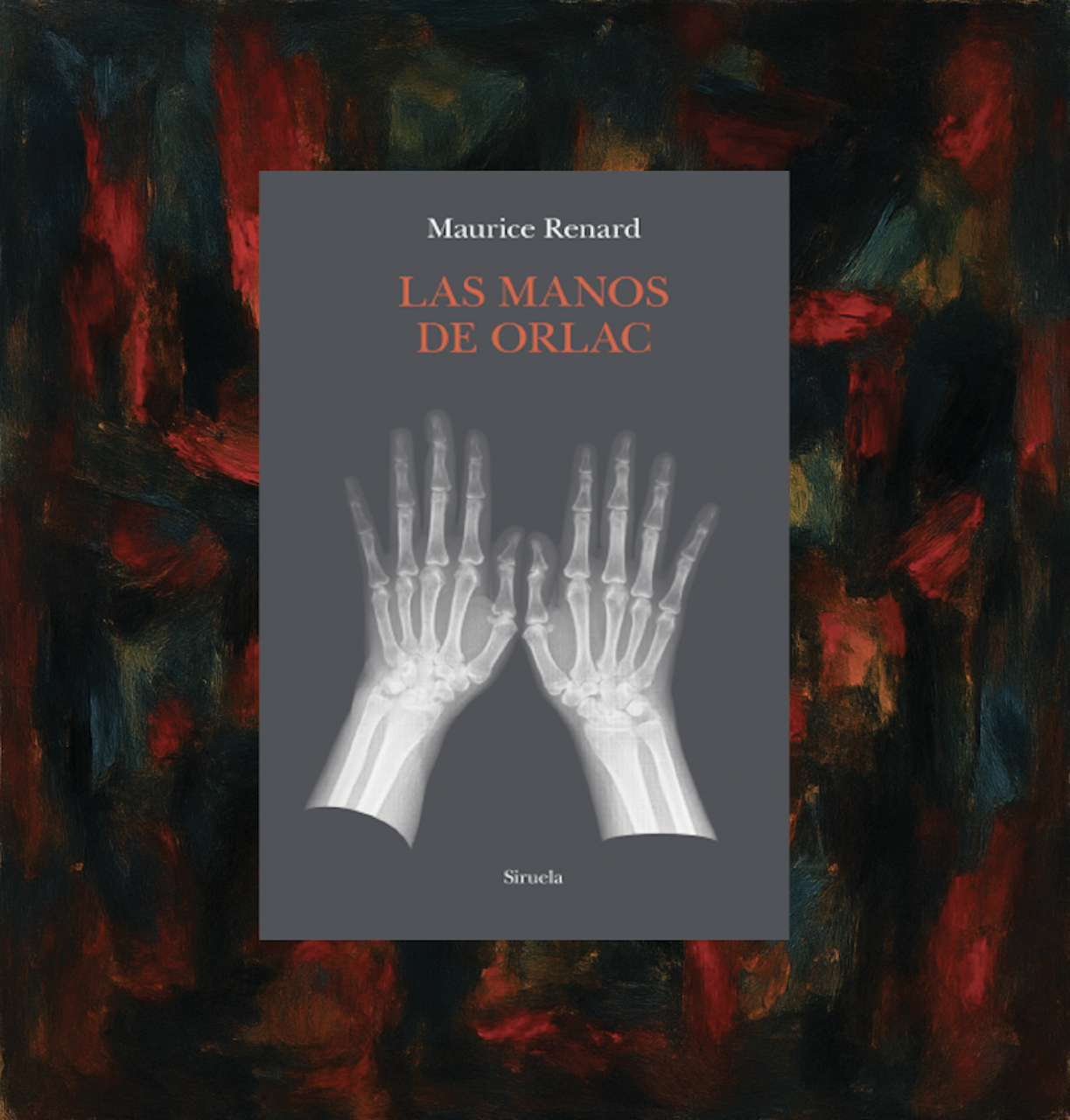
Originally published in 1920 under the title Les Mains d’Orlac, Maurice Renard’s novel tells the story of Stéphen Orlac, a famous pianist who loses both hands in a train accident. Dr. Cerral, a fictional character partly inspired by advances in regenerative medicine in the early 20th century, transplants the hands of an executed criminal onto Orlac. From this surgical procedure, the story unfolds as a psychological investigation, where bodily identity is altered by the idea that the body is not a limit, but a threshold.
Orlac’s initial recovery is quickly displaced by a series of impulses, hesitations, and fears: he believes he perceives traits of the murderer in himself, senses a drift in his will, and suffers growing alienation, which plunges him into a spiral of doubt and suspicion. His wife Rosine and the court reporter Gaston Breteuil become the two rational forces trying to shed light on what is happening, while the narrative avoids supernatural explanations and remains deliberately ambiguous until its dénouement.
Maurice Renard (1875–1939), an author less remembered today than other names in early 20th-century French literature, coined the term roman merveilleux-scientifique to describe a speculative narrative that does not stray from empirical logic but introduces anomalous elements into rational systems. Far from romantic exoticism, his work lies on the border between science fiction and mystery. In The Hands of Orlac, this poetics is expressed through a combination of clinical rigor and behavioral drama, where the essential is not the surgical operation itself, but the subjective and social consequences that emerge from it. This concern for the disturbing effects of science on the body and consciousness was already evident in Le Docteur Lerne, sous-dieu (1908), in which a scientist transfers organs and functions between humans, plants, and animals, blurring the boundaries between living beings. Similarly, Le Péril bleu (1910) proposes a hypothesis of invisible aerial life that kidnaps humans without leaving a trace, reaffirming in both cases Renard’s quest to narrate the unobservable within a logical framework.
The narrative structure of Las manos de Orlac (Siruela, 2021) is constructed with almost forensic precision. The main narrator, Breteuil, offers an external perspective that maintains sufficient distance so that the reader never directly accesses Orlac’s intimacy, which increases the effect of estrangement. Rosine, for her part, is presented as an active figure who acts through observation and analysis, without resorting to sentimental archetypes. The result is a story where tension does not depend on dramatic twists, but on the methodical accumulation of dissonant signs: displaced objects, seemingly involuntary acts, perceptual alterations. The atmosphere of the book, although not openly dreamlike, can be described as expressionistic in a broad sense: spaces are saturated with meaning, bodies are moving surfaces, and perception is subject to internal tensions that distort reality without the fantastic ever fully asserting itself.
This quality of intersection between scientific narrative and psychic deformation links him to other figures in French literature. Théophile Gautier, in his treatment of the supernatural as a poetic extension of symbolic logic, anticipates certain mechanisms that Renard reorients toward medical speculation. Gustave Le Rouge, for his part, shares his interest in scientific extrapolations that lead to paranoid scenarios or realities contaminated by technology. J.H. Rosny aîné, who recognized Renard as a legitimate successor to Verne and Wells, highlights his ability to maintain a pact of verisimilitude even when the narrative elements escape everyday experience. In all these cases, the suspension of reality does not occur through rupture, but through infiltration: the foreign is introduced into the familiar without abolishing the internal rules of the world represented.
In 1924, the novel was adapted for the cinema by Robert Wiene, under the title Orlacs Hände. This film version, starring Conrad Veidt, effectively transfers the essential elements of the text to a setting marked by German expressionism. The visual compositions, the arrangement of shadows, and the distorted geometry of the spaces amplify the protagonist’s inner conflict. Wiene translates into images what Renard had constructed through language: a progressive dismantling of the will, in which the body becomes a place of suspicion. This relationship between text and visual representation suggests the thematic relevance of the story, even when transferred to another medium.
This edition, translated by Mauro Armiño, restores the text to contemporary readers in a carefully edited version, accompanied by notes and a prologue that contextualizes the work within the medical, philosophical, and narrative debates of its time. More than a century after its publication, The Hands of Orlac continues to function as a narrative laboratory where the boundaries between science, body, mind, and identity are put to the test. Without resorting to the inexplicable, Renard manages to construct a story that questions not only medical technique, but also the areas of instability that arise when the body ceases to be one’s own and consciousness becomes incapable of sustaining itself in its old order.


