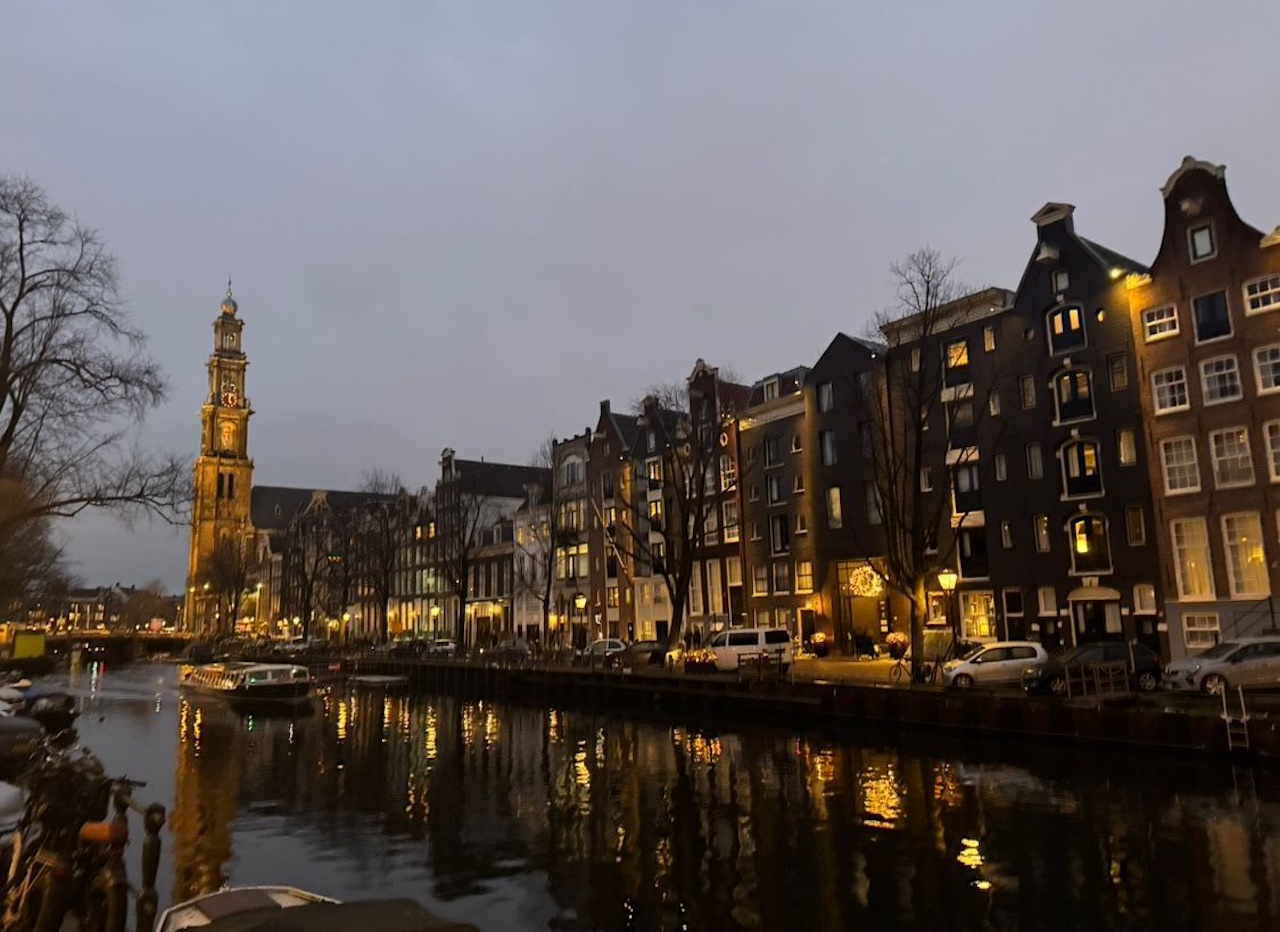
With Centraal Station behind us, we venture into the cold of a city that only just awakens at 9 a.m. and still seems to have its sheets stuck to its body…
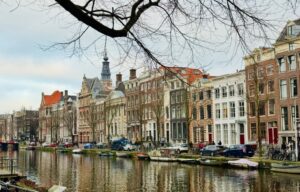
Far from the easy picturesqueness of watercolors for tourists, here the canals lack southern languor. They are straight, bourgeois, almost Protestant in their geometric discipline. The water seems to serve more to reflect the respectability of the facades than to invite reverie.
Here, the romantic traveler is quickly disappointed; no funeral gondolas, no masks. Instead, bicycles circulating in a secular procession, narrow houses—tall, brick—that seem to have stretched upward out of greed for space, without poetic aspiration. Many of them display their gables like minor noble titles. Likewise, the white starched curtains in the windows rarely reveal the interior, perhaps to tell us clearly that orderly people live here.
Entering one of these 17th- or 19th-century interiors (because in Amsterdam, time seems to have stopped in sober good taste) is like stepping into a painting by Pieter de Hooch or Emmanuel de Witte, but without the miraculous effect of light. The light is always grayish, diffuse, and domestic. There are no Caravaggio-like contrasts, because everything is bathed in an overly precise clarity.
Dutch furniture—monumental oak cabinets, embossed leather chairs, tables that seem to have been carved by the same hands that signed contracts for the East India Company—speaks of a bourgeoisie that did not need to show off because it had already won. With its baroque of restrained excess, Amsterdam lacks Venetian ostentation or French sumptuousness. Discreet, almost modest luxury: here a silver jug, there a Delft tile, next to it a family portrait where no one smiles too much.
However, something disturbing lurks beneath such restraint. Beneath the smooth surface of this Calvinist decency lies a repressed but unapologetic sensuality, the same sensuality that Vermeer—from Delft—suggested with a sidelong glance, the edge of a satin sleeve, a pearl in an ear. Amsterdam tames its desires until they become still lifes.
And then there are the mirrors. Mirrors everywhere, in the salons, in the small cabinets, mirrors that multiply the space and at the same time enclose it, as if the entire city refused to let the souls of its inhabitants escape. To look at yourself in them is to understand that here even introspection must be reasonable.
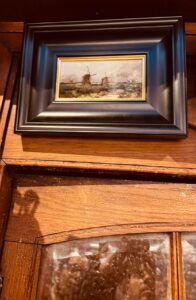
In the center, especially on Nieuwe Spiegelstraat, and in the intimate labyrinth of the Jordaan, antique shops extend this domestication of the past to the point of turning it into a profession. Among labyrinths of display cases and cabinets, the same objects that inhabit interiors are lined up: bronze clocks that mark time standing still, Delft porcelain (always), beveled mirrors that return the customer’s own image like a 17th-century painting. In the Jordaan, the disorder is more bohemian, a calculated chaos of objects that seem to have been rescued from a canal house in liquidation; in the center, on the other hand, a museum-like elegance reigns, where each piece is displayed as evidence of the cumulative Dutch wealth. Amsterdam’s antique dealers sell the illusion that bourgeois good taste can be bought on credit, and that the past, conveniently restored, fits perfectly into a modern living room.
In one of these antique shops, I bought a Book of Hours by Catherine of Cleves, illuminated with that Flemish patience that seems to obey a suspension of time. Its pages are governed by the same ethic that rules the city: intimate scenes, private devotion, precise colors, gold without ostentation; a book intended for the domestic table, to be read at a precise hour of the day, as if even prayer needed to be ordered. The whole of Amsterdam functions like a book of hours (which is why churches here always give the hours and half-hours): every gesture in its moment, every excess contained, every desire carefully illuminated in miniature.

But the good Dutch order—so jealous of its appearance—paradoxically admits an excess that is tolerated with the same phlegmatic acceptance as the rain: the dark cafés and coffeeshops—where smoke and resin are breathed in clouds as dense as the city’s own past—and the red-light district—where flesh is offered with the frankness of a Delft porcelain display case. In the former, the atmosphere is so thick that it seems to have been smoked for centuries, a domestic vice that needs no hiding because it is already part of the furniture; in the latter, the trade in pleasure is displayed with such methodical, cartographic nakedness that even the scandal is almost administrative. All this coexists with the same neatness that presides over the canals. Here, sin becomes another form of order, another still life, this time animated and breathing.

Amsterdam is a city to be observed with an antique dealer’s magnifying glass, to admire the perfection of good taste and, discreetly, to smile at the naive pretension that virtue and commerce can coexist without contradiction. It is no coincidence that this city has produced so many interior painters.
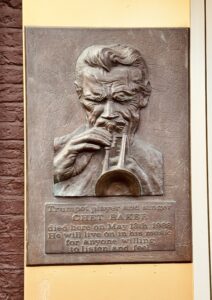
Is it a coincidence that Chet Baker died here, in a room at the Hotel Prins Hendrik, with his long notes fading away without drama? His trumpet—always on the verge of breaking—seemed made for this city, with its sound without excess, melancholic but neat, where even the fall occurs with discretion. Baker played as one lives in Amsterdam, without fuss, letting sadness sort itself out, letting the night claim nothing more than one last sustained chord.