
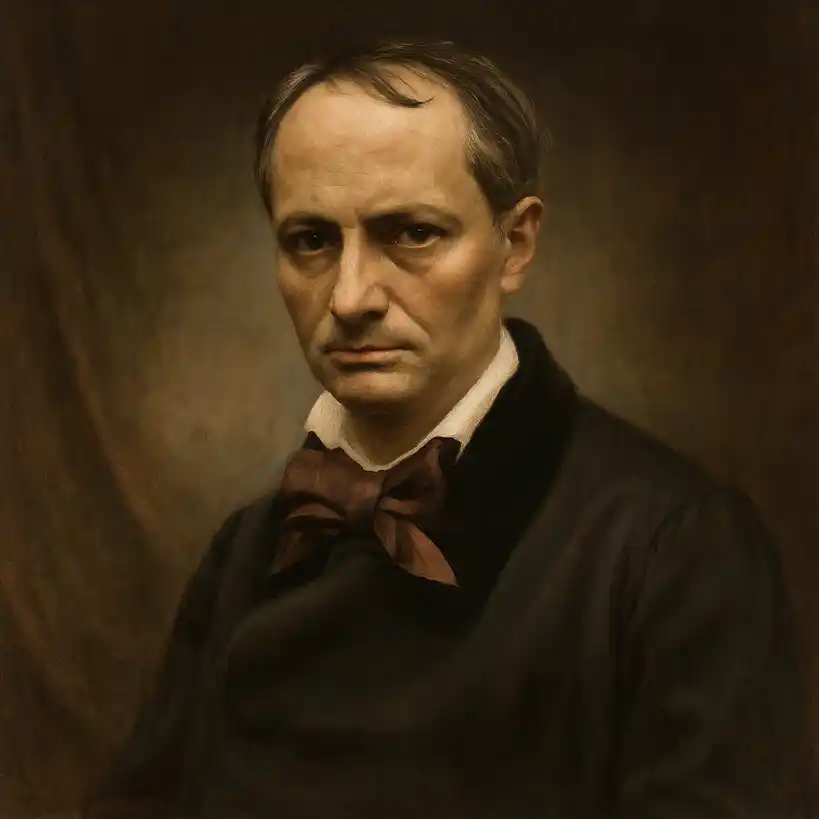
Mischievous and spectral, he peers from the left side of the screen. He is seen in the background, behind the owner and apparent protagonist of the photo, Monsieur Arnauldet. Despite the foreground Arnauldet occupies and the clarity of his figure—groomed to perfection: hair and mustache styled as the discreet charm of the bourgeoisie demands, dark suit in harmonious contrast with the trousers and the top hat resting on one leg and held by a hand, both pieces in light colors—Arnauldet loses the prominence that is his by right of payment.
Despite the lack of sharpness in the background—though the poet’s silhouette remains unmistakable—it is now Arnauldet who is the specter. Indeed, our gaze has rendered him invisible: it is no longer his photograph; it is Charles Baudelaire’s. Without paying a toll, the beggar Charlie became the subject. In 2014, the Musée d’Orsay paid fifty thousand euros for the photo because it is one of the fifteen surviving images of the author of Les Fleurs du mal.
For Charles Asselineau, his first biographer and close friend, Baudelaire’s life is “the biography of a talent and a spirit.” As much as or more than a 19th-century French poet and dandy, as much as or more than a precursor of modern poetry and a renovator of art criticism, Baudelaire is the greatest poetic spirit of Western lyricism since the 19th century. He became that ghost who crosses, in the middle of the night, the alleys and boulevards of Paris—then the world, reinventing itself thanks to Baron Haussmann’s urban genius—and the lines and between-the-lines of the modern poem. A bohemian spirit, melancholy, opium-addicted, syphilitic; “a poetic spirit to the point of terror,” Sartre dixit.
To write verses after Baudelaire implies feeling the presence—or the coldness, similar to what Adrian Leverkühn experienced before Mephistopheles in Thomas Mann’s novel—of that literary energy into which the author of Les Paradis artificiels evolved. Since the second half of the 19th century, the paths of poetry have been filled, albeit in a veiled manner, with Baudelairean echoes. Ô Mort, vieux capitaine, il est temps ! levons l’ancre ! […] Au fond de l’Inconnu pour trouver du nouveau!
Yves Bonnefoy called the 19th century the century of Baudelaire, as he was the first—perhaps in a manner “less resolute than Rimbaud and Mallarmé, but no less radical for it”—to free words “from the obligation of only having to signify.” In a West that proclaimed deaths everywhere, above all the death of God, Baudelaire was a pioneer who perceived “clearly the true place of his combat,” that place where, once “the religious faltered,” he “made it possible to discern the poetic in its difference, poetry in its own being.” Baudelaire provoked the migration of symbols of the sacred into the domains of the poem.
In his formative years, first in Lyon and then at the Louis-le-Grand college, Baudelaire practiced a hatred for History, a knowledge he considered “perfectly useless,” and professed a love for Latin, rhetoric, and composition. Therein lies his anti-modernity, or his being modern. From then on, he read much and wrote verses; however, he was bored. Antoine Compagnon has noted that “true modernism has always been anti-modern, self-conscious. The anti-modern suffers while composing.” More than his friends or his “Black Venus,” Jeanne Duval, boredom was his constant companion.
A ghost has haunted the world since 1821… starting at number 13 rue Hautefeuille, in the heart of the Latin Quarter, passing through 30 rue Saint-André-Des-Arts, 17 rue du Bac, rue de Lille, through one or two nights (sometimes weeks) at friends’ houses, in brothels, in Lyon and Brussels… in short, through more than thirty different residences on both sides of the Seine… until reaching our present day.
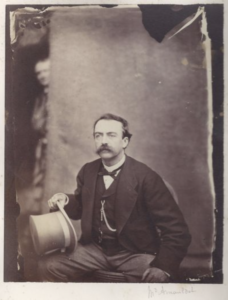
I too, Jonathan Edax, often find myself bored. In my wing chair, I practice sessions of exorcising tedium. I read. Never more than one page a day do I read in my wing chair. In the Wunderkammer, something of Baudelaire should not be missing, and indeed, it is not: there are the second edition of Les Fleurs du mal (Paris, Poulet-Malassis et De Broise, 1861, the last published in the poet’s lifetime) and the first edition of Oeuvres Posthumes et Correspondances Inédites (Paris, Maison Quantin, 1887).
The copy of Les Fleurs du mal has a gold-colored Morocco binding. Oeuvres Posthumes is bound with the same technique and materials, with a black leather spine, four raised bands, and gold lettering. In the Wunderkammer, both volumes sit between an 1853 edition of The Poetical Works of Edgar Allan Poe—in every library, it should be mandatory to place Poe next to Baudelaire—and the first edition of Stéphane Mallarmé’s Les poèmes d’Edgar Poe (1888). Thanks to the “misreading” Baudelaire made of Poe, French lyricism entered what Neruda called “the mathematical darkness.” For T. S. Eliot, who disowned the author of The Raven, “Baudelaire improved Poe’s prose.”
According to the pater Cyril Connolly, Oeuvres Posthumes proved to be one of the starting points of the Modern Movement. The book includes correspondence—with Poulet-Malassis, George Sand, Flaubert, Sainte-Beuve, Armand Fraisse, M. Soulary—sketches for two plays, and the intimate diaries Fusées and Mon cœur mis à nu. It also features an appendix including letters between Asselineau and Mme. Aupick, the poet’s mother, written shortly after his death.
In the diaries, the Baudelaire revealed to (us) is naked, visceral, at the heights of despair, his thoughts howling: “I have cultivated my hysteria with joy and terror. Now, I always have vertigo, and today, January 23, 1862, I suffered a clear warning: that of feeling the wind from the wing of imbecility pass over me.”
The first edition of Les Fleurs du mal dates to 1857. Its author called it a “dictionary of crimes and melancholies.” It sold out in just over a year, partly due to the obscenity trial in which it was embroiled. “You have endowed the sky with a macabre ray,” Hugo wrote to him. Likewise, in that context, an epistolary exchange began with Flaubert, who was also submerged in a trial regarding Madame Bovary—the novelist would be acquitted; the poet, condemned.
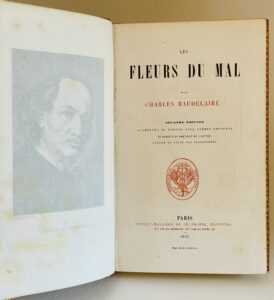
The second edition (fifteen hundred copies) went on sale in February 1861, at a price of three francs. Baudelaire intended it to be “definitive”; and though the six poems censored by the State were removed, it now included a new section (Tableaux parisiens), for a total of thirty-five new poems, as well as a lithograph of the poet’s face by Félix Bracquemond.
Baudelaire spent part of his inheritance—his father left him more than one hundred thousand francs, a fortune for the time—in brothels and cafés, expensive tailor-made suits, artworks, and collectible books. In that artist of modern life who practiced the ideal of the dandi, there was much of the bibliophile. He had his books bound by the most notable binders, such as the Lortic family. In each of his many residences, Asselineau recounts, he almost always left behind a hundred books that ended up in the hands of his creditors, always on the hunt for the “deadbeat Charles.” He collected several editions of Poe’s work; from these, he never parted.
Memorabilia. Inside Oeuvres Posthumes, I found a clipping from the Los Angeles Times of June 14, 1966, featuring the poem Baudelaire by Delmore Schwartz. A perfect poem if ever there was one. Perhaps these verses by Schwartz are the most beautiful tribute—it could be classified as a lyrical biography: all of Baudelaire’s vital demons speak in them—ever written about the cursed French poet:
When I fall asleep, and even during sleep,I hear, quite distinctly, voices speakingWhole phrases, commonplace and trivial,Having no relation to my affairs.Dear Mother, is any time left to usIn which to be happy? My debts are immense.My bank account is subject to the court’s judgment.I know nothing. I cannot know anything.I have lost the ability to make an effort.But now as before my love for you increases.You are always armed to stone me, always:It is true. It dates from childhood.For the first time in my long lifeI am almost happy. The book, almost finished,Almost seems good. It will endure, a monumentTo my obsessions, my hatred, my disgust.Debts and inquietude persist and weaken me.Satan glides before me, saying sweetly:“Rest for a day! You can rest and play today.Tonight you will work.” When night comes,My mind, terrified by the arrears,Bored by sadness, paralyzed by impotence,Promises: “Tomorrow: I will tomorrow.”Tomorrow the same comedy enacts itselfWith the same resolution, the same weakness.I am sick of this life of furnished rooms.I am sick of having colds and headaches:You know my strange life. Every day bringsIts quota of wrath. You little knowA poet’s life, dear Mother: I must write poems,The most fatiguing of occupations.I am sad this morning. Do not reproach me.I write from a café near the post office,Amid the click of billiard balls, the clatter of dishes,The pounding of my heart. I have been asked to write“A History of Caricature.” I have been asked to write“A History of Sculpture.” Shall I write a historyOf the caricatures of the sculptures of you in my heart?Although it costs you countless agony,Although you cannot believe it necessary,And doubt that the sum is accurate,Please send me money enough for at least three weeks.
In the copy of Les Fleurs du mal, I keep a pamphlet from the Raven Society of the University of Virginia (1963), purchased from an antiquarian in Charlottesville. It recounts that, in 1905, the train journey from Richmond to Washington D.C. took six hours. Because of this, a pamphlet from the Pennsylvania Railroad mentions three landmarks along the route: Civil War battles, tributaries of the James River, and a forest in Spotsylvania where the cawing of the American crow can be heard. According to the pamphlet, the crows of the area mimic Poe’s nevermore. In some way, French poetry has inhabited that Spotsylvania forest since Baudelaire.
A Bibliophile’s Diary
May 15, 2017.
A visit to the Cimetière du Montparnasse. One block before arriving, I stop before the windows of Barnes International Realty. Properties are advertised for both delicate and obese pockets. Beyond the prices, something catches my eye: apartments with balconies overlooking the cemetery have a 15% discount, for the superstitious. Among the properties for sale, an attic stands out atop La Comédie Italienne, located on the Rue de la Gaité. The advertisement emphasizes that from the window, one can make out the tomb of Charles Baudelaire. Is there any greater superstition than the French?
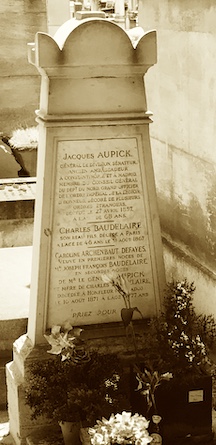
Baudelaire shares a grave with his “beloved and detestable” stepfather, Jacques Aupick. The remains of his mother are also there. “Shoot General Aupick!” the poet would scream at the barricades of 1848.
A few meters from Baudelaire’s final home, on the opposite sidewalk, stands the pantheon of Porfirio Díaz. “At artists and writers, shoot for the belly,” the Mexican dictator used to advise. Baudelaire will have no choice but to change residences once again, just to escape Don Porfirio’s bullets. Even in death, the poet has not rid himself of his creditors.
I pass near, though I do not stop at, the tomb of an Argentine writer who, like Baudelaire, also translated Edgar Allan Poe.


