
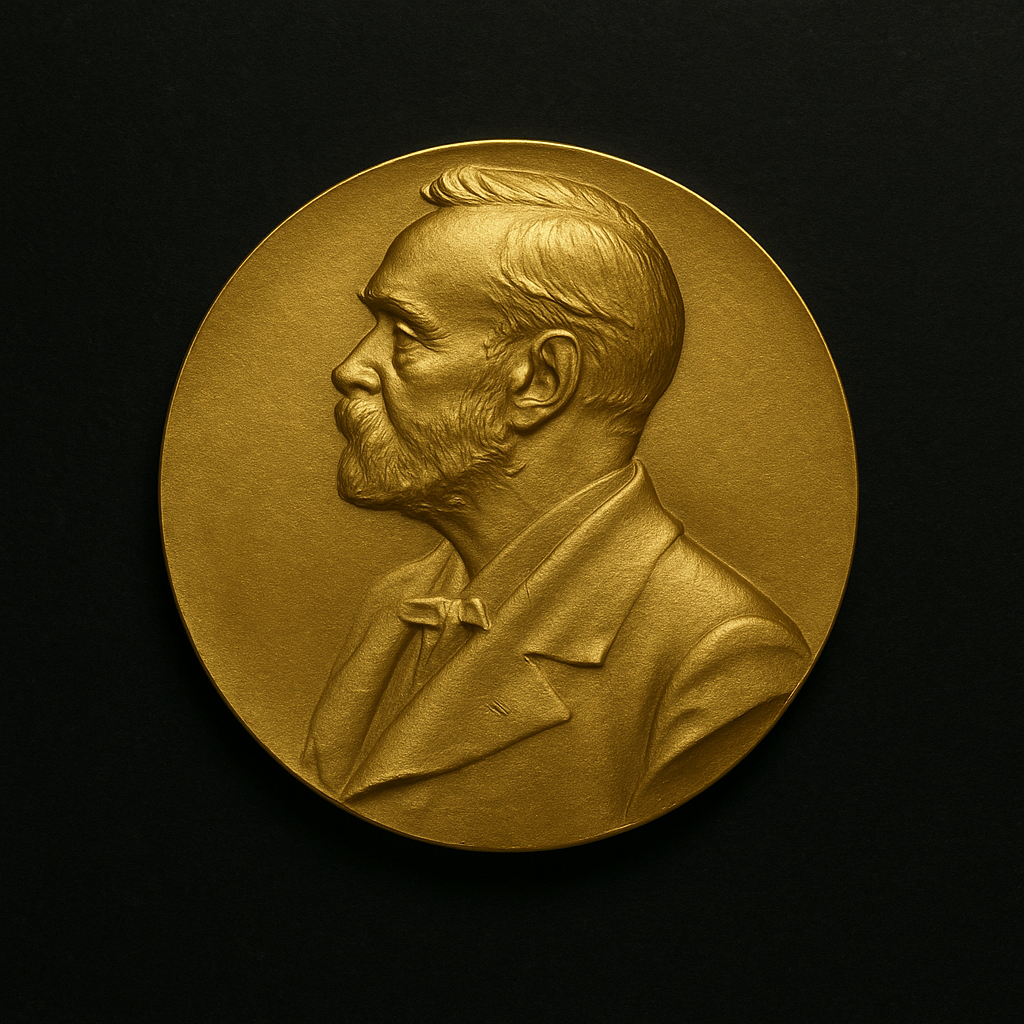
It’s already a ritual: the first cold spells of October arrive, and with them, the annual rumor mill about the Nobel Prize for Literature. The media, obedient as altar boys, sound the same old rattle: Salman Rushdie, whose candidacy has been around longer than Argentina’s foreign debt; Haruki Murakami, who has been “the favorite” for two decades and should be collecting royalties for the cliché; Thomas Pynchon, the holy grail of cultural journalists, because his aura as a publishing ghost feeds headlines; and, of course, César Aira, eternal substitute on the bench, waiting for someone to call him onto the field like a striker in injury time.
The spectacle is tragicomic. Hasty profiles are published, improvised essays on “the relevance of his work,” emotional columns assuring that ‘now’ the Academy will surrender to the evidence. All embellished with the same worn-out phrases: “literary justice,” “cult author,” “unpostponable prize.” And then, on the Thursday of the revelation, the monotonous voice of the Swedish spokesperson announces the unthinkable: the prize goes to a Korean novelist of whom only three little books have been translated into English and two into Slovenian, or to a Chinese writer who is not even invited to literary conferences in Beijing, or to a Tanzanian (Gurnah, Gurmah, Gurka… it takes journalists weeks to learn how to spell it correctly) who until the day before was an unpronounceable name in an academic catalog.
Swedish laughter echoes in newsrooms. And the press, instead of admitting embarrassment, turns the tide and celebrates the “opening up to new voices,” “cultural diversity,” and “sensational effect.” Wikipedia and Google Scholar are saturated with frantic searches: global cultural journalism rushes to disguise what is actually pure surprise mixed with ignorance as enthusiasm.
Meanwhile, in the corner of the great ignored, Jorge Luis Borges smiles with his infinite irony: the man who reinvented Spanish literature never received the award because, of course, he was not to the liking of a fussy academic deserving of the most universal oblivion. Philip Roth died waiting for the call from Stockholm, which never came, although along the way he saw it being awarded to authors who today survive only in onomastic indexes: Vicente Aleixandre, Dario Fo, some other Frenchman…
And if we’re talking about eccentricities, no one exemplifies them better than Bob Dylan: awarded in 2016, but absent from the ceremony, as if a Nobel Prize in Literature were an optional invitation to brunch in Stockholm. The Academy waited patiently for his acceptance speech for months, probably wondering if Dylan was going to send it written on napkins or via a sung telegram. In the end, it all came in a video, with the bard’s raspy voice and the irony of a man who turned the solemnity of the Nobel Prize into a private concert for one. More than one person was annoyed, asking themselves the same question as Dylan: wasn’t it all a Nordic joke, or did they actually award him the prize so they could dream of having his concert behind closed doors, even though in the end they had to settle for watching him skip a ceremony to which he sent a friend?
And if that weren’t enough, the Swedish Academy is also embroiled in scandals that seem straight out of a thriller novel. In 2018, the husband of one of its members, Jean-Claude Arnault, was accused of sexual abuse committed over more than two decades. What further fueled the controversy was the suspicion that his wife, Katarina Frostenson, was leaking the names of future laureates to her husband, who then used this information to place million-dollar bets in Paris. Given the magnitude of the scandal, several members of the Academy resigned and the Nobel Prize in Literature was suspended that year, a decision that had only been made once before, in 1949. The image of an institution that awards the world’s most prestigious literary prize was called into question, exposing a web of secrets, leaks and, of course, a good dose of Swedish irony.
The truth is that the Nobel Prize in Literature has become a kind of global reality show: the betting pool is the red carpet, the favorites are the media candidates, and the final prize is the meme that ruins all predictions. The Academy, from its icy ivory tower, seems to enjoy the game: let the journalists be wrong, let the readers be irritated, let the bets collapse. And in the meantime, they celebrate their true tradition: not rewarding the best writers, but the best unknowns.
Perhaps next year Rushdie will be “among the favorites” again. Murakami will renew his crown as the eternal loser. The cultural supplements will republish their optimistic editorials. And the Nobel Prize, true to its circus spirit, will end up in the hands of an Uzbek poet who prints his verses on tea napkins, or a Greenlandic playwright whose works are only performed with seal puppets. Because, let’s not forget, the Nobel Prize does not distinguish geniuses: it distinguishes oddities. And in Sweden, they have a monopoly on that.
Deep down, the Swedish Academy does not reward literature: it rewards bewilderment. And it does so with a perversion worthy of study, like someone who enjoys watching the whole planet feign enthusiasm for names they couldn’t pronounce yesterday. Perhaps that is where the true genius of the Nobel Prize lies: in reminding us that fame is fleeting, that talent guarantees nothing, and that, in the end, even Borges can be ignored while Bob Dylan takes home the medal. A literary raffle disguised as solemnity. And we, gullible and masochistic, will continue to bet on Murakami every October, as if next year—now for real—the Swedes were going to take their own prize seriously.


