
Castro speaking before five hundred thousand Cubans…
—Simone de Beauvoir
If the United States did not exist, perhaps the Cuban Revolution would have had to invent them: it is they who preserve its freshness and originality.
—Jean-Paul Sartre
She had written The Mandarins, The Broken Woman, Existentialism and the Wisdom of the Peoples, The Second Sex, Memoirs of a Dutiful Daughter… He was already the author of, among other books, Nausea, The Roads to Freedom, The Respectful Prostitute, Being and Nothingness, Baudelaire, and soon Critique of Dialectical Reason. The couple was attractive because they were controversial in any intellectual world. For the nascent Cuban revolution—the Revolutionary Government—inviting them was a kind of cultural legitimization. After the events in Algeria, Carlos Franqui invited them. But, in truth, what did Simone de Beauvoir and Jean-Paul Sartre come to Havana to do? Were they welcomed with great fanfare by many intellectuals and various Cuban institutions?
The bibliographic record of their visits to Cuba is as interesting as the images that Korda (especially at the funeral of the victims of La Coubre), Mario García Joya, and Ernesto Fernández managed to capture as a counterpoint to memory. Sartre almost always wears a black suit, and De Beauvoir has her hair covered with a scarf in one of the photos taken by Fernández. Her dress is quite flowery and perhaps unsuitable for the temperatures in Oriente and Havana. In one of these photographs, she blends in with the vegetation. She seeks shade and smiles because Cuba is an oasis compared to Europe and Latin America itself, even to Sartre’s keen eye. There is no jealousy or suspicion. She is satisfied. So it seems. For example, when he is sought after by almost all the media and interviewed on television, the author of Right Wing Thought Today is present and asked a question (“Madame De Beauvoir,” by Enrique Núñez Rodríguez), she simply replies, “I’m sorry, but tonight’s interview is with Mr. Sartre.” The journalist’s heteronormative and sexist comment prompted her to summarize:
With precision and grace, she stepped aside and left her partner in complete and total control of the scene. Just as our acclaimed Alicia Alonso might have done. At that moment, Madame de Beauvoir—like a ray of sunshine at the end of the table—won all our sympathy. She was a very feminine feminist. She was someone who, in a world eager to express itself, knew when to be silent. And she did all this with exquisite naturalness, with a modesty born from the depths of her cultivated spirit. If a gesture had been necessary to erase the vulgar attitude of a grotesque ambassador from the screens once and for all, Madame de Beauvoir’s humble, sweet, serene gesture would have sufficed. It was like placing a flower in the lapel of the televisions[1].
De Beauvoir, of course, was frolicking with the Cuban audience. She seemed secondary to her husband, because
she has not limited herself to observing and judging the world in her works. Heir to the best humanist traditions of French culture, her generous voice is heard whenever human dignity is threatened in the world, in the tragic fate of an Indochinese patriot, a Greek resistance fighter, a black American, or a tortured Algerian. Simone de Beauvoir has the lungs required to breathe the invigorating air of the Cuban Revolution[2].
“Invited by the Revolutionary Government, he will remain in Cuba for a month. Simone de Beauvoir is with him,” says Lisandro Otero in his chronicle (“Sartre and Beauvoir in the province of Oriente”). Otero’s text becomes more interesting as it takes on Sartre’s perspective and words:
I like Castro’s shyness. What I like most about this process is its spontaneity. I was very impressed that Castro is not the kind of resolute man who arrives, gives his speech, kisses a child, and leaves. Rather, he hesitated, he wavered, he didn’t want to hurt the people by leaving. The people have a great sense of possession with regard to Castro. Those people loved him. The child with feverish eyes who called out to him so much didn’t really know why he was calling him[3].
It shows the “innocence” of the first impression of happiness that tends to fail. Because, in this regard, was it difficult to imagine the amount of violence used to obtain it? And obtain it for whom or for whom?
With a young figure in power like Fidel Castro, Cuba was in vogue. More than a hope, it was the representation of many utopias at a time when they were dying for a project that seemed to be taking shape soon. This was assured by the hasty changes of the Revolution. The cynical exploitation of a term that soon took refuge in the invariability of its daily execution was not yet apparent. The deceitful gerund that the philosopher couple failed to see as they passed through the island of political and cultural promises.
The revolution was always going to be in progress. Although Sartre saw it coming, socialism had not been decreed. Castro, then prime minister, said that it was not the time to mention that word. Jorge Mañach, dean of the Faculty of Philosophy and Letters at the University of Havana, still in Cuba, introduced Sartre for a discussion at the great institution on March 14.
Beauvoir attended almost all the activities but preferred to remain in the background. She wanted her husband to shine more. The newspaper Revolución reported on what happened there the following day. In a passage from Sartre and Beauvoir in Cuba, we read:
A student began by asking if he thought it would be interesting to write a novel about the Cuban Revolution. Sartre replied that he was passionate about the Revolution but that he would not write novels for that reason. Cubans are the ones who should write about their Revolution. He would give his testimony in newspaper articles[4].
They had not come in February 1960 to rejoice in the new atmosphere in Havana. They visited José Martí’s tomb in Santa Ifigenia. Martí had set the tone for the present. There was continuity. They were made to believe it. In addition, they wanted to witness the spirit of change throughout the island. The Cubans were affectionate, but the crowd, although happy, was at times undefined. Too much commotion. Nevertheless, “Caribbean joy alongside revolutionary transformations, the carnival of race in tune with the revolutionary fiesta, the richness of tradition and the power of modernity” were on display, as Díaz Infante recalls in “El fantasma de Sartre en Cuba (remix)” (Sartre’s Ghost in Cuba (remix)), the first—perhaps the most historiographical—of his three seemingly interdependent essays.
In principle, each can be read separately. They have their own autonomy.
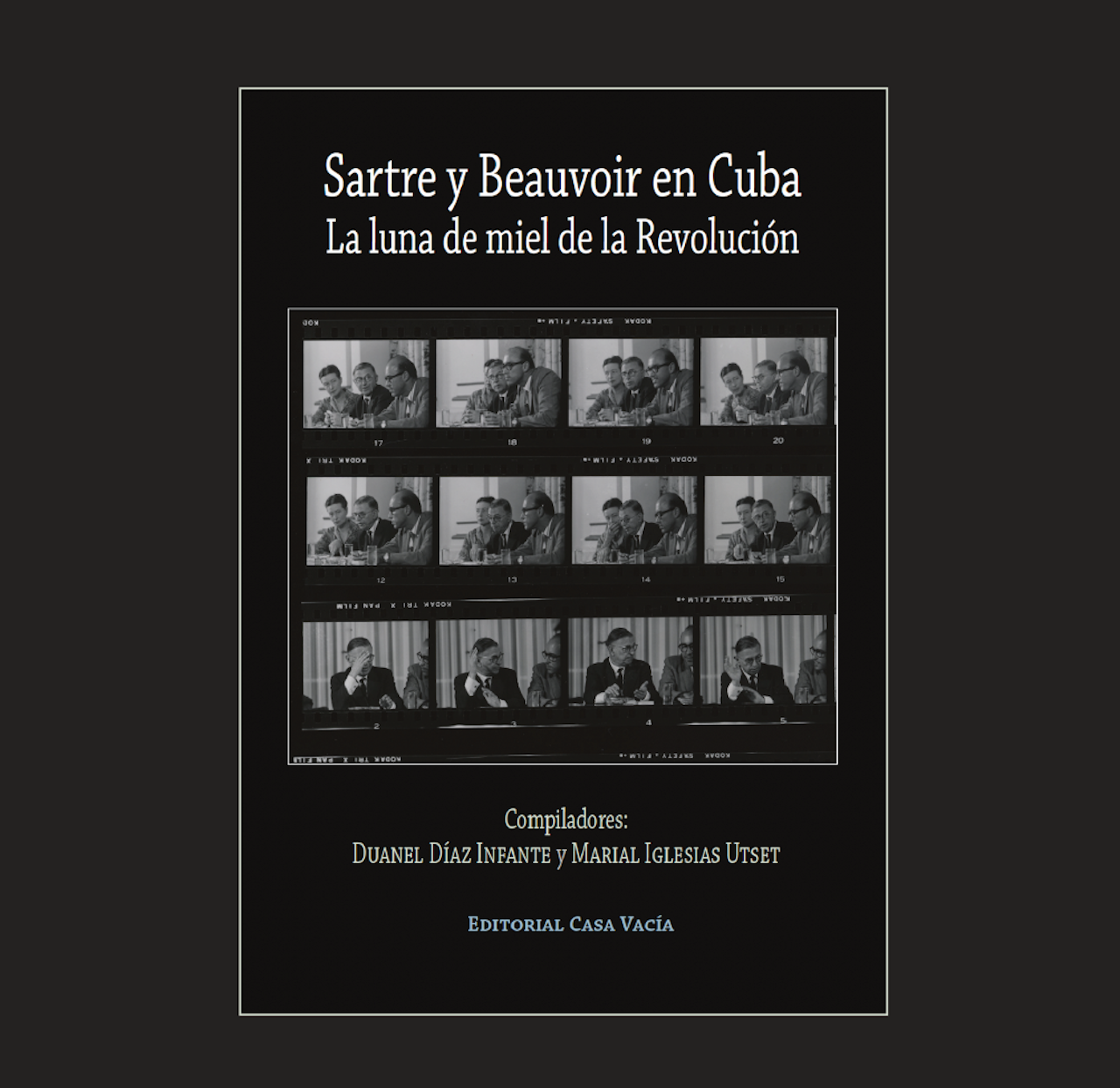
The compilation by Duanel Díaz Infante and Marial Iglesias Utset brings together, without dispersion, a story by Rolando Sánchez Mejías (“Umbral”) that is also inserted into the change in reception towards two intellectuals who were later branded as degenerate bourgeois. Even today, Sartre, in particular, is not fairly analyzed for his intellectual audacity in relation to the epic Cuba of the early revolutionary years. It is not the intention of recent researchers and essayists (Díaz Infante and Iglesias Utset) to defend the French presence in Cuba. What they do make clear—and this is one of the great merits of this book—is their initial sympathy for the Cuban process. They interacted, confused (or at least hopeful), with what was promised and was far from being fulfilled. Iglesias Utset—who wrote a very detailed chronology for this work—has said it very well from the beginning:
Through the prism of the philosopher’s (notably myopic) gaze and (unbridled) imagination, Cuba, a “diabetic island” with a hypertrophied economy in the hands of American monopolies, is transformed overnight into the “Athens of the Caribbean,” where “direct democracy” flourished thanks to the miraculous advent of a “revolution without ideology.”
It is well known—or perhaps “some” here will learn—what it meant to mention both philosophers years after their visits, even when they were able to assess the Cuban phenomenon from a safe distance, when they were concerned about the Padilla case/affaire:
Then Sartre’s name, very present in the debates hosted by the Cuban media in the 1960s, disappeared from them. Sartre, who in 1960 had stated that “criticism has no right to exist” outside the Revolution, went, with a certain poetic justice, to swell the ranks of the non-existent; he ended up on a blacklist of authors whose works had to be removed from library catalogs[5].
Except for a very few cases that do not conform to the official history, no matter how much culture there was in Cuba in the early 1960s compared to the current circumstances of detachment and ignorance of national history, Sartre and Beauvoir were not widely understood. They never were. That popular image of Franqui in which he records the lyrics of the song: “Saltre, Simona, one two three / Saltre, Simona, put your foot down” is laughable, if not spurious familiarity. That they were recognized is one thing; that they identified with them is quite another. In reality, “after a few days, in the most remote corners of the Cuban provinces, was Sartre’s face as familiar as the silhouette of Marilyn Monroe”? It is as if one naively believed that a people in the throes of fanaticism would take the time to develop a confidence that was far from being felt.
Simone and Sartre did believe in the euphoria of the crowd and were “infected” by the enthusiasm on their first visit. But they were wanted more as a bridge to popularize what was not yet solidified. And, as might be expected, this directly and indirectly led to conflicting opinions, attributions, and rejections from those who could rigorously assess their presence on Cuban soil. Fortunately, or perhaps too late, they saw what was hidden, without so much brazenness, behind the collective uproar. Was it easy for them to disagree afterwards? They were foreigners and were very far from here. Due to discretion, the rescue of both figures in relation to their reception in Cuba had been very fragmentary until today. Sartre and Beauvoir in Cuba. The honeymoon of the Revolution has been very favorable and has strongly promoted the impartiality that, for Cuban culture, both creators deserve.
Notes
[1] Enrique Núñez Rodríguez: “Madame De Beauvoir” in Sartre and Beauvoir in Cuba. The Honeymoon of the Revolution, Casa Vacía, 2024, United States, pp. 172-173.
[2] Edith Depestre: “Simone de Beauvoir, Witness of Our Time,” in Sartre and Beauvoir in Cuba. The Revolution’s Honeymoon, op. cit., pp. 43-44.
[3] Lisandro Otero: “Sartre and Beauvoir in the Province of Oriente,” in op. cit., p. 50.
[4] “Talk at the University,” op. cit., p. 125.
[5] Duanel Díaz Infante: “The Ghost of Sartre in Cuba (Remix),” Sartre and Beauvoir in Cuba. The Honeymoon of the Revolution, op. cit., p. 359.


