

The books published by editor Javier Castro Flórez (Plasencia, Spain, 1966) under his Newcastle imprint are unlike those of any other publisher. That exclusivity is a credit to him, and we are delighted that he has agreed to answer our questions about his work and his tireless search for readers. You can see him on social media showing off his book finds, spending time with his cat Misha, climbing the hills near his village, Corbera, Murcia, and also putting together a Revista Murciana de Letras, which is now in its third issue.
1- How and when did Newcastle Publishing come about and what encouraged you to embark on such a venture?
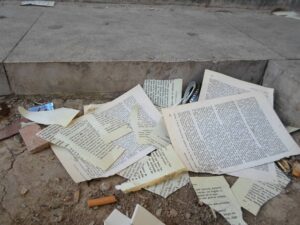
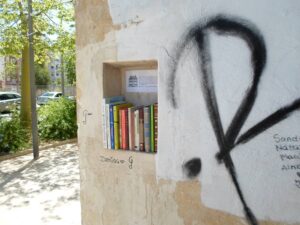
The publishing house was created in response to some anonymous book destroyers. Ten years ago, taking advantage of a small space in the façade of an old military barracks, I set up a small street library. It was a tiny window that could barely hold fifteen books, but I liked the idea that where people had once been trained in the use of weapons, works by Kafka, Maupassant, Chesterton, and books about ghosts and UFOs were now available to everyone—since I also thought of those readers who believe that this world is not strange enough and invent another one. Half an hour after opening the mini library and announcing it on my social media, someone destroyed all the books. They had made an effort: the pages were torn out and scattered on the floor… Even the cardboard covers of the hardback books had been twisted and torn to pieces.
This detail—imagining the force and rage that had been applied to the destruction of those fifteen books—made me instantly decide that I wasn’t going to give up, and I chose not to replace the vandalized books, so as not to give the perpetrator the satisfaction of doing it again. I thought the appropriate response was to publish books to put in bookstores and readers’ homes, in a thousand different places, so that, just as many species do when they lay hundreds of eggs, some of them would survive their enemies and storms.
2- After all this time, do you think it has been worth the effort?
Yes, absolutely. First, because of the extraordinary happiness that making the books I have published has given me, but also because of the feeling that some of these books, as Borges said, will not know that I am gone when I die and will continue out there in the world telling the story that each one has to tell. As if their silent voice would never fade and would be resurrected with each reader.
3- We see that you are very active on social media, showing your “captures” as a reader. Not all publishers tend to promote their books in this way, whether they are acquired or published. To what extent has the reader’s perseverance dictated the need or pleasure of publishing?
I show the books I buy or read as a missionary endeavor. But not to say that I know a lot, but to show that books bring a lot of happiness, to show how much I enjoy them. For many people, the image of reading is associated with the suffering of student life, and books are a kind of terrible obstacle that must be overcome in order to pass an exam. That’s why neither my book Lo que lee un editor (What an Editor Reads) nor my social media posts or videos ever have a professorial tone, because they are the testimony of someone who enjoys reading, not a scholar. I take books with me on walks and then to bed with me, as if I were a teenager with his girlfriend or a Tinder date.
As for my consistency as a reader, I imagine that it has clearly shaped my need and pleasure as an editor. For the last 50 years, I have read every day of my life: in hospitals, before I got married and on the day of my divorce, walking in the mountains, traveling, waiting in line at the supermarket… Just as you have to drink water every day to avoid dying of dehydration, I need to read to keep my curiosity about everything alive and to make my world vast, not only in space but also in time, since the past continues to speak to me on many pages. Reading is like making love in the sense that the more you do it, the more you want to do it. Discovering a manuscript that you are passionate about is wonderful because by helping it come to life and become a book, you feel like you have helped make the world even bigger, deeper, more beautiful…
4- How can an American reader, from any part of the Americas, get hold of Newcastle’s books?
I think the adventure of buying a Newcastle book is similar to that of the Indiana Jones saga. It’s strange, because I feel an extraordinary closeness to America, where so many extraordinary writers come from, but I haven’t been able to get my little books across the sea. That’s why every Newcastle book that makes it there is something of a miracle.

5- We’ve arrived at the library, which, as you’ve shown in your publications, is very well stocked. How did Javier Castro’s bibliomania come about? How many “accidents” have ended up defining the journey to your current library, like lambs digested by an insatiable wolf?
Paradoxically, bibliomania came about because of poverty. I come from a lower-middle-class family where there was very little money but a lot of respect for culture. At home, we only had the Bible, Don Quixote, and a book on the history of cycling, but my parents always encouraged us to read, and they gave us books for our birthdays and Christmas. We never went on vacation, but there was money for our books…
When I was studying in Madrid, I discovered second-hand bookshops and the Cuesta de Moyano, where, despite my very modest income, I could buy books because they were much cheaper. The funny thing is that sometimes—this was before the internet standardized prices upwards—you could buy first editions and books that were impossible to find for next to nothing. Even today, I still go to these kinds of flea markets, street markets, and second-hand bookshops. When I buy a new book in a bookshop, I feel like I’m swimming, but in those chaotic and mysterious spaces where piles of books are always on the verge of collapsing, I feel like I’m diving into the depths of time.
As for “accidents,” I think every library is the result of hundreds of them, of coincidences, of books that suddenly, as if opening a door, gave way to other books… To give an example, many years ago I read an extraordinary book—I don’t remember what led me to read it—The History of Civilization Begins in Sumer, by Samuel Noah Kramer, and it sparked my curiosity about the Assyrian and Babylonian world, and I ended up buying and reading dozens of books about that period. It’s like a party where one guest invites others until everything gets out of hand and what was a modest family celebration turns into a huge New Year’s Eve party. Rather than the image of the wolf eating lambs—and as I look after a colony of stray cats near my house—I like the image of books as stray cats: one day you’re feeding one or two, and before you know it, you’ve got eight or ten meowing for their food. It’s as if they call each other… Like books.
6- I think it was Sciascia who spoke of the “demon of possession” when it comes to books. Does owning books lead to showing them off? Or the other way around: is showing them off a consequence of owning them?
The world of those of us who love books is as varied as the Amazonian fauna, and there are great readers who keep their books under seven layers of secrecy and would rather show their private parts than their library. If I show mine, it’s not out of exhibitionism or to say that I have a bigger one than you (the library), but—as I’ve already said—to preach the word, the good news: that books are a marvel that give life to life. Right now, cell phones have made books disappear from the streets. Those readers who used to take advantage of their subway ride to read for a while or who enjoyed a book while having coffee on a terrace have practically disappeared, replaced by endless scrolling. That’s why I think it’s my duty as a publisher to teach people about books, to be seen smiling and surrounded by books with the same happy expression—or even happier—as some people have when they’re drinking a gin and tonic on a luxury yacht.
But as well as being an instrument of pleasure—a kind of satisfyer for the brain—books are also a school of life. I mean that far from educating us in the demon of possession, as you ask me, it teaches us the opposite: the fragility and brevity of life because, as all of us who buy books that once belonged to others, whose signatures sometimes appear on the first pages, know, our books are not ours: we are only their temporary custodians. Soon they will pass into other hands, rest on other shelves, and illuminate other lives. In fact, my bookplate features a drawing of two runners passing a torch to each other, under which is written: “Between the last decades of the 20th century and the first decades of the 21st, this book belonged to the library of Javier Castro Flórez. Now it belongs to,” and there I left a space for the name of that stranger who will one day enjoy that book. I am very happy to think of that future reader who will enjoy as many good books as I have. It is, I imagine, the joy felt by someone who signs a future organ donation form, thinking that someone will be able to live with their heart or kidneys.

Head image: Martha Ma. Montejo
The rest of the pictures were sent by J.C.F.


