
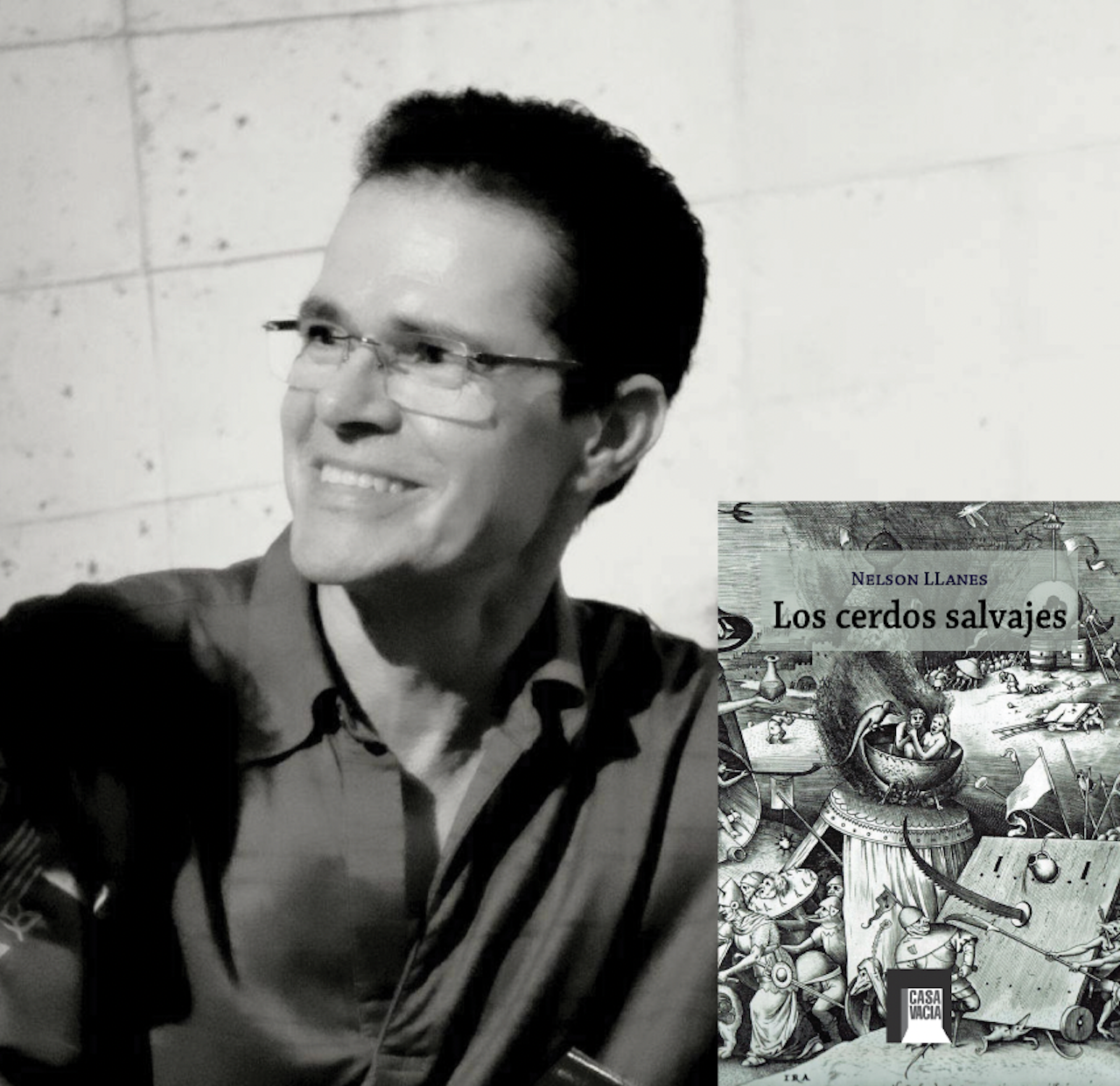
In Los cerdos salvajes (Casa Vacía, 2025), Nelson Llanes (Cuba, 1962) constructs a dark fable in which the pig—a biblically cursed animal and emblem of impurity—serves as the axis for a stark examination of the human condition. From the “warning to the reader,” the book presents itself as a “journey into human nature in its most rudimentary sense,” where violence and hatred operate less as external outbursts than as latent forces that shape its characters. With echoes of Flaubert, Shakespeare, and the great Russian tradition, the novel offers a fragmentary, silent, and hopeless view that forces us to question the boundary between the human and the animal, between language and its failure. With these keys in mind, the following interview delves into the symbolism of the pig, the ethics of style, and the mechanisms of moral violence that run through the text, inviting the reader to enter a literary universe where, rather than answers, what is sought is to expose “the inhospitable traces of truth that dwell in the abrupt folds of the soul.”
The figure of the pig, not as a fable animal but as a moral, social, and almost metaphysical presence, imposes itself with brutal clarity from the title of Los cerdos salvajes. What led you to give it such symbolic centrality? What do you recognize in this animal that you don’t find in other beings from the narrative bestiary?
Pigs are mentioned about twenty times in the Bible, and they are always stigmatized as animals locked up in pigsties and as the repository of the highest degree of repugnance imaginable. “Do not give what is holy to dogs, and do not throw your pearls before pigs, lest they trample them under their feet and turn and tear you to pieces,” says Matthew 7:6. When Jesus expels the demons that live in men, he commands them to enter pigs, which, far from agreeing with their new tenants, end up rushing into a ravine. No other animal would have had the same symbolic significance, which is evident from the mere mention of the word. I needed a cliché that had much of the work already done and didn’t require me to start from scratch. Literature, like all other arts, speculates on the established. The problem lies in knowing how to make good use of the symbol. Of course, it remains to be seen who the reader considers to be pigs. It depends on the reader’s perspective.
In the world depicted in the novel, there is no redemption or promise, but rather the persistence of violence that needs no justification. Is this vision a consequence of the times we live in, a reading of history, or a form of structural pessimism on the part of the narrator?
Exactly, there is none of either in the novel. I don’t believe in literature that offers either of those two outcomes. That path leads straight to propaganda. I am reminded of the end of The Magic Mountain, when the author wonders whether love will ever prevail. Not even he dares to take sides. It would have been a disaster if he had. Why would we need readers if every author offered us their own recipe? As for violence, which in this case (despite the circumstances) is greatly diminished, it is all of the above: a consequence of the times we live in, of a personal reading of history, and of a pessimism that, more than in me, inhabits the common denominator of the events that have convulsed the world since its creation, and their ramifications.
The writing is constructed with sober phrases, but at times images of unexpected intensity emerge. Is this an ethical style—not giving in to excess—or a desire to let lyricism emerge as an anomaly?
It was difficult for me to choose the style, that is, to establish the type of line along which the car with all its explosive cargo would travel. You send out some sappers (at least I do) and then listen carefully to what each one tells you. Most of those I sent advised me to use elaborate language, but without neglecting the characteristics of the subject matter. Criminals, even when they are cultured (El Leñador seems to be), always carry with them the powerful weapons that their profession provides. In this way, when a certain lyricism or philosophical approach emerges, it is perceived, in my opinion, as a fresh breeze that, without warning, eases the tension and tells the reader: “Be careful! This is not about actions, but about visions.” In the end, the author cannot determine how his words will be perceived, but he can at least try to ensure that they are not perceived in a way he did not intend.
The structure of the book, far from the traditional arc, seems to obey a fragmentary logic: not linear, but made up of remnants, intervals, and a sometimes suffocating rhythm. Where does this form come from? From the ear, from the breathing of the text, or from a deeper conception of narrative time?
For a storyteller like me, whose practice has been mainly in the short story, it is understandable that, even in the novel, I still owe a debt to the techniques of the short form, although in my case I have been a storyteller who reads more novels than stories. Instead of visiting the techniques of other storytellers, I prefer to invent my own from what is hidden in other genres. I find it a more stimulating exercise. Well, perhaps this fragmentary logic comes partly from the short story and partly from a violation of the usual narrative time that only promises what the reader already expects or what they have been taught to expect along those paths. Even so, I think the structure is consistent with the ingredients it uses.
The novel seems to be written from a frontier between the human and the animal, between what still articulates language and what only responds to instinct. Is this ambiguous zone where your writing is situated a way of thinking about politics from a position of dispossession, or simply the most honest literary place to narrate?
I don’t believe in the honesty of the writer. That’s for martyrs. The writer owes himself to the raw material he has in his hands. You are given a piece of plasticine, and if you are honest with the material, you will never achieve anything different from what has been done with it before. You have to try to make that same plasticine disobey (or appear to disobey) the physical laws of its composition. It is within this juggling act that the greats debate. Why not compete with them? And as for ambiguity, I don’t know of a writer who isn’t a master in that contest. Tolstoy or Dostoyevsky wouldn’t let me lie. How many times does an author make a statement that seems to be a kind of declaration of principles, only to throw it completely out the window five pages later? Kafka knew how to plunge us into a sea of doubt.
Throughout the book, there is a sense of unease not only with language but with its function. As if words were not enough, or always arrived too late. Was writing here an act of testimony, of denial, or simply a way of continuing to walk among the rubble?
Writing is, in this century and possibly for a long time, a way of walking among the rubble. After two world wars, more than a dozen literary movements, and so many excellent writers shining brightly, there is no choice but to ruminate on the leftovers that this or that writer left behind. In Los cerdos… there is a tribute to Flaubert, but also to other writers, to Shakespeare, for example. But homage does not mean copying; it means appropriating the spirit and, in a way, denying it in another context. Seen in this light, one could also say that it is a form of negation. Great works are supposed to be, in a sense, a negation of their predecessors.
Faced with a novel like this, one wonders what kind of reader the author has in mind. An accomplice, an intruder, an heir to the ruins? Is this a book for those who have already seen too much, or for those who still need to learn to look from a place of horror?
I imagine that almost all writers (I’m not too sure about this) would be content to find certain accomplices, someone who believes wholeheartedly in certain assumptions; but in this novel there is no room for any reader other than an heir to the ruins. Or are any of us spared from this category? As for who the book is aimed at, although I find the second category (those who need to learn to look from horror) more consistent, I think it is designed for those who still believe in good literature, in literature that, regardless of the subject it addresses, is interested in telling the reader: a good story (if there still is such a thing) is worthless if it does not show us the inhospitable traces of truth that dwell in the abrupt folds of the human soul.


