
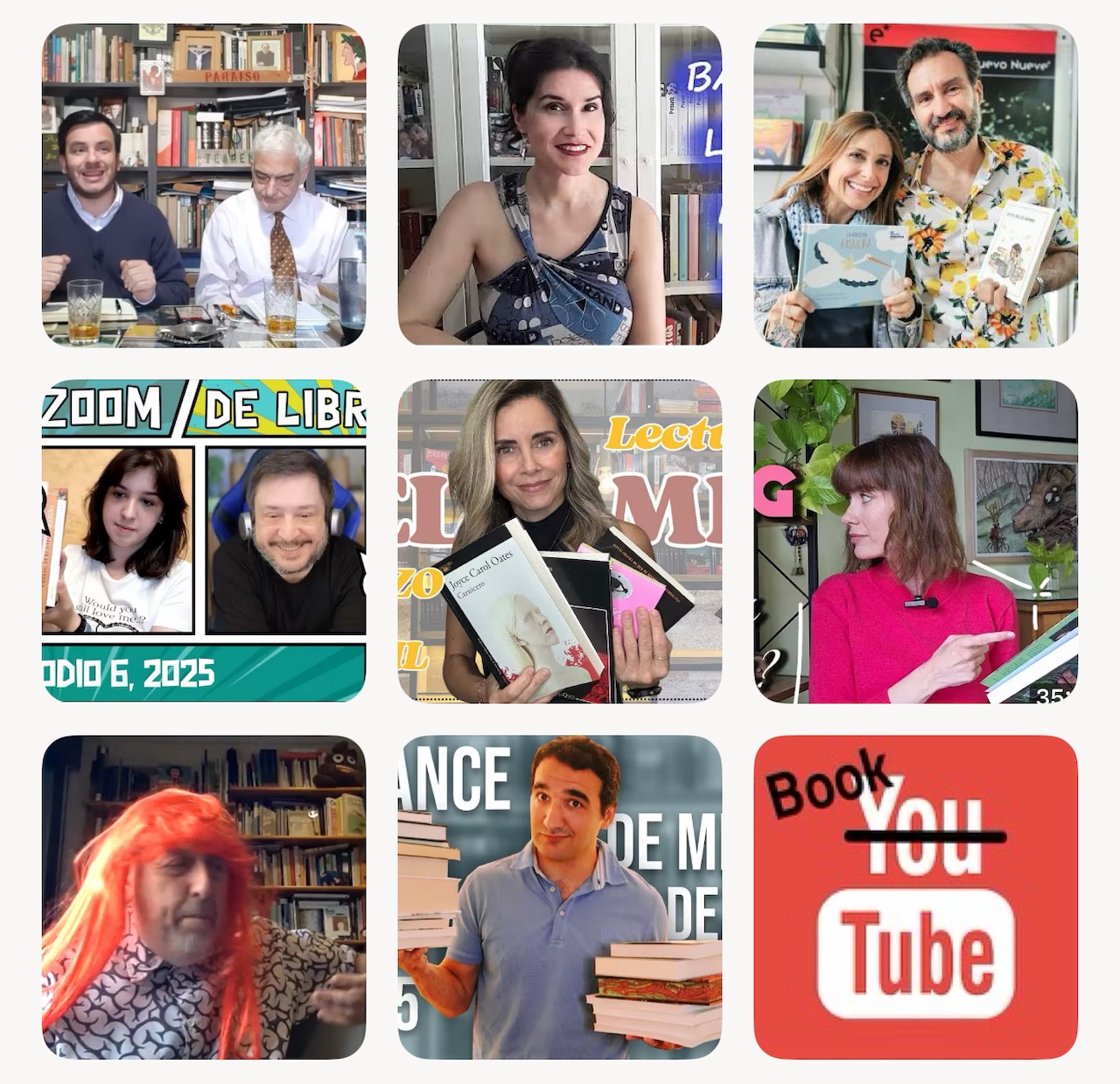
The last time I saw a booktuber, they were talking trash about Mario Levrero because who would think of writing a book like La novela luminosa without having anything to say?
This made me wonder who the audience for booktubers is, but I can only speculate. Several of these videos have hundreds of comments, most of them expressing their experiences with the book being discussed or the video in particular, or recommending other books.
There are booktubers with over a million followers, mainly in English and, surprisingly, in Arabic. In Spanish, I don’t know of any with over 100,000 followers, with the exception of the channel “El librero de Valentina” (Valentina’s Bookshelf).
I usually check out a few of them to see what they have to say about things that interest me and sometimes also to get an idea of the publishing landscape in their countries of origin. But I soon realized that many of them actually review books that everyone reads, which are not exactly forgotten gems, eccentric or strange to a tradition.
The degree of difficulty of a book is directly proportional to the booktuber’s lack of interest. This is generally true. Take, for example, the novel Klaus y Lucas. The booktuber tore it apart because she couldn’t understand what was really going on in the story.
I remembered that it is a somewhat demanding novel, made up of three stories in which each one rewrites the previous one. But everything is narrated from the perspective of the old Central European totalitarianism that emerged after the war. It shouldn’t be that complicated, but keep it in mind for when you have to talk about the importance of references.
The case of La novela luminosa was even more interesting. It doesn’t tell you anything, says the booktuber. That’s what certain novels have been doing for some time now: reformulating the canon that imposed adventure as a narrative value, the profuse arc that goes from The Odyssey to Don Quixote and from there to Tristram Shandy, Balzac, Dickens, Dumas, Verne, Tolstoy, and The Magic Mountain.
Then came the weariness of having to tell a story. I want to narrate, but I can’t think of anything: tell a dream or tell what you do during the day, look out the window and see the remains of a decomposing pigeon, as the narrator does in La novela luminosa. Tell for what purpose and, above all, for whom. You reap what you sow. Don’t you like novels that don’t tell you anything? Perfect, take a look at a day in your life and start telling it.
I’m saying all this and thinking that the booktuber phenomenon may be the biggest revolution in terms of readers since the advent of touch screens. It has been articulated from reading. And in many cases from reading badly, which has its merits. Because, strictly speaking, given the absolute irrelevance of the role of the critic in these times, who could be interested in a booktuber‘s opinion on a book we have just read?
I must confess that when Martha and I started making videos about books from our old house in Fayetteville, Arkansas, during the 2020 lockdown, we had no other idea than to try to spread our enthusiasm for certain books. I imagine that many booktubers are doing the same thing. At first, I showed the books that were arriving at home, I would say out of sheer boredom, a little perplexed by the unusual situation we were living in. Then it drifted into comments on the books we were reading. At the time, I was reading Faulkner’s novels, and those videos have been the most viewed on the channel, along with the one on The Magic Mountain. After about seventy videos, we stopped and haven’t done it again since.
That last piece of information tells us that there are Faulkner and Mann readers among YouTube users. It also tells us that there are booktubers for all tastes. A curious experiment is that of Argentine writer Hernán Casciari: he makes two-part videos about the books his teenage daughter reads, him in Buenos Aires (where he says he no longer reads anything), and her in Barcelona (she is a voracious reader in three languages: Spanish, Catalan, and English).
Based on some very preliminary fieldwork, it is true that there are many booktubers who read and comment on young adult books at a dizzying pace. They are hyperactive people who know how to connect with their audience, who do wrap-ups of what they have read to the point of turning the act of reading into just another trivial gesture. It can be disconcerting to recommend ten books in five minutes. And just as fake as those cardboard sets with images of bookshelves that someone imagined during lockdown for the background of their videos. They are booktubers just as they could be gamers. No one needs to give four stars to The Metamorphosis, and that’s what we do on Goodreads all the time.
Are booktubers part of some mechanism of so-called “reading promotion”? I have my reservations about that and understand that it’s a complex issue. The booktuber movement is driven by individual impulses or those of a group. So far, so good. In Continuación de ideas diversas, César Aira says he opposes the promotion of reading because most books are very bad and are generally full of vulgarity, prejudice, stereotypes, and falsehoods. Good books are excluded from this characterization, but they are read by people who do not need promotional campaigns.
I am neither opposed to nor involved in programs or campaigns. I continue to talk about books because reading is what I do most on a normal day, and I continue to try to be consistent with what I liked to do when I was a young reader. But I recognize that part of the complexity of the issue lies in the fact that there are governments, such as totalitarian ones like Cuba, that love to launch reading promotion programs while maintaining growing lists of banned books. And as soon as someone starts reading and praising them, they are repressed and expelled from the literary city. It is a malicious and hypocritical practice.
Reading can be an adventure of knowledge or simply leisure. What you’re not going to do is get all high and mighty about how “you can’t read without exposing yourself to infection.” I can’t say for sure whether it was Cioran or Mesonero Romanos who said it, but I do know that Susan Sontag already warned about the use of disease as a metaphor. In any case, if that were true, the cure is not on YouTube.


