As far as possible.
Ignoring whether, by 1946, Virgilio Piñera perceived Borges not as the immaculate and “dangerous adversary” devoted to the prevalence of symbol over reality, but as the ophthalmic encyclopedist whom neighboring writings, in their demarcation, refused to serve. (2)
Afterwards.
Ignore whether (during his arduous task of translating Ferdydurke) the author of Los siervos glimpsed in every word, every approximation, every montage, a reproduction of his destiny. Or whether he saw himself as that Kowalski led by a mentor, on his journey of no return through the pantheons of the satirical and the strange.
Next.
Striving not to know (despite everything) whether decades later—and already in the ostracism of the “gray five-year period”—the irreverent Piñera was taken aback by the famous and controversial phrase attributed to the Polish novelist. (3)
What follows is disturbing.
In poetry, we have seen almost everything. From low-intensity authors winning the Nobel Prize to writings virtually aged by time (or boring as a parade) reproduced over and over again… There is no doubt that behind these absurdities lies the shameless and lazy conscience of kitsch.
There are traces of kitsch, for example (and as a striking introduction to the topic) even in Borges and even in Lorca himself, but never in Virgilio P. Because for V.P., kitsch is “a serious matter.”
A statement of this nature will undoubtedly earn me (in addition to accusations of applying incompatible analogies to two opposing phenomena) a significant number of detractors and boos. Although this would still require explanation. Furthermore, in aesthetic analysis as in law, every argument is manageable.
Piñera uses these postulates for the sake of a comforting critique, a “parody” of the model, the type, and its function within the polis. Black irony, even feigned naïveté, is a tool. With it, he excavates (undermines) the city, offering us the horror of adulthood. Therefore, in his field of inquiry, Piñera is impeccable.
(…)
If I die, if I don’t die,
if I die because I don’t die
if I don’t die because I die.
If I die on the road.
If I don’t die but on the road if I die.
If I die because I don’t die on the road
If I don’t die because I die on the road,
don’t put “f” on me, don’t put “l” on me, don’t put “o” on me,
don’t put “r” on me, don’t put “e” on me, don’t put “s” on me,
don’t put “flo” on me, don’t put ‘res’ on me, if I die on the “c”. (4)
The text contains everything. Imagination, modernity and, without suspecting it, what Olson opposed to certain poetry emulates the stationary: movement. A rare paradigm of simultaneous Dadaism and concretism. Playfulness and laterality in a single device.
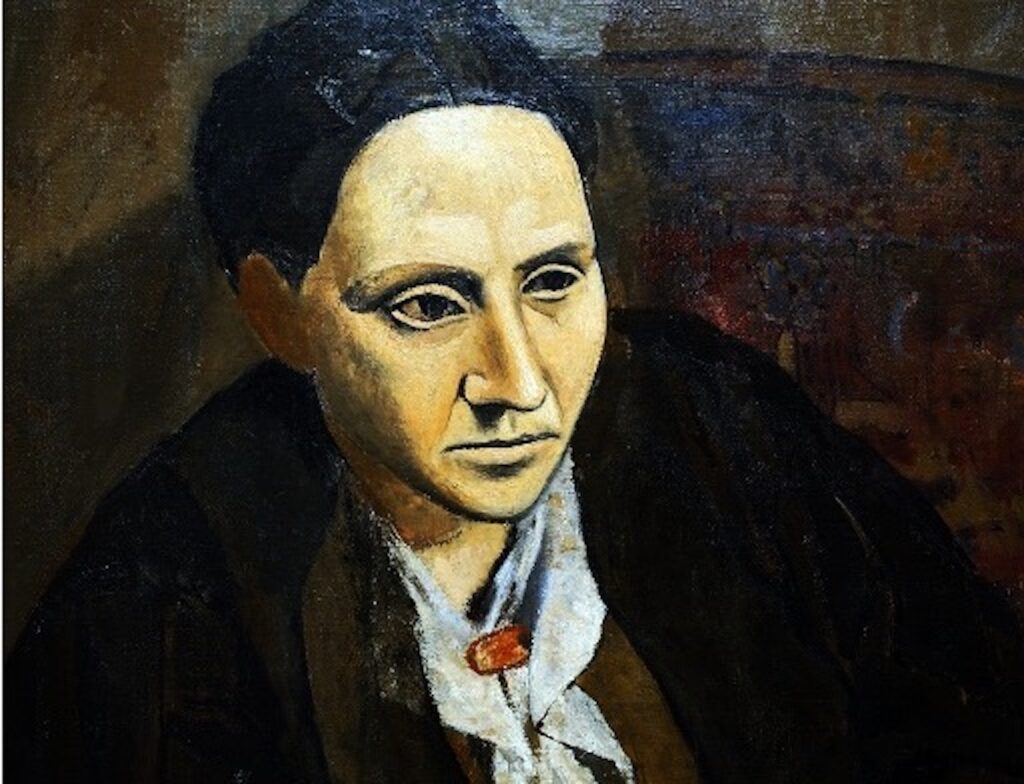
Conversion of the ‘commonplace’ into high literature, following its intervention by an avant-garde mechanism. That is, by the maneuver and application of a tautological, graphic resource to the verse. Hence: or, put another way: through playfulness, ‘saving’ oneself from the agonizing. Incidentally, the (formal, structural) connection with Gertrude Stein’s stanza “21” is (still) hair-raising.
Because it is like that
I love my love with a b
Because I am beside that
A king.
I love my love with an a
Because she is a queen
I love my love and a a is the best of them
Think well and be a king,
Think more and think again
I love my love with a dress and a hat
I love my love and not with this or with that
I love my love with a y because she is my bride
I love her with a d because she is my love beside
Thank you for being there
Nobody has to care
Thank you for being here
Because you are not there.
And with and without me which is and without she she can be late and then and
how and all around we think and found that it is time to cry she and I.
No less synchronous is the expressionist tone with which both authors—both avant-garde, playful, both homosexual—and from different contexts, groom and dress the object of the poem. Thus, in V.P.’s “Vida de Flora,” the dress and hat of the bride-to-be in Stein’s text are transformed, through mockery and the grotesque, into the enormous shoes of the unfortunate F. In “21,” the parody of the glamour that old Europe still retains. In “Life of Flora,” the humiliating scarcity or hardship of a Caribbean island where nothing thrives. (Incidentally, behind some lines, the ghost of Federico García Lorca seems to smile discreetly).
“You had big feet and a humped heel.
Put on the flower. Wait for me, we’re going on a trip together.
You had big feet. What sadness in the air!
Who was chasing its tail? Who was singing that tune?
(…)
You came and went between two hot irons:
Flora, be very careful, your feet are very big,
and the furrier’s is hiring you to display their giant shoe lasts.
Flora, how many times did you walk around the neighborhood
asking for a little oil, and you loved the moonlight.
Suddenly your two monsters climbed into bed,
your monsters horrified by a cockroach.” (6)
The irregular, albeit subtle, element of kitsch combined with comedy, in its function of desacralizing a pompous and buttery tradition, also appears in that text by F.G.L., the “Song of the Sissy.”
The sissy combs his hair
on his silk dressing table.
The neighbors smile
from their back windows.
The sissy organizes
the curls on his head.
Parrots, fountains, and planets
shout in the courtyards.
The mariquita adorns himself
with a shameless jasmine.
The afternoon becomes strange
with combs and vines.
The scandal trembled
striped like a zebra.
The mariquitas of the South,
sing on the rooftops! (7)
That’s right.
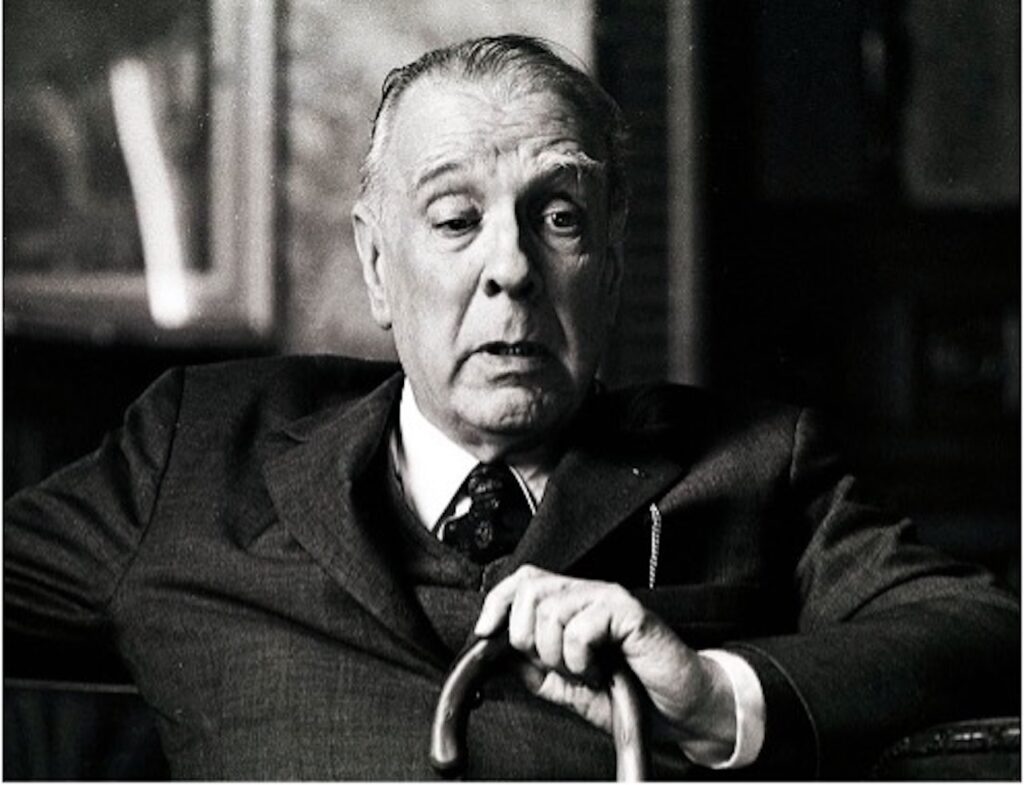
That character, where the fateful or the irreparable are annexed to the playful with a brazen and vigorous quality, is not seen in his books after 1936. Humor, after Historia Universal and the end of his poetic alliance with Guillermo de Torre, has practically disappeared from his poetry. Consequently, J.L.B. does not assume—although his Ultraist period admits a less vaporous approach to the question—if not a seriousness that occasionally “constrains” him to border on the yellow line of the easy in the name of some neoclassical purity.
As Jaime Alazraki explains: “Borges, who in his literary career moved from Ultraism—or, in other words, from the almost exclusive cult of metaphor—to that modest opinion that sees in universal history the history of the diverse intonation of certain metaphors (O. I. 17), summarizes in his work the two extreme opinions of Abdalmalik and Averroes on that phenomenon. “The first sees the purpose of the poem in wonder (as the Ultraists wanted, or at least the Ultraists of Seville and Madrid, according to Borges’ testimony in I, 96), and the second says that ‘the poet is less an inventor than a discoverer’ (as Borges’ later poetics would have it).” (8)
That lucidity of friction, which, through the electricity of its components, draws Piñera into his writing, even with the impurities and dangers of the bizarre or the corny, has vanished in Borges.
Hence, his poetry occasionally strikes us as numb, semi-hard. Or, to put it in another tonal, epistemological field: hence the facial freeze with which this poetry often manifests itself, with that poker face that Parkinson’s patients reveal.
On the contrary, even in its most sentimental moments, Piñera’s poetry has the quality (conscious or intuitive) of improving his impostures. ‘Aquesta’ farce, to which he seems to expose language and himself. An urgency to return to art what has been degraded by those stylistic features—which he articulates with skill—emitted as the non plus ultra of high culture. An insult to the spirit; a (covert) attack and disregard; “A corruption of High Culture” (9), in the words of Dwight MacDonald; for he “borrows” the procedures of great art to use them, wear them out, abuse them; dissolving true knowledge, true authenticity, into artistry, into a mass of weak writing, into a stew that tastes like ass.
Piñera controls the materials of kitsch and incorporates them into his literature as revenge against kitsch. The reader’s expectations are satisfied, albeit with a particular strangeness because in this case the corny has been nullified; defeated by poetry. Gains of a privileged pupil and eardrum over the troubled waters of the eyes and ears of literarization. Of everything that is presumed and marketed as essential, but which is artistically weak, or at least predictable.
Rough tablecloth,
you can’t help but marvel,
prepare your shoulder blade because the angel of pumpkins
wants to embark on the journey.
Rough tablecloth.
Nothing but this rough melancholy. Which is a bird.
Perhaps if she ordered her beak between two clouds
when, in order not to see the sky, the blacks threw themselves into the water.
Rough tablecloth,
whiter than the herons’ handkerchief.
Today five monsters were born with the sound of a harp.
If anyone is sad, they can sit on the podium. (10)
(…)
Where civility cuts the throat of all phenomena of mildcut kitsch. Another arrangement from the imposture of the transvestite.
Because, in the case of V.P., it consists of that manifestly kitsch discourse (understood as aesthetics) that the great poets S. Sarduy and N. Perlongher knew how to exploit and manipulate (from another radicalism) in their day. By immersing himself in its codes, the author of Una broma colosal (A Colossal Joke) noticed the possibility of a new alibi for language. Thus, through parody and meticulous exploration of linguistic material, he exercised a (studied?) (11) practice of “bad taste” against the prefabrication of a poetics that would carry within itself the attributes of artistry and the banalized and banalizing mechanisms of the spirit.
Whether as revenge of art versus … or as elective affinity, the fact is that Piñera, like those Neo-Baroque writers later on, managed to reverse and reconvert the flat codifications of the mildcut into a remarkable, imperishable artistic product.
O.
Perhaps these words from another “strange” poet, dedicated to Haroldo de Campos, serve to describe, in part, the peculiarity of that textual movement that Piñera brought to Cuban poetry. “Unlike Octavio Paz and Jorge Luis Borges (…) he did not use the avant-garde as a starting point to arrive at a kind of classicism. He had achieved (…) the practically impossible: to turn the avant-garde into a permanent gesture of measuring life, or more precisely: of the excess of measurement, of measuring in leaps and bounds, with the increasingly scarce means of poetry, the excess of existence in relation to words. // “Unlike the Cuban Lezama Lima, he did not adopt the baroque as a basic rule of excess. He passed (…) through the baroque as a poet who leads the devil, determined not to be caught by the system (…)”. (12)
Borges, who, paradoxically, distrusts the veracity of feeling in literature, considering it unliterary, sometimes condescends to lines such as:
A symbol, a rose, tears you apart
and a guitar can kill you.
II
I will no longer be happy. Perhaps it doesn’t matter.
There are so many other things in the world;
any given moment is deeper
and more diverse than the sea. Life is short
…The happiness you gave me
and took away must be erased;
what was everything must become nothing
Only the joy of being sad remains…
(13)
A woman’s name betrays me.
A woman hurts me all over. (14)
In what hollow shall I hide my soul
so that it does not see your absence
which, like a terrible sun without sunset,
shines definitive and merciless? (15)
No, these are not excerpts from a poem by Ángel Buesa. We owe these preliminaries to J.L.B., world champion of the Spanish language poetry championship of all time. Hurrah and hop!
Borges is torn apart by the rose of Milton and Coleridge, the same one that Gertrude Stein would later parody in “Sacred Emily”; and before her, Robert Frost and Juan Ramon Jiménez themselves.
Town at night, a glass.
Mahogany color.
Center mahogany color.
A rose is a rose is a rose is a rose.
Extreme grace. (16)
Let’s dramatize.
The man from the River Plate is killed by a woman, or a poorly strummed milonga on that guitar played in his mythical Buenos Aires. Literature kills V.P. with laughter, because a greater atrocity surrounds him.
To give accuracy to a classical continuity—to which he always believed he was destined—Borges sets aside, destroys in himself, the playful and vigorous (albeit irregular) Borges of his ultraist adventure. In doing so, he annihilates (in his poetry) the sense of formal freedom that also intrudes on concept and spirit. He thus gives rise to the death of the comic element so that the writer’s great tragic principle may survive, although in his case he transfers it to the sentimental. Piñera takes the opposite path.
Or, it could be summarized this way. In P, kitsch is superficial, a (cruel) simulation—perhaps not as elaborate as in Sarduy and Perlongher, or as refined as in Girondo.
In B, from another perspective, it appears when, after his persistence in privileging an exteriority or alienation (the term is Sartre’s) that comes from Europe or from his “ought-to-be” of culture, it gives way to a thematic loosening, with visible cracks. Facilism seeps into the dam and eats away at the neoclassical city. As if at times, despite its formal perfection, there had been a death of encyclopedic curiosity.
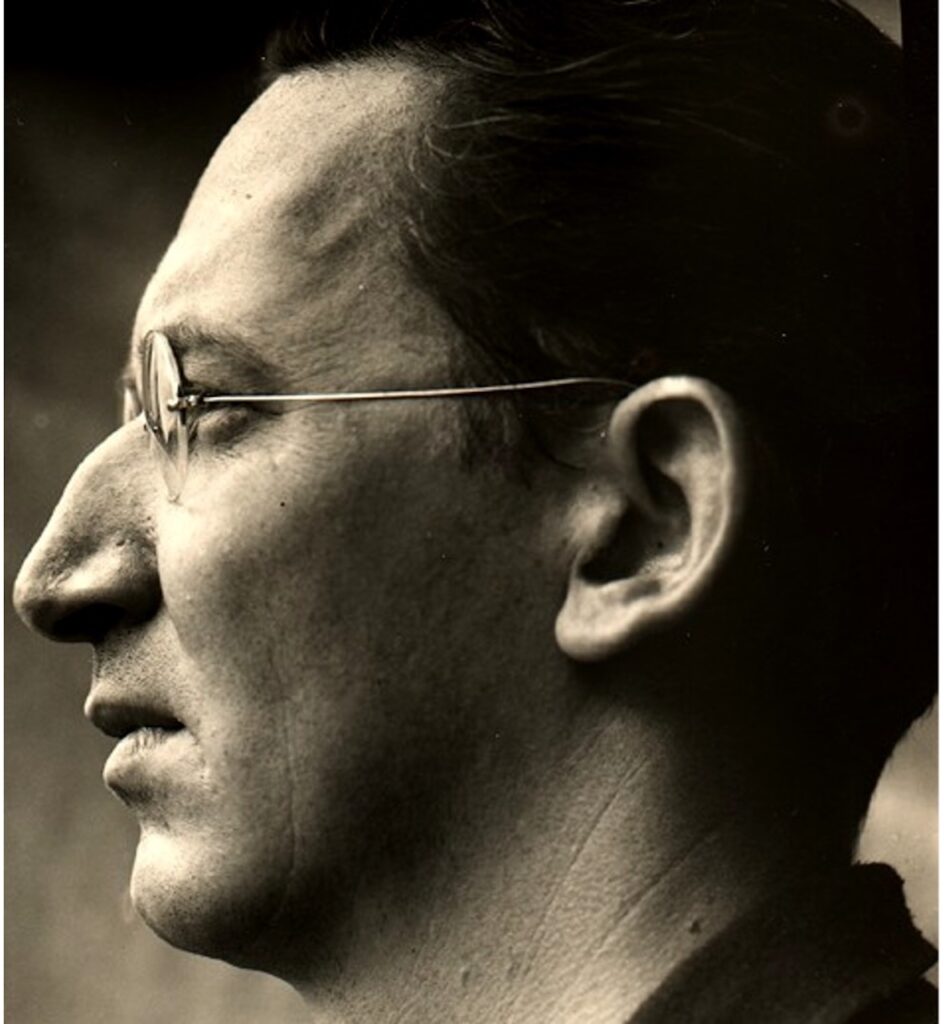
The obsolescence that can already be perceived in Borges’s poetry (and which does not appear in any way in Girondo and Ortiz) is the almost absolute deficit of what—after Michaux, Jarry, Huidobro, Jandl, and Parra—could be called “the sense of parody.” And it is perhaps this that gives it that old-fashioned flavor that we find difficult to digest today, at least as living literature.
There is in this poetry (I am not talking about his narrative) an abysmal seriousness, focused sometimes on myth and high culture, sometimes on form. However, it lacks comedy, the desacralizing/cushioning screw of laughter (as if that were not part of the absolute). This is a recurring element (sometimes in high doses) in the poetry—no less tragic for that—of Virgilio P., Parra, Perlongher, and the enormous Drummond de Andrade. For these authors, the comic, even the festive, is also onerous, hence the use of kitsch as a conceptual device, a decompressor. Or perhaps because parody, the hilarious, is another way of recycling pain, its undermining reality.
Despite everything, and to now (urgently) come to the defense of the author of Fervor de Buenos Aires, we should reflect on the following. In the great Buenos Aires writer, the superficial, certain areas of the pathetic, and even the kitsch (combined with very vigorous and fundamental texts) nevertheless create (which is both bizarre and magical) spaces for “cool” reading that critics accept, without devaluation or reservations, as signs of intensity within his work, due to the balanced classicism they embody.
Finally, F.G.L., a constant child, poet, and prodigy if ever there was one, “believes” (still and only in certain stages) in certain codes of kitsch which, sublimated by a passive and anguished homosexuality, his unconscious strives to decode in order to stimulate “sentimental (or erotic) effects in the reader.” On page 46 of Romancero, we read:
I took off my tie.
She took off her dress.
I took off my belt with my revolver.
She took off her four bodices.
Neither darts nor conch shells
have such fine skin,
nor do moonlit crystals
shine with such brilliance.
(…)
I don’t want to say, as a man,
the things she said to me.
The light of understanding
makes me very restrained.
(…)
I behaved as I am.
Like a true gypsy.
I gave her a large sewing box
made of straw-colored satin,
and I didn’t want to fall in love
because, having a husband,
she told me she was a young girl
when I took her to the river (17)
And isn’t there in this (hackneyed) romance by F.G.L. something of that manliness, also artificial, that Borges, from his ivory tower, assigned to compadritos and knife-wielders in his irreproachable, though nefarious, milongas?
I see him as tall and upright,
with a restrained soul;
capable of not raising his voice
and of risking his life.
(…)
Perhaps at that moment
when he was wounded,
he thought that it befits a man
not to delay his departure.
Only God can know
the true nature of that man;
gentlemen, I am singing
what is encrypted in the name.
Among all things, there is one
that no one on earth
regrets. That thing
is having been brave.
Courage is always better,
hope is never in vain;
so here is this milonga,
for Jacinto Chiclana. (18)
Perhaps Umberto Eco’s reflections on “some of MacDonald’s most delightful critical pages (…) devoted to the analysis of midcult, with its intentionally artificial and lyrical language, its inclination to present ‘universal’ characters (but of an allegorical and mannerist universality)” make sense now, and once again. (19)
Of course—who doesn’t know this?—the genius and grace of the Andalusian F.G.L., Borges’ infinite imagination as the awakened consciousness of Virgil P, transform every word into gold, demolishing and destroying this and any other insipid analogy.
Notes
(1) This excerpt is from the essay “Muchachos, maten a Borges: o 23 apuntes sobre un imposible fin” (Boys, kill Borges: or 23 notes on an impossible end), forthcoming.
(2) In a talk (read) for Radio Nacional, which would later form his controversial “Note on Argentine Literature,” the Cuban playwright had written: “Is not what Borges leaves hidden in his work at least as valuable as what he expresses in it? Isn’t what remains hidden what should appear as explicit?“ (Virgilio Piñera, ”Note on Argentine Literature Today,” Dossier Virgilio Piñera, Diario de poesía #51, Spring 1999, p. 19).
(3) It is well known that on his way to Berlin (1963), about to board the Federico and unaware that his work was already well received in Europe, the narrator and personal friend of Virgilio Piñera, Witold Gombrowicz, was intercepted at dusk by that noisy journalist:
“What urges Argentine writers to acquire a desired literary maturity?” asked the reporter.
“Boys: Kill Borges!” replied W.G. as the steamboat’s siren drowned out the conversation.
(4) Virgilio Piñera, “Si muero en la carretera” (If I die on the road), Virgilio Piñera, La vida entera (1937-1977), Huerga y Fierro publishers, Madrid, Spain, 2005, pp. 85-86.
(5) “21,” Gertrude Stein, in Gertrude Stein –Poems-, Classic poetry series online publisher Poemhunter.com – The World’s Poetry Archive, p. 17, G. Stein poetry.pdf.
(6) “Vida de Flora,” Virgilio Piñera, La vida entera (1937-1977), Huerga y Fierro editores, Madrid, Spain, 2005, pp. 39-40.
(7) “Canción del mariquita,” Federico García Lorca, Canciones (1921-1924), Litoral, Imprenta Sur, Málaga, Spain, 1927.
(8) Jaime Alazraki, Footnote 2, in “La ley de causalidad” [The Law of Causality], Jaime Alazraki, La prosa narrativa de Jorge Luis Borges [The Narrative Prose of Jorge Luis Borges], Editorial Gredos, Madrid, Spain, 1968. // Another possible interpretation of this thesis—after his abandonment of ultraism—would contrast a Borges who discovers poetry with a Piñera who reinvents it.
(9) Dwight MacDonald (1906-1982). The phrase, the backbone of his magnificent study on mass media: Masscult and Midcult: Essays Against the American Grain, New York Review Books Classics, N.Y. USA, 2011, serves as a colophon to Umberto Eco in his no less impressive volume Apocalyptic and Integrated. Regarding that concept, restored by the New York critic, the Italian semiologist notes that “literary celebrities who have recently achieved resounding success owe their fortune precisely to the reasons put forward by MacDonald regarding The Old Man and the Sea: they disseminate cultural positions that have lost their initial force and have been ostensibly trivialized (aided by the habituation of taste over the years) and place them at the level of a lazy public, which believes it is enjoying new cultural values when in reality it is merely confronted with an aesthetic stockpile that has already expired.” Umberto Eco, Apocalípticos e integrados, Editorial Lumen, Madrid, Spain, 1968, pp. 63-64.
(10) “Rudo mantel,” Virgilio Piñera, La vida entera (1937-1977), opus cit. p. 41.
(11) In the case of V, the incorporation of kitsch tactics seems to be more intuitive; this is not the case with Sarduy, Perlongher, and especially Puig. Although in all three, the garish, deliberately caricatured element of gay aesthetics establishes a kind of continuum. A common root.
(12) Rolando Sánchez Mejías, “poesía menos,” in Haroldo de Campos, In memoriam, https://letraslibres.com/revista-espana/haroldo-de-campos-in-memoriam/
(13) “1964,” Jorge L. Borges in El otro, el mismo, Jorge Luis Borges, Obras Completas (1923-1972), Emecé Editores S.A., Buenos Aires, Argentina, 1974, p. 920.
(14) “El amenazado” [The Threatened One], Jorge L. Borges in El oro de los tigres [The Gold of the Tigers], opus cit., p. 1107
(15) “Ausencia” [Absence], Jorge L. Borges, in Fervor de Buenos Aires [Fervor of Buenos Aires], opus cit., p.41.
(16) From the poem written in 1913. Gertrude Stein, “Sacred Emily,” Geography and Plays, Boston, 1922. // Translation: Benito del Pliego, Andrés Fisher.
(17) “La casada infiel” (The Unfaithful Wife), Federico García Lorca, Romancero gitano (1924-1927), Editorial Moderna, Santiago, Chile, 1938, 46-48.
(18) “Milonga de Jacinto Chiclana,” in Para las seis cuerdas, Jorge Luis Borges, Obras Completas (1923-1972), Emecé Editores S.A., Buenos Aires, Argentina, 1974, pp. 959-960.
(19) Umberto Eco, Apocalípticos e integrados, Editorial Lumen, Madrid, Spain, 1968, p. 43.