
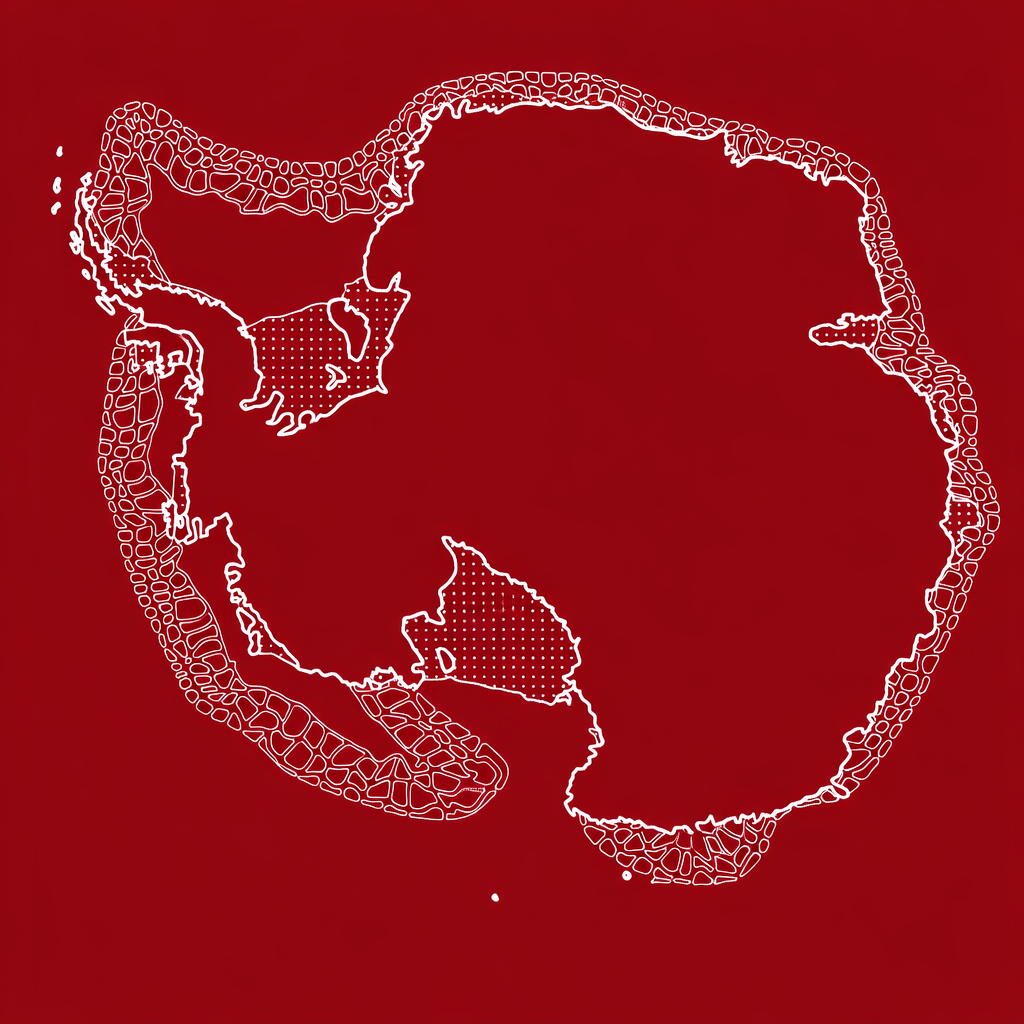
In 2018, at Bellingshausen Station—while the wind swept the snow as if to erase every trace of human history—a Russian scientist decided to update his national literature’s most tormented tradition. He dispensed with the monumental axe; a humble kitchen knife sufficed.
Yet, the gesture carried a clear genealogy.
Since Raskolnikov, we have known that Russia produces more than mere crimes: it produces crimes with a thesis. In Crime and Punishment, the young student justifies murder as a moral experiment, a test of superiority, or a metaphysical venture. In Antarctica, the experiment took on a humbler but equally Russian scale: can a man endure the ice, the alcohol, the confinement… and, on top of it all, the spoilers?
The accused, a disciplined reader, found in the novel a form of spiritual resistance. The snow seemed infinite; the suspense, finite. His colleague, by contrast, practiced a meticulous cruelty: revealing endings prematurely and gutting the climax with the coldness of someone slashing a tent flap in a blizzard.
In Saint Petersburg, guilt dwells in psychology. In Antarctica, it resides in the climate.
Isolation—that quintessential Dostoevsky character—acted here as a co-author. In the Slavic tradition, crime transcends the act; it involves fever, theory, and the doubling of the soul. The repeated spoiler operated like that hammering inner voice: “You already know how it ends.” And faced with the certainty of a tragic finale, the temptation arises to hasten the conclusion.
One could imagine the scientist wandering through metallic corridors like a polar Raskolnikov, weighing whether certain readers—those who annihilate another’s intrigue—belong to the “ordinary” or “extraordinary” category. He sought to confirm whether the morality of suspense admits exceptions.
In the great Russian novel, punishment emanates from within; the conscience drafts its own sentence long before any tribunal. Perhaps, in the aseptic whiteness of Antarctica, the true penalty revealed itself as literary: the realization that the right to surprise remains inalienable, even in the face of violence.
Antarctica, with its absolute silence, functioned as a stripped-back stage for a Dostoevskian scene: a man, a fixed idea, and an irritation that becomes destiny. There was no Sonya to intercede, nor a confession in a public square. Only ice, silent laboratories, and an interrupted novel remained.
Perhaps the episode confirms what nineteenth-century literature already suspected: human beings tolerate hunger, cold, guilt, or redemption, but they succumb when robbed of mystery.
And so, at the edge of the world, the legacy of Crime and Punishment found a minor but faithful variation: homicide as a defense of the elemental right to remain ignorant of the story’s end.
In Russia, even spoilers can ascend to the level of metaphysics.


