
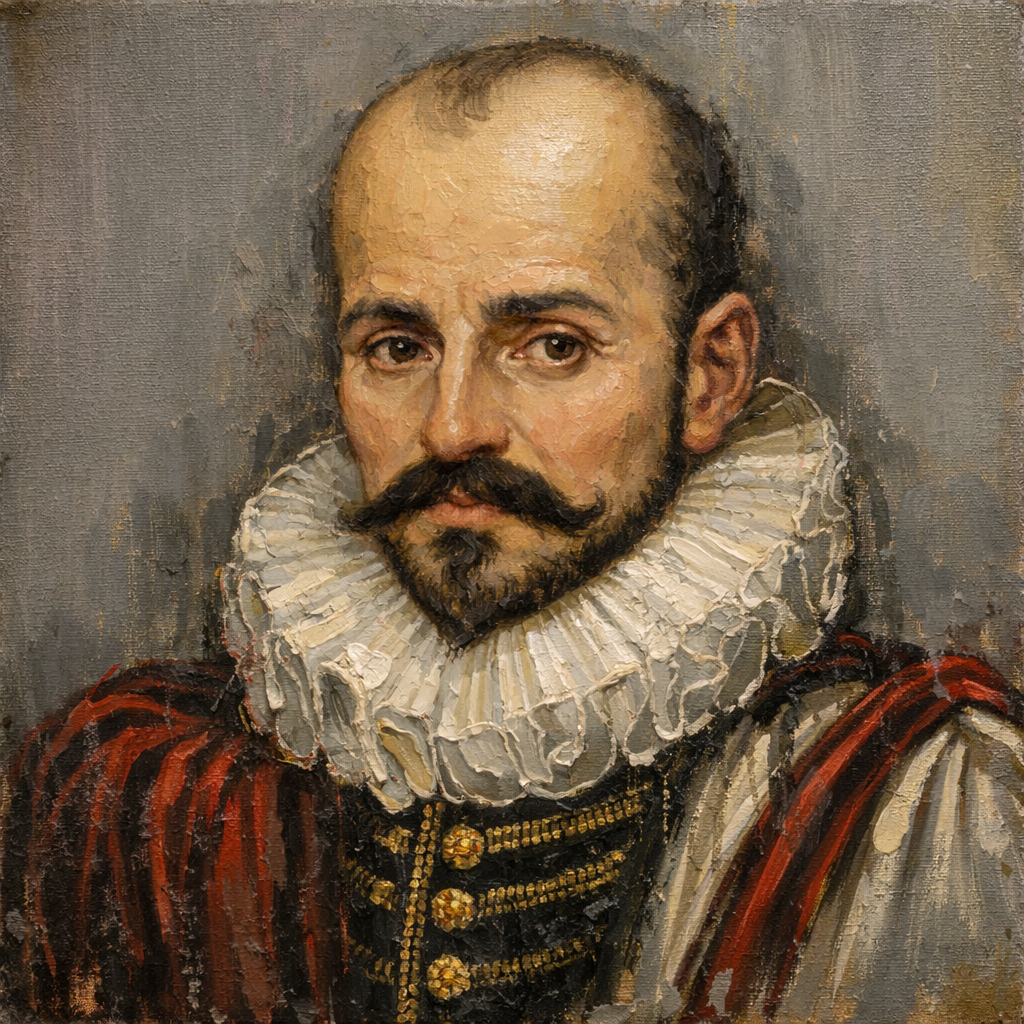
Citario. Derived from the Latin citāre (to quote) plus the suffix -ārium (repository), similar to bestiario. A 21st-century neologism, it emerged among Spanish-speaking scholars at Bookish & Co., with roots in ancient anthologies and florilegia. “Citario” is related to medieval books of commonplaces (such as those by Erasmus of Rotterdam) and proto-examples from the 19th century, such as Familiar Quotations. This CitarioMontaigne marks the 493rd anniversary of his birth and proposes a cabinet of converging gazes: judgments, intuitions, and verbal portraits that others have drawn of his figure and his work.
The first reaction against Montaigne dates from the end of the reign of Louis XIII. Mademoiselle de Gournay was among his detractors, reproaching him—as so many did—for speaking too much about himself in his book. A figure who, strangely, showed little understanding for the extraordinary French moralist was Balzac. Concerning the composition of the Essays, the author’s judgment, and what Montaigne relates of his private life, Balzac observes, mingling criticism and praise: “He knows well what he says; yet, without diminishing the respect I owe him, I think, on the other hand, that he does not always know what he is going to say.” And in that, no; here Balzac, regrettably, is mistaken. For what the immense novelist regards as hesitation or uncertainty is precisely what gives everything Montaigne affirms its tremor, its warmth, its most personal tone. It is curious, for example, that in his Entretiens Balzac nevertheless denounces the harshness of Montaigne’s language. For, according to the author of The Wild Ass’s Skin, in the kingdom of the Valois and being a Gascon, it was natural that his tongue should bear the vices of his century and the defects of his country.
Yet the opposition to Montaigne, as we can see, remains in Balzac still superficial and, above all, “formal,” as we would say today. The one who attacked him implacably in reality was Pascal. He reproaches him for thinking of nothing but dying quietly and comfortably throughout his book. Moreover, among the line of detractors stand out M. de Saci, Arnauld, and Nicole, who find him little short of subversive and dangerous. “His words,” they go so far as to tell him, “do not proceed from Christian humility; they unsettle the foundations of conscience and, consequently, religion itself.” From there to considering Montaigne a corrupter is but a single step.
Enrique Azcoaga, foreword to Ensayos escogidos (Edaf, Madrid, 1999)
◾️
Montaigne relates that “if, in former times, someone had shown me Erasmus, I would hardly have failed to regard as adages and apothegms everything he might have said to his servant and to his hostess.” And he adds that we commonly imagine these great figures, installed upon their thrones, “do not stoop to live.” The Journal shows us that, despite the jest, the man Montaigne is not merely “essays in flesh and blood,” just as Erasmus did not reduce himself to “adages and apothegms.” For the Essays contain a certain philosophy, however slight and modest, proper to a merely “unpremeditated and fortuitous philosopher.” In the Journal, precisely because of its lack of philosophical-literary elaboration, there is scarcely room for anything but daily life, simple and material.
The Montaigne who in the Essays possesses a certain literary-philosophical stature appears in the Journal stooping to live—that is to say, let us attempt a brief list of what that means—sleeping poorly, eating crabs, mistaking a young woman for a student, fearing the possible revenge of a vetturino, observing the courtesans posted at their windows, sinking into a terrible melancholy, enumerating the diversions of Rome, suffering unspeakably from kidney stones, urinating, moving his bowels, dancing with peasant girls, taking part in a lottery, speaking with Spanish soldiers, buying horses…
In the Journal we see fulfilled one of the central ideas of the Essays: no philosophy or wisdom, however elevated, has the power truly to remove us from material and ordinary life. “Be as wise as you please, but in the end he is a man […]. Wisdom does not force our natural conditions,” says Montaigne; and a little further on he recalls Terence’s well-known maxim, though in a decisively altered version, with a meaning that is not the usual one: Humani a se nihil alienum putet(“Let him not think that anything human is alien to him”). This is, in fact, one of the fundamental points of Montaigne’s philosophy—of his almost non-philosophy—and it may be found scattered throughout many pages of his book.
Jordi Bayod, foreword to Diario del viaje a Italia (1580-1581), (Acantilado, Barcelona, 2020)
◾️
November 8 [2005]
I reread with great pleasure Montaigne’s Journal de voyage: the figure moves curiously from place to place, attentive to everything he sees around him, yet without ceasing to auscultate himself—concerned with his bowels, the discomfort caused by gas, the gravel in his kidneys and the stones he passes when urinating; attentive to the color (at times threatening, blood-tinged) of his urine. The book unfolds a populous, bustling Europe in which ideas circulate swiftly and relatively freely, and where the prestige of important figures—important for one reason or another—is transmitted, turning them into points of reference in the cities where they live; they become part of the prestige of the urban patriciate. Thinkers, artists, scientists adorn the cities and fill their neighbors with pride, who participate almost by osmosis in the unstoppable expansion of modern ideas. The reader is comforted by the unprejudiced way in which the author regards whatever he encounters, describing the various forms of nourishment, the cuisine, the quality of lodgings, the prices—comparing them with those of his homeland, at times ranking them lower in his scale of merit (as might seem natural), but also—more frequently—higher. Many are the things and customs he prefers to those of his own land, guided by a desire for fairness that excludes chauvinism: he esteems the virtues and knowledge of others. He is favorably surprised by the bed linens in Italian inns—which, except in Florence and Venice, he generally finds excellent—and he appreciates solid German cooking and its good breads, which he consumes with pleasure.
November 9
I read chapter 9 of the Essais: “Of Vanity.” How much wisdom concentrated in a few pages. How can one think of sitting down to write after having read them? In Montaigne, his absolute freedom is always striking: I am I and I act from the I and, from my I, I write. Insofar as the I is a territory distinct from others, it deserves to be explored; it is diverse, autonomous, and, above all, vast and free: it never quite allows itself to be captured either by religious norms or by civil laws. The most innocent and upright human being, scrutinized closely, could be condemned to death ten times over in the course of a lifetime, because life is more powerful and more ambiguous than any law. Only from such a premise can one understand several things that extend to our own day in the French literary tradition and have scarcely taken root in Spain. First of all, the interest in self-analysis, the conviction that writing is not a trap that captures only the object, but also—and very especially—ensnares the subject. From this springs a vein that leads us to Proust, to name one of the summits, but also to the narcissistic ravings of so many contemporary writers and critics. France has been a stepmother to most of them.
Rafael Chirbes, Diaries 2005-2007 (Editorial Anagrama, Barcelona, 2023)
◾️
In general, Montaigne speaks of his readings and of the ideas they inspire in him, or else he describes himself, but he does not narrate events. Here, by contrast, we are given a personal incident. The account is full of detail. The circumstances are precise: the second or third civil war, between 1567 and 1570. During a truce, Montaigne leaves his house—without straying far from his lands and without a large escort—mounted on an easy horse, to take a ride.
Then comes the long and very beautiful sentence in which he recounts his mishap, rich in picturesque details: the powerful packhorse ridden by one of his servants; he himself, “little man and little horse,” knocked down by the enormous animal charging upon them. We see the scene; we imagine the Dordogne countryside, amid the vineyards, under the sun, the small escort galloping. Then the collision: Montaigne on the ground, unhorsed, deprived of belt and sword, bruised, and above all unconscious, having lost awareness.
For that is the key. If Montaigne provides so many details, it is because he remembered nothing and his servants told him what had happened, concealing the role of the great nag and its rider. What interests and unsettles him is having lost consciousness, and then his return to life once they had carried him home, taking him for dead. This accident was thus, for Montaigne, the occasion on which he came closest to death—and the experience was gentle, insensible. Therefore, death should not be too greatly feared.
Beyond this moral, Montaigne draws from the experience a more important and modern lesson. It leads him to reflect on identity, on the relation between body and mind. It seems that, while unconscious, he acted, spoke, and even gave orders that they should look after his wife, who had been notified and was on her way toward them. What are we, if our body stirs, if we speak and give orders without our will taking part? Where is our self? Thanks to that fall from a horse, Montaigne—before Descartes, before phenomenology, before Freud—anticipates several centuries of concern with subjectivity and intentionality, and conceives his own theory of identity, precarious and discontinuous.
Anyone who has fallen from a horse will understand.
Antoine Compagnon, A Summer with Montaigne: On the Art of Living Well (2019)
◾️
The Essays are Montaigne’s principal contribution to taming the “wild beasts” unleashed by the Wars of Religion and the dynastic conflicts. But they are also the “foundation stone” of the literary edifice of classical France: they prepare minds to see in legitimate monarchy the only possible and reasonable order, and they associate acceptance of such an external order with the careful effort to preserve the prince’s subject’s inner freedom. To sustain this double claim requires tact and prudence.
It is important to note, however, that Montaigne does not resort, as his former teacher Marc-Antoine Muret did, to the genre of the letter. For Muret, the letter is the modern genre par excellence, since the modern Forum is not public but private; it is no longer popular, but reserved for a courtly elite gathered around the prince. The epistolary genre unites in a single formula the “familiarity” of the ancient letter and the affairs of state of ancient oratory, and it is the fullest expression of courtly life. Without entering the “reserved domain” of the prince and the Court, the genre of the essay that Montaigne chooses more clearly and decisively respects the “republican” autonomy of individual privacy. A French genre par excellence, it would find its highest expression in the letters of Madame de Sévigné, infinitely closer to the Montaignian essay than to the letter in the manner of Muret—or even of Balzac. The essay, in effect, turns away from courtly exchange in order to expand into the soul’s confidence, the free sincerity of a “conversation” liberated from the official formalism of the Court.
Marc Fumaroli, La Diplomatie de l’esprit: de Montaigne à La Fontaine (1994)
◾️
In the great vestibule of the Faculty of Letters in Bordeaux, we were obsessed with Montaigne’s tomb—stern, icy, encased in armor. In it we found not something to nourish our Gascon or Bordelais chauvinism, but rather a pretext for mocking a certain cult of glory.
To honor the most penetrating decipherer of the human soul, was it necessary to erect that mausoleum of reddish marble, that recumbent figure armed from head to toe, flanked by helmet and sword? Did they expect us to confuse Montaigne with Charles Martel or with Blaise de Monluc? We scoffed.
Because we had read the Essays badly, and the Travel Journal and correspondence of the man who had been mayor of our city even worse, we were mistaken. It is enough to appreciate at their true worth the masterly glosses on the chilly egotist, the ailing and sedentary lord of the manor, and to immerse oneself in chapters such as “Of Practice,” “Of the Most Excellent Men,” “Of the Useful and the Honorable,” or “Of Experience,” to discover in Montaigne a bold actor in history, a citizen of the world, often engaged in the front ranks of the debates of a century bathed in blood, constantly “battered” between opposing camps, a pioneer in the struggle for tolerance that would culminate in the accession to the throne of his friend King Henry.
For this reason Fortunat Strowski, who taught Montaigne to so many Bordeaux students—among them François Mauriac—could write at the beginning of his biography of the author of the Essays, inspired by his research undertaken with a view to establishing the famous Édition Municipale:
Montaigne appears in a clearer light. He is no longer a kind of bourgeois-gentleman grown wealthy, timidly bent over his books, but a figure of great importance, familiar with kings and princes, called upon to play an active role in the politics of his country, a noble of the sword like his father and respected throughout the kingdom… His wisdom will no longer seem to us the effect of a congenital indolence, but a conquest of will and spirit over the torment of anxiety and the fear of death, not to mention the violence of his temperament.
In this renewed light, Montaigne’s mausoleum (now part of the Musée d’Aquitaine) no longer seems aberrant. This marble armor is not the solemn concealment of a deserter from history, but the tribute paid to a man who, “in the thick of the wars” called Wars of Religion, assumed the most dangerous responsibilities and displayed what, according to his Roman masters and according to Machiavelli, might have been called his “virtù.”
Jean Lacouture, Montaigne à cheval (1996)
◾️
The proximity of the sentences of Montaigne and Pascal—their relationship, distant in time—when brought close together in space, releases a delicate tableau. Montaigne writes: “I myself am the matter of my book,” savors his phrase, steals softly toward the neighboring room, and hears, like an echo, the harsh sentence that another man who writes, and who is called Pascal, applies to him: “the foolish project he has of painting himself.” I like to think about those two sentences, and to stage the scene for myself once again. Montaigne makes a slight grimace and seeks to continue his work with greater pleasure and a mild, temperate air. He takes up again his mayoral staff and, as though he had not heard, writes: “what happens to me is my physics and my metaphysics.”
Pascal wished to forget that between Montaigne’s foolish project and the absurd project of a Renaissance navigator, for example, there exists a relationship of epoch, of dignity, and of intellectual heroism. Man at the center of the earth and of himself—and highly perilous navigation. They are two equally Renaissance sentiments (whose necessity and nostalgia each age will go on confronting).
Brunschvicg’s book (Montaigne. Pascal et Descartes, lecteurs de Montaigne) has the charm of turning those three figures into intimate companions; it pursues a sentence not in its direct influences but in the echo gathered and prolonged. We behold how those great creators placed their hands upon the same ideas, without concern for the empty arrogances of priority. These were essential ideas for their time; they understood that they had to traverse them, caring more for their vitality than for turning them into closed objects of private ownership. The author believes—so as to bypass the uninteresting question of Montaigne’s originality, without troubling himself over the Cicero or Seneca behind his pages on friendship and death—that the Essais “are the most original book in the world.”
José Lezama Lima, Analecta del reloj (1953)
◾️
Herein, it seems to me, lies the great interest of Montaigne’s Essays. They propose to us two versions of emptiness and of its complement. From one version to the other there is an absolutely decisive turn. The first version is theological, in the fideist form set forth in the “Apology for Raymond Sebond.” Christian Pyrrhonism, Montaigne declares, “presents man naked and empty, acknowledging his natural weakness, ready to receive from on high some external strength, stripped of human knowledge, and more disposed to accept the divine. His judgment is annulled in order to leave more room for faith […] He is a blank page prepared for God’s finger to trace upon it whatever forms He may please to engrave.”
The other version of emptiness is that which, beginning from a melancholy still accessible to remedies, lends itself to the irruption of “chimeras and fantastic monsters” and, in a somewhat less disorderly fashion, to the entrance upon the stage of the self. Let us recall the famous sentence: “And then, finding myself entirely devoid and empty of all other subject matter, I set myself to writing about myself as argument and as theme”: Montaigne apologizes for it, but he does not repent. For this he would expose himself to the criticism of religious writers: Pascal, his principal adversary, would declare that “the heart of man is hollow and full of filth.” In his view, Montaigne had appealed only to vanity—that is, to the emptiness of words, to the emptiness of self-love; he had merely aggravated the emptiness of the heart and remained captive to nothingness.
Jean Starobinski, L’Encre de la mélancolie (2012)


