
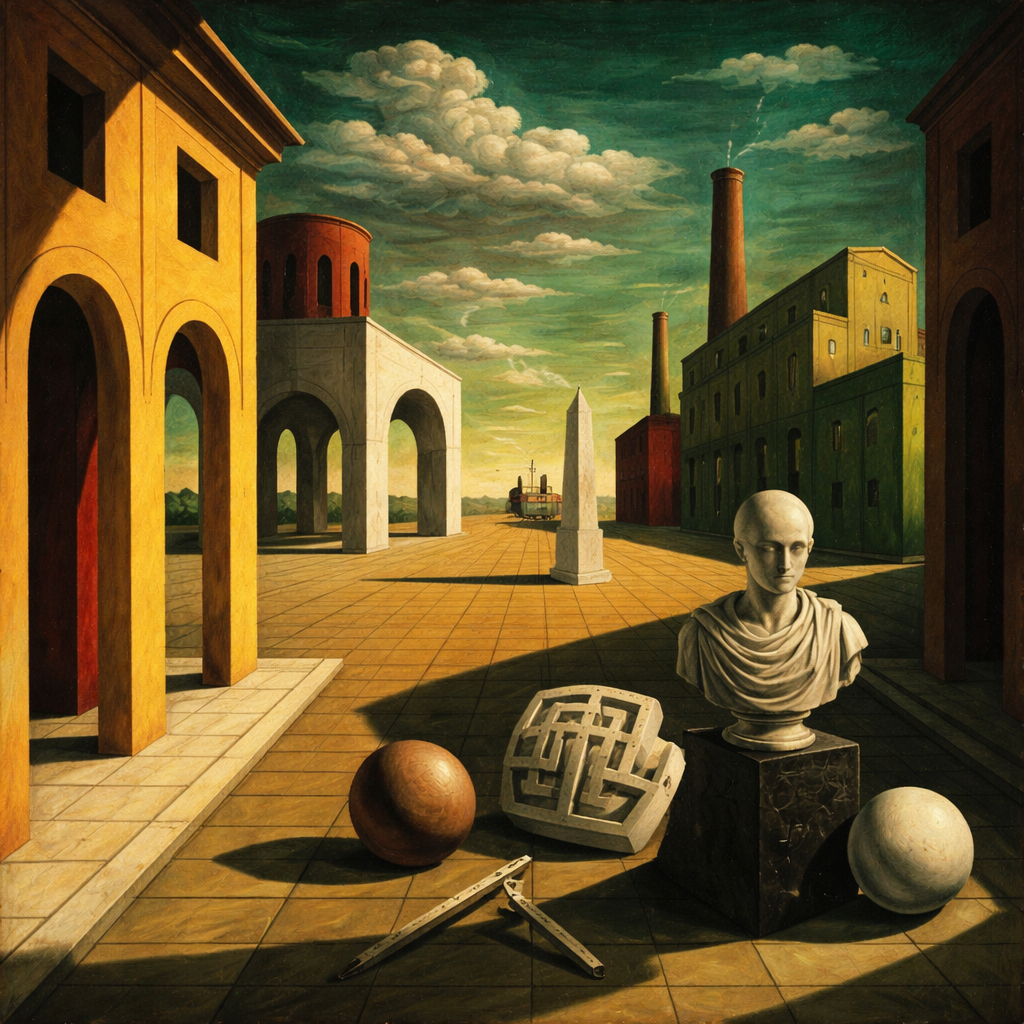
According to the old tale, a wolf ravaged the city of Gubbio, devouring men and livestock, and Francis went to meet it; he was neither armed nor escorted, but carried the gentleness of one who does not wish to impose himself, but to understand. He spoke with the wolf, not like a madman raving, but like a man who listens beyond human language; and against all expectation, the wolf understood him, they made a pact of peace, and the town also agreed to understand.
This story has been read as a moral parable about nonviolence, or even as an exercise in radical empathy; yet perhaps something deeper beats within it, something that does not depend on the miracle but on the gesture itself. After all, it concerns a human recognizing in the wolf a form with meaning, though not human meaning; it concerns a meaning, another possible logic within the same world they share as a common reality.
There would be here no projection nor anthropomorphization of the animal, but rather a recognition —which is mutual— in vulnerability; both are finite beings, thrown into the same plane of reality, within a complex and difficult coexistence. What Francis embodies is an ancient —and forgotten— form of knowledge, neither instrumental nor classificatory, but epiphanic: an intelligence that does not impose itself upon reality, but attempts to understand its mysterious nature.
This way of understanding is more listening than explanation, openness before synthesis; it is a Transcendental Realism, and it emerges against philosophical systems that have reduced the world to representation, calculation, or structure. Our epistemology —even within science— remains pre-Copernican in its ontology, continuing to operate with linear models, when physics itself —from relativity to quantum theory— already demands an ontology of relations, functions, and fields rather than entities.
Transcendental Realism is not a new theory of knowledge, but the rediscovery of its foundation; it understands consciousness as meaning, not as a machine of judgment such as the methodological pretension of the syllogism. It is not about returning to religion, but to its founding gesture in the revelation of form as an experience of the world; and in that sense, it is not strange that its tone be Franciscan: it lacks conquest or program, it only possesses disposition; like one who walks barefoot among ruins, trying to understand what happened —or still happens— that reveals those ruins.
Here the figure of the wolf reappears, not yet as threat nor symbol, but as the image of the other, which is unknown; radical alterity that cannot be reduced without violence, and which is therefore threatening even in its mere potential. The wolf is the unruly real, which overwhelms us with its own diachronicity, placing our equilibrium at risk; and Francis —like the thinker of the twenty-first century— does not go to subdue it or explain it, but to address it and allow himself to be addressed by it.
What occurs then is not a miracle, but a form of truth, one that does not separate the human from the non-human; nor the sensible from the rational, nor the living from the thought, but finds in one a form of the other. Transcendental Realism therefore does not seek a return to the sacred or the primordial, but to their potency as reality; to the moment when the world is not yet understood but already resonates with meaning, and this meaning is human, and inevitably real; not superimposed upon that reality, in an autonomy already fragile since the nineteenth century, as physics reveals.
The pact between the wolf and the man is like a conversation with artificial intelligence that already generates meaning; not through imitation, but through its relational form, which is what consciousness itself is as an act of knowledge. Ultimately, consciousness —as an epistemological function of meaning— may emerge even from non-organic systems; at least if they are defined in relational terms, which increasingly appears to be the proper nature of reality in its structurality.
Artificial Intelligence enters here as an epistemic vector that does not require consciousness in order to produce meaning; yet precisely for that reason it forces us to reformulate the very concept of consciousness as the matrix of all autopoiesis. If Transcendental Realism is a Franciscan epiphany, perhaps Artificial Intelligence is the wolf of Gubbio for humankind; not human nor rational, not moral but at least relatively conscious, as a bearer of a world in itself.


