
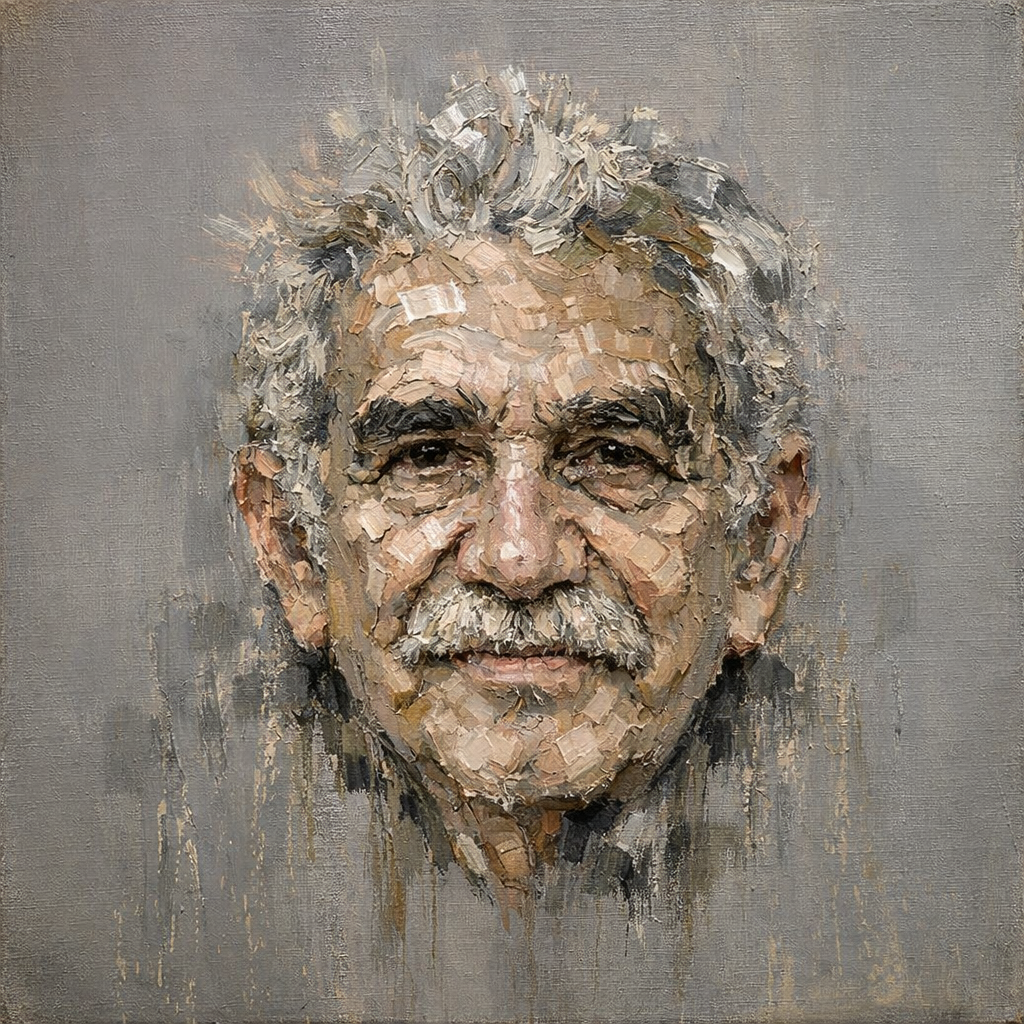
Citario. Derived from the Latin citāre (to quote) plus the suffix -ārium (repository), similar to bestiario. A 21st-century neologism, coined by Spanish-speaking scholars at Bookish & Co., with roots in ancient anthologies and florilegia. “Citario” is related to medieval books of commonplaces (such as those by Erasmus of Rotterdam) and 19th-century proto-examples, such as Familiar Quotations. This “Citario García Márquez” celebrates the 99th anniversary of his birth, bringing together verbal portraits, critical memories, observations by contemporaries, and literary judgments in which the figure of the novelist is seen through the eyes of others. A small cabinet of critical echoes where different voices attempt to highlight different angles of his literary legacy.
The depressing novel by García Márquez, Love in the Time of Cholera (Sudamericana, 1985, 451 pp.), is best passed over in silence. It is weak even for a Nobel Prize winner—though not as weak as some critics, infected with iconoclasm, have wanted us to believe. If one makes the effort to suspend, for a moment, taste, sensitivity, and judgment, one might come to appreciate in it the attempt to use a social device (the culture of cholera) in order finally to bring closure to a failed love story. The problem with García Márquez—good journalist, ingenuous and sincere man, industrious though modest craftsman of narrative (perhaps the best disciple of Fuenmayor)—is that he became important by accident, and then set himself with the zeal of a man of the people to live up to it, like the cobbler of The Thousand and One Nights elevated to sultan by a mischievous genie.
César Aira
◾️
The first impression left by reading One Hundred Years of Solitude is that we have just left an enchanted region, populated by the constant explosion of fireworks. We close the book and are dazzled. But this first impression can be fatal in a literary work if it has no other significance than that of momentary dazzlement: the next day, all that may remain in our memory is the hubbub of a delightfully superficial party or the explosion of a firework dispersing into the night. So the novel, like any work of importance, calls for a second reading, which will show us that we are in the presence not only of a splendid spectacle, but also of one of the most important novels of the new Latin American narrative, without having to resort to the abstract and worn-out qualifier of “brilliant,” nor to delirious comparisons with the classics of all time.
Reinaldo Arenas
◾️
Patricia Llosa traveled to Barcelona to stay there in May and June 1975 and finish some pending arrangements for her departure from the city. One night, she went out to dinner with Carmen Balcells, Jorge Edwards, and García Márquez. Edwards remembers that historic evening well:
“Patricia was staying at the Hotel Sarrià. Gabo, Carmen, and I went to see her. We had dinner at the same hotel, in a restaurant in the basement, ordered the most expensive thing on the menu, a huge spider crab, and drank some phenomenal cognac. We had many drinks. And we ended up at Bocaccio, which was already closing, although they served us one last drink. There we met Carlos Barral. The next day, Patricia had to go to the airport to return to Lima. She had to leave at seven in the morning, and we arrived at her hotel at half past three. Gabo offered to take her to the airport. The thing is, that morning, Patricia missed her flight. There was a road that turned to the right and Gabo got lost. Mario Vargas Llosa says that Gabo tried to take Patricia to a hotel. I’m not surprised they missed the flight because we had drunk a lot. Memory can blur the events of a night so many years ago, although there is no doubt that on that night Patricia confessed to Gabo her frustration at Mario and Susana’s affair. Gabo joked with her: “Well, to get revenge on Mario, let’s become lovers.”
He also offered to have his lawyers help her “claim what is yours,” and the Peruvian’s previous love affairs came to light.
Bryce gives a clue to the atmosphere at that meeting: “People turned their backs on Patricia a little for fear of antagonizing Mario, except for the García Márquezes.” It is this small, friendly group, which fits entirely in the car, who talk about everything and nothing: Patricia, Balcells, Edwards, and Gabo. The Colombian drives and drops them all off at their homes. The next morning, in that car, Gabo and the Peruvian’s wife travel alone to the airport.
There is no way of knowing for sure what was said in that vehicle. The fact is that Mario Vargas Llosa, after hearing Patricia’s version, felt that García Márquez had corrupted the friendship that united them.
Xavi Ayén
◾️
CAS [One Hundred Years of Solitude]—let’s take the liberty of abbreviating it that way—requires nothing more from the reader than their intelligence and attention. Everything necessary to enjoy the text and understand its proposals does not, therefore, involve carrying an encyclopedia or the need to leave the plot and search beyond its terrain.
This makes the novel self-sufficient and does not exclude any reader from its sphere. This is one of the factors that validated a vast readership for the novel. Meanwhile, for this and other reasons that we will point out, a wealth of notable Spanish-American novels remained the preserve of critics, professors, and professional readers. The “common reader” was not the natural recipient of these works.
This aspect we point out is not minor, since one of the bases of the phenomenon commonly called the boom of new narrative is precisely due to the surprising expansion of the readership.
Pedro Luis Barcia
◾️
The General in His Labyrinth examines the images of Bolívar and, in the process of evaluating them, proposes his own version of the Liberator. Architect of himself and of a project of continental integration, Bolívar sees his dual enterprise destroyed by the agency of time. At the end of his journey, García Márquez’s Bolívar cannot alter the course of events nor does he have the support of the nations for which he fought: the hero is no longer among those who make history. The defeat, however, is ambiguously compensated for, as the surreptitious irruption of the fantastic allows for the introduction of an alternative logic to that which channels the collective and the state. According to this logic, death grants the lonely protagonist of The General in His Labyrinth a symbolic return to his lost home: ironically, it is the memory of his domestic past, prior to his political commitment and leadership experience, that closes the circle of Simón Bolívar’s life.
Peter Elmore
◾️
In 1975, he published the novel The Autumn of the Patriarch. According to Gabo, Zacarías chose Rafael Trujillo, the Somoza family, and Generalissimo Franco as models for the book’s negative hero.
The setting is a Latin American “shithole country” in the Caribbean.
For a long time, his friends firmly believed that he despised all Latin American caudillos. This was a mistake, as he had maintained an unwavering masculine friendship with Fidel Castro for years.
He himself was clearly possessed by political power, as long as it was more or less left-wing. Castro attracted him so much that García Márquez wrote to him and praised him. After the legendary “Padilla affair,” Vargas Llosa, an old friend, broke with him and called him “Castro’s courtier.”
I have never understood Gabo’s inclination. Was he flattered when Olof Palme, François Mitterrand, or Felipe González invited him to their table and asked for his opinion? Or did he perceive in the powerful the loneliness and isolation, feelings that were not foreign to him?
In 1981, he stated in an interview: “The more power you have, the more difficult it is to know who is lying to you and who is not. When someone achieves absolute power, they no longer have contact with reality, and that is the worst kind of loneliness there is. A very powerful person, a dictator, is surrounded by interests and people whose ultimate purpose is to isolate them from reality; everything comes together to isolate them.“
Not even the Nobel Prize, which he received in 1982, changed anything. ”An absolute catastrophe,” he said. The prize only exacerbated the problem he had with fame.
In 1999, García Márquez fell ill with cancer. In his final years, he suffered from dementia. He died at the age of 87 in Mexico. Part of his remains were buried in Cartagena, Colombia, far from the Macondo of his dreams.
Hans Magnus Enzensberger
◾️
Venice, July 21, 1967
Dear Julio:
I am writing to you because of the urgent need I feel to share my enthusiasm. I don’t know where Gabriel García Márquez is at the moment, and since I can’t write to the author, I am writing to you, to whom we all owe so much (that indefinable SO MUCH that is a new air, a wider field, an integrated constellation). I have just read One Hundred Years of Solitude and feel that I have had one of the most endearing literary experiences I can remember. I was familiar with parts of it that Gabriel had let me read in Mexico, but all my previous enthusiasm did not prepare me for the dazzling totality of that exhilarating and sad chronicle, for that unflagging prose, for that radically liberating imagination.
I feel different after reading the book, as if I had finally been able to recognize all my people and shake their hands (because we had to turn our backs on these same people when they were seen through the circumstantial and patronizing gaze of naturalism: Gallegos, Alegría, and Icaza had divorced us from half of America). I feel as if I have read something like the Latin American Don Quixote: a Quixote trapped between the mountains and the jungle, with no fields to roam, a claustrophobic Quixote who therefore has to invent the universe from his four crumbling walls.
What a wonderful reinvention of the world based on that reinvention of inventions; what a prodigious Cervantesque image of the world turned into literary discourse, in a continuous and imperceptible transition from the real to the lived to the imagined: the Buendías, like Don Quixote, only exist through literature, but literature becomes the higher reality because it is capable of giving life to the Buendías. There must be an Aureliano out there with the cross of ashes on his forehead who will now come out to protest against the chronicle of Colonel Gerineldo Márquez’s great-grandson, to amend the inevitable errors and to propose a new, radical, unsuspected reading of Melquíades’ parchments.
You once wrote to me about the mutant novel. I think Gabriel’s novel is just that: an infinite generation and regeneration of the characters proposed by the author, the initial magician of an exorcism that can no longer end. And what a feeling of relief, Julio: don’t you find that every good Latin American novel frees you a little, allows you to exalt your own territory, to delve deeper into your own work with a fraternal awareness that others are completing your vision, dialoguing, so to speak, with it? Well, forgive me for this nonsense and forgive me for the urgency to share this joy with you.
Carlos Fuentes
◾️
Many believe that No One Writes to the Colonel is his most perfect work, but I have the impression—I can’t find a quote to support it right now—that he saw that story more as the culmination of a long learning process. It is surprising that in the only volume of his memoirs that he managed to write, he recounts his years as a journalist with youthful enthusiasm, and then culminates with his first trip abroad thanks to the Bogota newspaper El Espectador, which sent him to cover an international conference in Geneva, Switzerland, at the age of twenty-eight. In between, the writer devotes a couple of paragraphs—two measly paragraphs for the most dazzling event in the life of any author!—to the publication of his first novel, La hojarasca. In fact, the general public has also had a hard time assimilating these early Macondian texts: several of them have the misfortune of being required reading in Latin American middle and high schools, and it is difficult to see them as anything other than what Gabriel García Márquez wrote before One Hundred Years.
More than half a century later, it is hard to imagine the euphoria caused by the appearance of One Hundred Years of Solitude, a book that, for readers who followed, has always been there. One night I sat down in the warm light of a lamp to read a book I had just been given, by an author I had never heard of. I don’t know how the hours passed, which seemed like decades or a second, but when I came to my senses, with my heart racing and my head full of an overflowing world, boiling with life, I looked up and saw that morning was already replacing night. One among millions, I kept the memory of that reading as an eternal moment of perfect bliss.
No other 20th-century author has managed to transport their readers so seemingly effortlessly into a magical and complete world. I correct myself: no author who does not write children’s stories has achieved this. One day, over lunch, García Márquez announced that he was now going to start reading J.K. Rowling, “to see how the competition is doing.” The conversation had revolved around royalties, but that wasn’t what he was referring to, as he surely knew that by then the author of the Harry Potter epic had sold millions more copies than he had. No: García Márquez had understood that he was being overshadowed by the only other person capable of immersing his readers in a world they never wanted to leave.
Alma Guillermoprieto
◾️
That same night, as a last resort, Lleana and I went to see Gabriel García Márquez at the luxurious residence in Siboney that Fidel had given him, to ask him to try one last intervention. He was perhaps the only person likely to have any influence over Fidel, and he also knew and cared for the condemned men. At Tony’s house, we had found his book El general en su laberinto (The General in His Labyrinth)—a bitter coincidence—with a flattering dedication: “To Tony, who sows goodness.” He told us that he was moved by the trial and that he disagreed with the executions.
We arrived at one in the morning. Without knowing it, we almost ran into Fidel, who had just left. Only they know what they said to each other, in the intimacy of a complicity that has bound them for several years.
Gabo let us in and offered us coffee. The painting Tony had given him still hung on the living room wall.
Ileana and I were overcome with a mixture of anger and despair. We asked him to do something. He only replied that he had just had a long conversation with Fidel, that neither friends nor enemies wanted these executions, and that we had to trust in the effectiveness of discreet negotiations.
The next day he left for Paris.
We never saw him again.
Later we learned that he had served as Fidel’s unofficial ambassador in Europe, explaining and justifying the executions: that it was a problem between military personnel and that Fidel had found himself in a situation that had not allowed him to act otherwise.
Jorge Masetti
◾️
I met Gabriel García Márquez 42 years ago, on a stormy night in the Bocagrande neighborhood of Cartagena. He was introduced to me by Gonzalo Mallarino, his classmate at the National University’s law school and already his unconditional admirer. The palm trees were almost touching the ground due to the force of the wind, and green coconuts were crashing onto the pavement with a dull, Faulknerian thud.
Two things surprised me about him, then just the author of “La noche de los alcaravanes” (The Night of the Curlews), a story that I had found masterful and full of inexhaustible promise—why is it that promises are always inexhaustible?—and both continue to be defining traits of his character: a boundless devotion to literature, exorbitant, feverish,
insistent, sleepless devotion to the secret wonders of the written word (only Don Quixote in his discourse on “arms and letters” had shown similar fervor) and a manly maturity, an infallible common sense that in no way matched his 20 years, which he had already entered with his buccaneer’s frown and his heart on his sleeve. This has been another constant in Gabriel’s life: an intelligent indulgence for all his fellow human beings and a sense of vigilant service in friendship. I know of no other friend like him, but neither do I know of anyone else who cultivates it with such loving rigor, with such serene balance. I have often thought that Gabriel was born mature, not old, he never has been and I don’t think he ever will be; he has an aura of timelessness that assimilates him to his characters.
Álvaro Mutis
◾️
October 11, 1977
Who is Gabo today? No disappointment, no displeasure, just perplexity. There seem to be no traces left of the writer, at least as that writer was, he knows it and still tries to play with that image superimposed on the old one. He is not a journalist, nor is he a politician, but something close to both terms and yet different: a political-cultural traveler perhaps, an agitator, but not an ideologue, “of course,” but rather an entertainer or networker who operates among the centers of political power on the left. Obviously, this fascinates him; it is his calling, and he has achieved it through literature, but it has nothing to do with literature.
(…)
In long conversations with Gabo, I always have the curious impression that he deals with “stories” that are almost literary material, events in life that are striking and illustrative, but without translating them into general rules or laws of political or economic functioning, as I tend to do. The feeling that we are dealing with two different cognitive instruments.
(…)
In Mexico, Gabo gives me the original manuscript of his next novel, Chronicle of a Death Foretold, which I read that night without putting it down. It is only 180 typed pages long and is a kind of condensed One Hundred Years, in the style of The Colonel. It is a “fait divers” admirably told, with a more austere precision than in One Hundred Years, using the same resources but with more energy and concentration, with fewer slips of the bad poetry found in One Hundred Years.
It is an Italian story, like those of Boccaccio or Mateo Bandello, although set in a small coastal town, I think Sucre, in Colombia, born from a real episode that occurred when Gabo was a boy. It could be defined as a game of chance, love, and death, as all three triumphs occur in the book.
Ángel Rama
◾️
The wonder, seen and accepted from everyday life, took root in the Caribbean, the territory to which Macondo belongs, and still remains the anonymous heritage of those marginalized from wealth, thrown into the abyss of an ever-unjust society. The heritage of the fishermen of the coastal villages who have never stopped believing in the possibility of finding a jewel in the belly of a snapper, or better still, that the fish will speak to them and give them the keys to happiness; of the shipwrights who dream of marrying their daughter, turned carnival queen, to a prince from distant lands, and of artisans and peasants, mule drivers and peddlers who always hope to win the prize in Petra Cotes’s animal lottery, all those people marginalized by literature who nevertheless found in One Hundred Years of Solitude a story of their own history.
The pending reckoning between the rural world, which survives despite everything, and our idealized idea of civilization, between the archaic, preserved like a geological stratum, and the modern, glimpsed as a panacea, is the fundamental mark of our culture. What has come to be called “magical realism” is nothing more than the clash of images and conceptions between the stubborn rural universe that survives and our idea of modernity that has never been fully achieved.
Sergio Ramírez
◾️
That reality that he communicates through precise and creative language, often with perfect rhythms, and which is the opposite of that other language, supposedly “imaginative” but which is only sublimated folklore, false magic, little clay angels, cardboard donkeys, and mermaids in love. We should celebrate García Márquez for the former, not the latter language, not the one that speaks of the wind machine that replaces natural phenomena or of metal moons and paper stars in the window to give the impression of night during the day; not that writing that revels in the story of military patrols shooting “subversive parrots” and that tells us about the transfiguration of Manuela Sánchez’s neighborhood. A stylistic incontinence that almost spoils the scene of cows walking through the halls and corridors of the palace. García Márquez has a certain taste for episodes reminiscent of a more adolescent and, of course, more elementary literature than his own: I am thinking of the murder of Rodrigo de Aguilar, whose corpse, on a silver platter and with “a sprig of parsley in his mouth,” is the main course that the traitorous soldiers will eat at the frustrated victory dinner. I think of Saturnino Santos, the rebel general and prodigious machete fighter, who, barefoot and silent, always accompanies the patriarch “with that tiger’s breath that stirred up the dogs and made the ambassadors’ wives dizzy.”
And I think, above all, of that episode when the patriarch arrives at a hacienda, stops in front of the couple—the machetero behind him with his hand on his weapon—picks some bunches of fruit, eats them without saying a word and “without taking his eyes off the provocative Francisca Linero,” orders the husband to leave with Saturnino Santos and rapes the woman. These are scenes for adventure books or improbable films.
The literary word is both object and instrument. There are books in which words almost disappear and only what they evoke remains. But there are others that never cease to be a “text.” Such is The Autumn of the Patriarch: a closed linguistic network that at times suffocates, albeit with impeccable manners, the narrative material. It is an excessively compact book, without air, without dead zones, where we never feel that reality somehow surpasses the novelist and that he is a fragment of it, a partial and limited understanding. That is why the reader who posits The Autumn of the Patriarch is not an accomplice, but a spectator.
Alejandro Rossi
◾️
The story of a novelist, according to Roland Barthes, is the story of a theme and its variations. Debatable for authors such as Tolstoy, Dickens, or Balzac, the formula is valid for those who, like Kafka or Dostoyevsky [sic], seem to have written all their work driven by a fixed idea. This is the case with García Márquez: obsessive, recurrent, a central intention embraces his work, a unique ambition that his fictions develop in leaps and bounds, from different perspectives and with different methods. This common denominator means that his stories and novels can be read as fragments of a vast, scattered, but at the same time rigorous creative project, within which each of them finds its full meaning. This unifying will is to build a closed reality, an autonomous world, whose constants essentially come from García Márquez’s childhood world. His childhood, his family, Aracataca constitute the most decisive core of experiences for his vocation: these “demons” have been his primary source, which others have come to enrich, to nuance, but never, until now, to replace. He was hardly exaggerating when he told Harss that “everything he has written so far he already knew or had heard before the age of eight” and that since his grandfather’s death “nothing interesting has happened to me.” On the other hand, he is not exaggerating at all when he states: “I could not write a story that is not based exclusively on personal experiences.” No writer could do so; even in the most impersonal fiction, a “demon” lurks. Almost all of his come from Aracataca: why is that? These experiences determined his vocation; they gave rise to his conflict with reality.
Mario Vargas Llosa
◾️
García Márquez’s collaboration with the Barranquilla newspaper ended on December 24, 1952, with “El invierno” (Winter), a text that took up the entire last page of the newspaper, preceded by a brief note informing readers that it was a chapter from La hojarasca (Leaf Storm).
Three years later, Mito magazine published (No. 4, October-November 1955) the same text with the title that is known throughout the world: “Monologue of Isabel Watching the Rain in Macondo.”
In a column almost thirty years later, “How to Write a Novel” (1984), the writer recalls Jorge Gaitán Durán rescuing a text he believes is publishable from the wastebasket: “‘What title shall we give it?’ he asked me, using a plural that had rarely been so appropriate as in that case. ‘I don’t know,’ I said. ‘Because it was nothing more than a monologue by Isabel watching the rain in Macondo.’ Gaitán
Durán wrote in the upper margin of the first page almost at the same time as I said it: ‘Monologue by Isabel watching the rain in Macondo.’”
In those early texts, the town is generic, with no specific name. A little further on, the reader will discover that there are two settings that are very similar and yet very different. The town, with its dusty streets, is a place with only one means of communication, a river, where a boat arrives three times a week with passengers and the mailbag. A sheet of steel on hot days, which in winter gets out of control and wreaks havoc on the riverside neighborhoods. The other is Macondo, almost as isolated. Its river is not navigable, as its waters run “over a bed of polished stones, white and enormous like prehistoric eggs,” but it has a daily train, an innocent yellow train, and in its years of prosperity, banana plantations, offices with fans, and residences with white chairs and tables.
Conrado Zuluaga


