
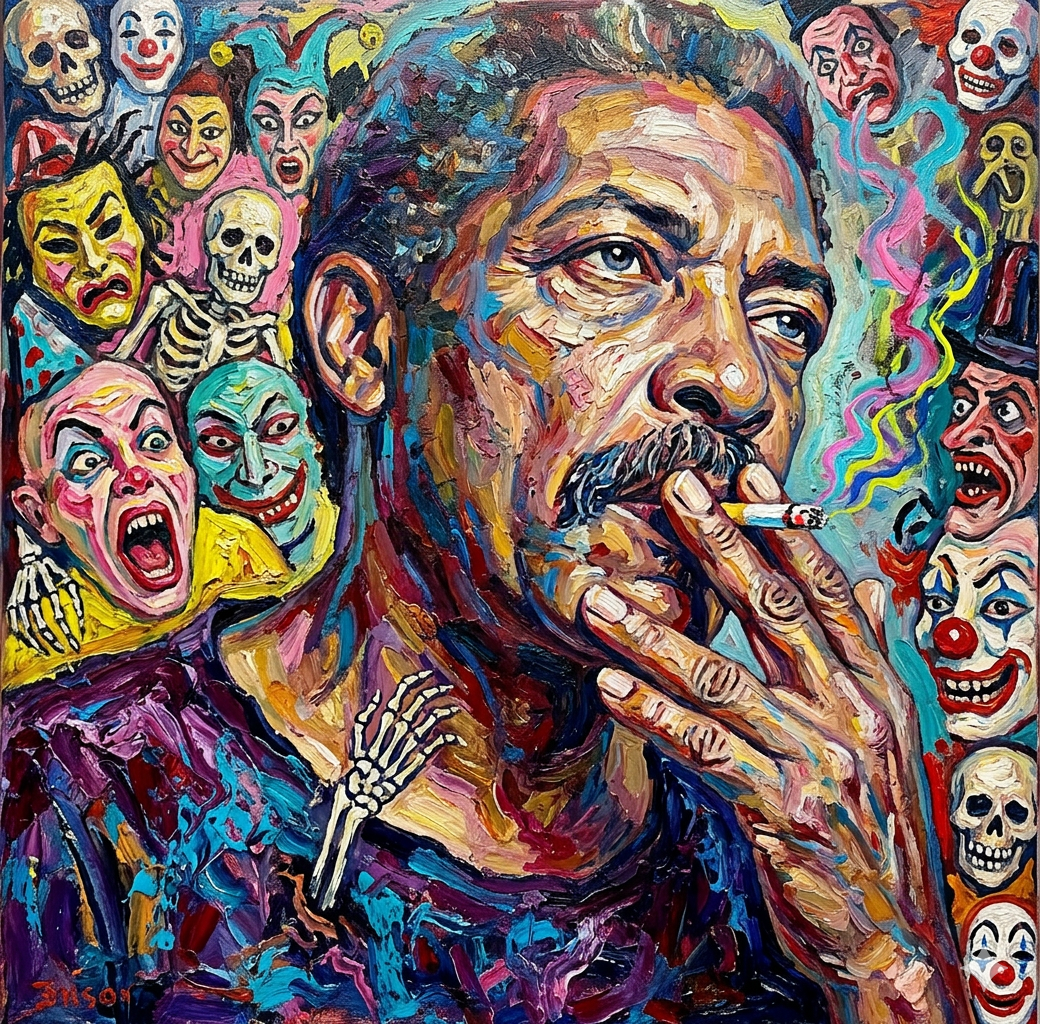
In the annals of Cuban poetry, the work of Ángel Escobar reclaims spaces unexplored by the word since the emergence of the Orígenes Group in 1944. In that long journey toward the articulation of an absolutely personal lyrical discourse, the poet left us testimony of his world, his obsessions, and the misfortunes of the human condition—for that is what writing poetry is about: revealing the shadows that await us as if one inhabited in perpetuity “the dark night of Saint John” invoked by José Lezama Lima.
Grandfather, father, mother, older brother. The first poem of his first published notebook—“Libro primero” from Viejas palabras de uso (1978)—acts as a threshold to all his poetry, evoking these family figures, bringing them back to life within the territory of memory. It rebuilds the environment where the child who will become a poet is born and raised, evoking not only the beings who populated his existence but also the chaos of a life lived on the edges.
From a young age, Escobar showed signs of schizophrenia. He said he heard voices. When he was barely an adolescent, his stepfather stabbed his mother to death. Shortly after, his younger brother committed suicide in prison. Both events would scar him for life and would later be evoked in his poem “Al dorso de figuras” from his book Cuando salí de La Habana.
It seems to be the anguish of living that dictated the poems we read today, many years after his leap into the void. His writing—at times fragmented, at times zigzagging, especially in his final books—is a reflection of the inharmonious, of that “rupture of homogeneity” of which Severo Sarduy speaks when defining Neo-Baroque writing. There is a discursive voice of great solidity, particularly in the Escobar of Cuando salí de La Habana (1997) and subsequent works, though it was already glimpsed in his most mature collection, Abuso de confianza (1992). However, his word is already marked by discontinuity, by “dethronement”—Sarduy once more—and by the brutality of losing that which is already irreparable, irretrievable. “The gaze is no longer solely infinite; as a partial object, it has become a lost object,” Sarduy tells us in his essay “The Baroque and the Neo-Baroque.”
Altered prosodies and metrics—rough and harsh in their conception; linguistic escapes like spirals or slides; the continuous fragmentation of syntax; the use of imitative and onomatopoeic sounds in a sense distinct from the traditional (which we had heard to exhaustion in the negrista poets). Escobar finds a certain relish in the use of popular or street expressions, such as “Oye, dame un breake / cual baqueta a la paila” or the interjection “¡Ea!”. These are eloquent signs of a need to implode an overly celebrated line of meaning in Cuban poetry that was entirely alien to Escobar’s sensibility—a sensibility so permeable to the mechanisms of tension and release inherent to Neo-Baroque operations, stemming from his deep readings of Lezama Lima’s Dador and César Vallejo’s Trilce, as well as his assimilation of North American poetry and his Latin American contemporaries.
It is impossible to imagine Escobar’s poetry apart from the Baroque/Neo-Baroque referent, also due to its marked chaotic magnetism, its discursive character rooted in excess, self-referentiality, and irony—that oblique gaze that does not seek to overstep the limits of the text or poetic writing, but ultimately places the reader in a verbal labyrinth that incites and invites risk.
Likewise, Escobar’s work, like that of every legitimate poet, glimpses and focuses on a grand question always directed toward and against himself, and also toward the possible futility of poetic writing—that is, of life itself, according to his order of things. More than one sign links his voice, indeed, with that of the Mexican poet Gerardo Deniz, whom he likely read at some point—we do not know, and likely never will—and it is the ironic rite, the sarcastic tone against everything and everyone that expelled him from the inner circles that confer doubtful glory; against that “vain presumption of poets, erudite stupidity, the delusions of doctrinaire thought, the bad faith of good consciences, the lack of love, the black bile of cities, the vexations of bureaucracy.”
The basic material for poetry in Escobar’s case could be found nowhere else but in his own experience, his memory of lucidity and dementia—what the poet himself defined as his “psicatriz” (psy-scar) in his poem “Suceso así remoto.” The primary necessity for Escobar the poet lay in creating an other language; that is, eroding tradition through the re-cognition of its cultural and racial paradigms until shaping a singular voice that stood out from the choir. Escobar understands the poem as an autonomous entity, certainly not severed from history, but free from explicit socio-historical ties that would diminish its aesthetic quality. The poet does not need to borrow a voice. He has his own voice, he is his own voice, and with it, he can dispute the denied spaces.
As if the paths he managed to open since those 1970s when he began publishing had suddenly closed, Escobar’s poetry became even more self-referential starting in the late eighties, when the mental imbalances he suffered worsened: “Only the voices / that little by little annul the emblems. / This which passes over me is them” (“Desde el suelo”) (2006: 212). In a letter sent in 1995 from Havana to his friend, the French writer and translator Alain Sicard, he admits that an “atrocious fear” overcomes him, adding:
…something unknown that will do God-knows-what to me, but which I see hovering around my head and triggering my body (…) I no longer know what to want. It is all like the defiance and the hubbub of others. I want to hide my face between rotten hands. Nothing holds back the enormous stone that falls on me at every moment, and I go and go, street by street, exhibiting my desired invisibility and crashing into everything, defenseless, frozen with cold in the middle of the tropics (…) I must gamble my nerves, my sensations, but they fall into broken sacks. Slitting one’s veins is nothing anymore.
The best example of his state during that time is his book Abuso de confianza, published in 1992, which contains several poems considered by critics to be among the best of his entire poetic production. There we find “Grafiti,” “Desde el suelo,” “El castigo,” “Hospitales,” “El escogido,” “Apuntes para una biografía de Helene Zarour,” and the title poem.
Escobar understood that writing no longer saved him from disaster. His poems close in on themselves to become a living expression of solitude, weariness, restlessness, orphancy, and the search for some foothold amidst so much turmoil. His versification grows more chaotic. Words like “knife,” “blows,” “loudspeakers,” “shrieks,” and “thorns” abound—allegories of violence, mentions of death, of some murder. He is now nothing but the one who watched his own people die under beatings and gnashing teeth; the one who feels death lurking and knows its scent is not frivolous. He senses that when death hovers, one dispenses with the blandness of living; trivialities are stripped away, the scrapbook of insipidity shrinks, and one takes shelter in the antonyms of artifice.
A voice from some screen speaks to him of bloodshot eyes. Escobar is then that poet who dissents and repeats himself. “I wrote in the midst of the clamor,” Escobar says, and he is the first Cuban poet to teach us that language is not fatality. His writing is harrowing—a farewell to the icons of real life, to the frivolous vanity of the public animal. Escobar was able to found for himself a de-generation, an anti-school, a counter-myth. He was able to wage counter-revolution in his own way, but the gesture only sufficed for him to throw himself into the void in Havana on Valentine’s Day, 1997.
There is a tendency to consider mere wordplay or syntactic implosion as a transgression of language; in Escobar, these are not gestures but the only way to cling to the incorruptible nature of a breath. It would be difficult today to trace the formative routes of his poetics. Plácido, Juan Francisco Manzano, perhaps; Vicente Huidobro, Pablo Neruda, César Vallejo, surely. But it is not, however, a “poetics” that we find in Escobar. It is less a system of related, akin ideas, and more a body of resistances that finds verification in the poem. If an important sector of Cuban poetry upholds the rejection of literature as a demonic practice and the corresponding praise of poetry as an integrating activity where division has no place, Escobar set out against the grain of the iconic and erected an absolutely singularized way of speaking from the antipodes.
It was as if he embodied that Lezamian question that is an entire essay in itself—his essay on the relativity of truth—which inquires: where is meaning to be found? It is in poetry alone that he found coherence amidst paranoia and a schizoid praxis. The first poem of all his books, as mentioned at the start of this work, reconstructs a family in memory. The last—which is not the last he ever wrote, but merely the last in this book—speaks of transience and, logically, speaks of politics: that is, it reconstructs the history of the Island from the negative of a passport photo. The family, which is the absence of what remains. The Island, which is what remains of all his most tenacious absences, of each of his most tenacious agonies.
And once again, dementia; acid rain upon these bodies, upon those bodies, upon something beyond. A balcony and an embankment. The scent and the pain that inhabit one another. A table that was his unfinished novel. A “not knowing”: the leap, the abyss. In the annals of Cuban poetry, the work of Ángel Escobar is that point in the void that you feel narrowing, that flows.


