For Pablo de Cuba and Rolando Sánchez Mejías, great writers and friends, who, like me,
are children of dysphasia—that chiasmus between thought and language.
One sings when one has been seized by the Muses, the ancients said. The language of the possessed neither reflects nor expresses his thought.
Thus, in mythological form, the truth of the literary was spoken.
Literature begins when language stages its rift with thought: when it says what thought cannot articulate, when it utters what no one dares to think, when it expresses even the opposite of what is thought.
Whether because it inscribes what cannot be fully thought; or because it allows language to expose what the mind fears or silences; or—as in the case that concerns us here—when words mask, disguise, or deflect the speaker’s intention. This phenomenon tradition has called εἰρωνεία: simulation, dissimulation, feigning.
English, with its syntactic economy, condenses this into an aphorism: it doesn’t mean what it says.
Handbooks usually locate the word εἰρωνεία—and its derivatives—for the first time in Aristophanes, linked to imposture. Plato expands its meaning by associating it with the figure of the philosopher, especially Socrates, whose irony does not lie in falsehood but in speaking in such a way that meaning does not coincide with the surface of discourse, exposing the certainties of others and showing that the most knowledge can aspire to is a learned ignorance.
But before becoming a word, a concept, or a philosophical method, irony appears as a procedure. And it can already be traced in a text as early as the Odyssey.
From Book XVI onward, the poem becomes a true dance of masks. Its protagonist—godson, as it were, of Mētis, the goddess of cunning and polymorphism, capable of transforming herself into lion, fly, fish, bird, flame, or flowing water—like Athena, has manipulated language and fabricated fictions in order to conceal his identity. But in this book something new occurs: the rupture between word and thought is staged.
Penelope accuses the suitors of plotting her son’s death, and one of them replies:
“So to me your son is the dearest man alive, and I urge the boy to have no fear of death, not from the suitors at least. What comes from the gods—there’s no escaping that.”
And the narrator adds:
“Encouraging, all the way, but all the while plotting the prince’s murder in his mind …”
For the first time, the fracture between thought and language is made explicit: someone says exactly the opposite of what he thinks. We are not yet fully within irony, but language has ceased to be transparent; it conceals the face of thought. While the tongue moves, the mind turns its back.
In the following book, XVII, a decisive step is taken. Telemachus declares:
ἐγὼ δ᾽ ἀληθέα μυθήσομαι
(“I like to tell the truth and tell it straight.”)
He says this at the very moment he takes part, alongside his father, in the stratagem—the deception—that will determine both their fates. Here the distance is no longer revealed by the narrator; it is inscribed within the speech act itself. Truth-telling becomes part of the deception: ψεῦδος presents itself as ἀλήθεια.
We have now entered the terrain of irony proper. The “I” that identifies itself with truth appears as a mask. What is said emancipates itself from what is felt and thought, and organizes a theater of new meanings.
In the Iliad, anger (μῆνις) and blind folly (ἄτη) are sung, but word and action, thought and language, do not come apart. The Odyssey inaugurates a world in which that correspondence breaks down. And in that rupture—in that distance between saying and meaning—something begins that we can retrospectively call the literary.
Borges, long before going blind, stuttered. Of Homer, nothing was said on the matter—perhaps out of modesty.
In one respect tradition was mistaken: literature is not the domain of the blind—it was invented by stutterers.
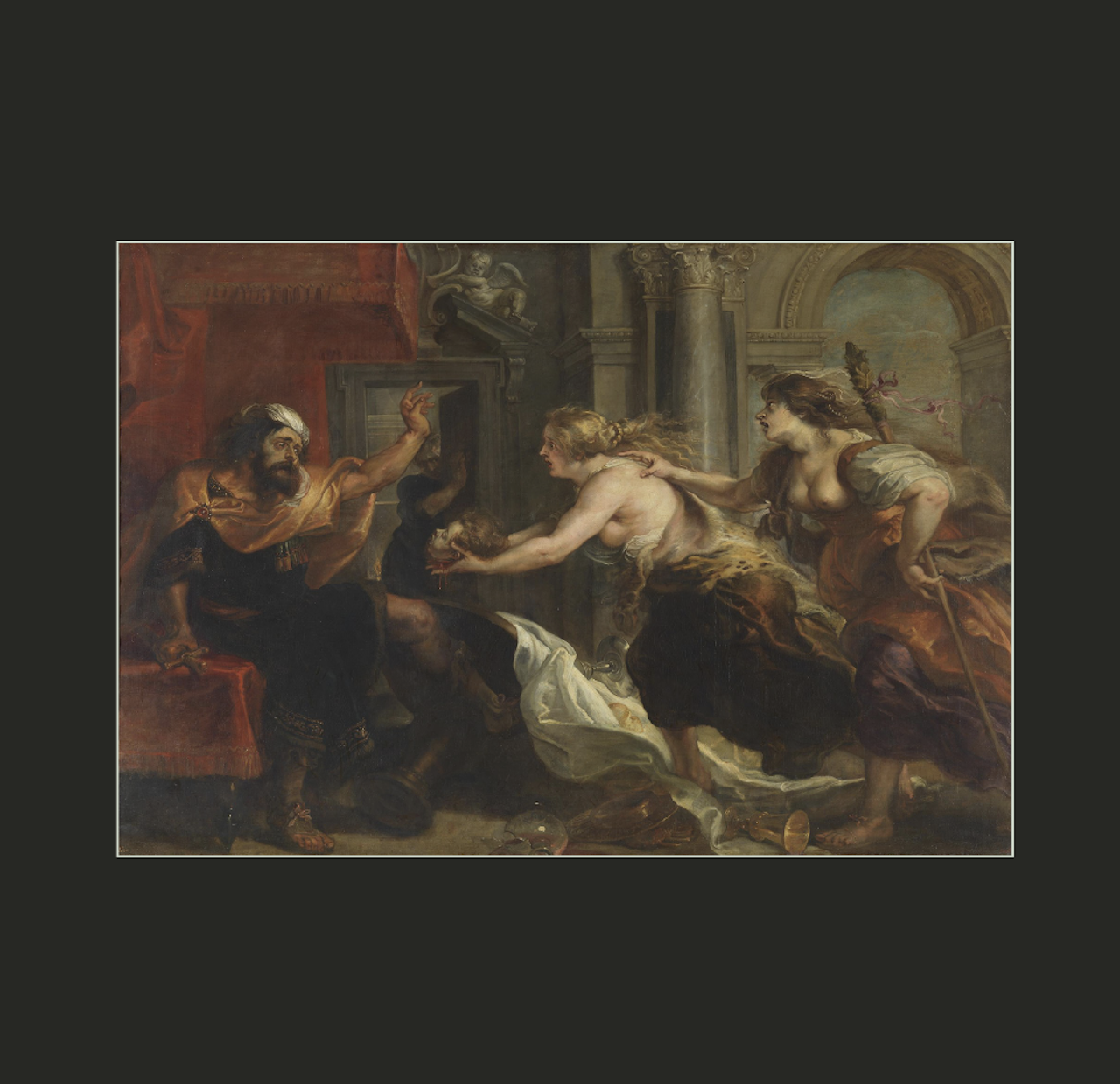
Image: Banquet of Tereus (1636–1638), by Peter Paul Rubens and his workshop.