
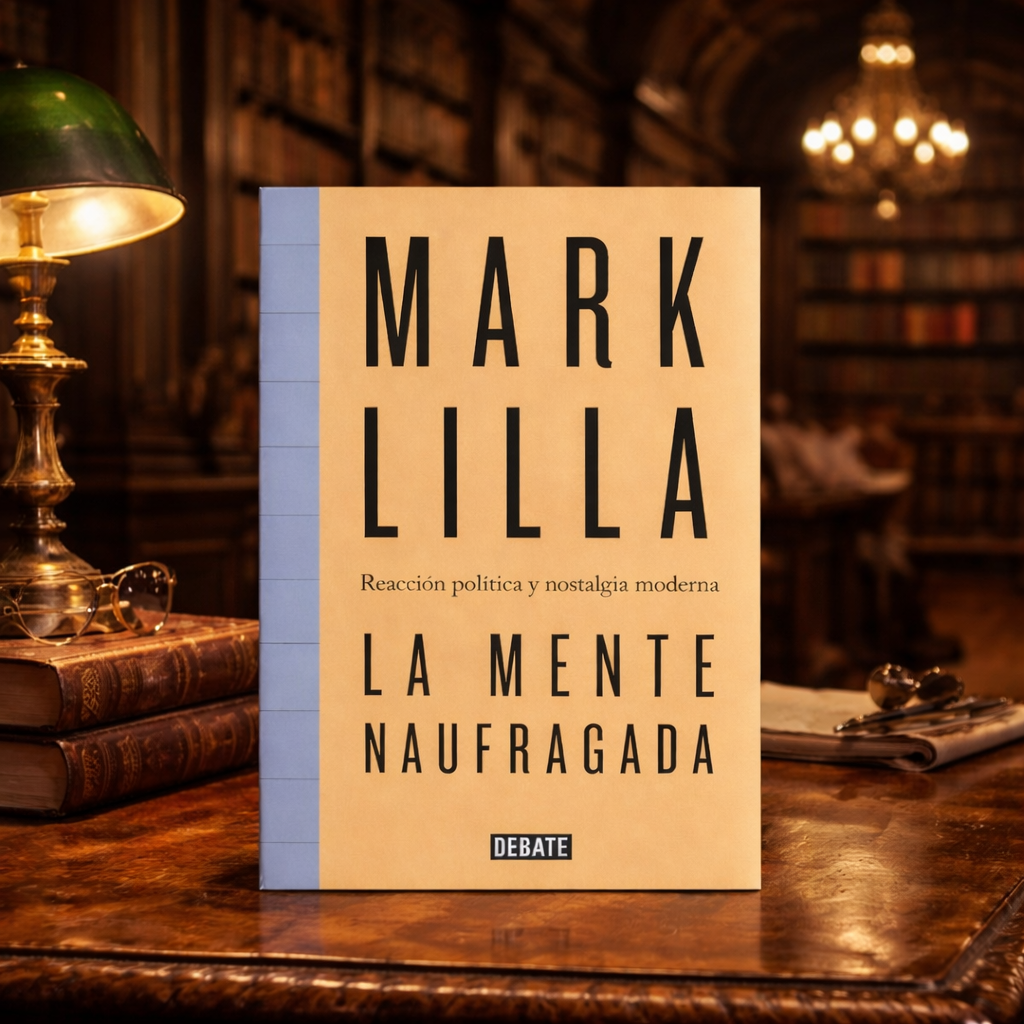
What does a Cuban intellectual read today, living abroad or surviving within a country in ruins? Do daily routines leave any room for reading and philosophical reflection? Why not? Did not Virgilio Piñera’s The Island in Weight reveal unusual Caribbean wonders back in 1944? What shipwrecks are we Cubans not already familiar with? Do we look back? Do we react under the idea that much of the past was better?
A reaction can be read in The Shipwrecked Mind—a public reaction and modern nostalgia—by the American social philosopher Mark Lilla. Or so it has seemed to me. Since its appearance ten years ago (The Shipwrecked Mind, 2016), the essay has sparked a fertile debate. Perhaps a debate not quite as intense as the one Lilla achieved in his provocative The Reckless Mind, with its sharp chapters dedicated to Martin Heidegger, Hannah Arendt, Karl Jaspers, Carl Schmitt, Walter Benjamin, Alexandre Kojève, Michel Foucault, and Jacques Derrida. There, he manages to characterize the “lure of Syracuse”—the propensity of many intellectuals, like Plato, to draw close to the fascinations of totalitarian philosophical currents, such as Marxism, and the absolute power wielded by dictators. A theme, by the way, very close to Cuba; take, for a single example, the relationship between Fidel Castro and Gabriel García Márquez.
The Shipwrecked Mind maintains the same engaging prose and exegetical sagacity, analogous to that of brilliant historians like Robert Darnton; a similar talent for making us meditate. Let us meditate here on the essential question: Am I a reactionary? Must we Cubans necessarily be a little reactionary?
After rereading the book, I will attempt to answer—without fear, of course, of being labeled a “reactionary” (the Hegelian Right). Especially if the label comes from Marxists (the Hegelian Left) whose progressive seal has remained in the Jurassic Parks of the philosophy of modernity, with their laws of a peculiar dialectic clinging to a reality that has shattered them axiom by axiom, chair by chair, country by country, until cornering them in the closets of philosophical archaeology. Also, naturally, without fear of disqualification for praising some of the critical rescues of the past coming from “revolutionary” charlatans, if not corrupt ones, sunken in a candid political naivety or a frankly laughable blindness—like that Latin Americanist “anti-imperialism” of political elites, such as the one currently in power in Mexico.
From the outset—and from my sympathy for liberal thought—I will try to give an idea of the powerful study by the Detroit-born thinker, for decades a professor at Columbia University. In the final two paragraphs, I will individualize my response under the smile of a flexibility derived from phenomenology—my admiration for Edmund Husserl and studies without presuppositions—which mocks dogmas and closed-mindedness. Above all, it mocks caricatures. These are almost always plastered on by the lazy and the swindlers who presume to carry the truth in their pockets—in the left pocket, of course.
There is a consensus that The Shipwrecked Mind carries a suggestive thesis, even if it is not—like any other—entirely new. Lilla starts from the premise that “re-acting,” as an attitude of moving toward the past, is not simply a conservative stance, but a mental structure that allows one to imagine historical time as a fall from an idealized past—a past viewed as something lost that is better than the present. Karl Mannheim, Hirschman, Arendt, and Nietzsche, among others, outlined this idea previously. Lilla reviews it with admirable objectivity, without aspiring to establish a conceptual novelty or a theoretical innovation. However, his excellent way of summarizing the concepts around and within the reactionary as an intellectual tradition grants him, through his vigorous expository synthesis, a place similar to what Georg Lukács perhaps meant for European Marxists, especially those of the German language.
Shipwrecked or reactionary minds certainly seem timeless. Their uchronia—similar to other types of minds, such as revolutionary ones—makes them as everyday as wars. Following the brutal failures of totalitarian regimes like the Communists, Fascists, and Nazis, they are simply attractive forms of contemporary liberalism. In most countries where they have governed or currently govern, they show more practical efficiency than social democrats and other ideologies, which generally still depend on absolutizing the idea of progress—a mostly inoperative sophism.
Is it perhaps that “reaction”—in general—is only a nostalgic delirium? I don’t think so. The exaltations of ancient forms of government and laws serve not only as antidotes to avoid infinite and uncritical trust in the modern, but also, on an individual level, as an effective way to avoid “novolatry”—that cult of the new for being new, which also leads to the uncritical worship of youth, with all the predictable consequences when it inexorably begins to fade and disappear.
This also pertains to different types of reactionary thought, especially intellectual, philosophical, theological, artistic, and literary reaction… Which includes popular, economic, and ethnic reaction, and even current religious reactions alongside fierce nationalist ones. We observe or suffer these on a planet where it was once thought that history had ended, that progress was leaving behind wars, regionalisms, religious fundamentalisms, and trade borders.
With such optimism we once read Francis Fukuyama. Though today we remember that The End of History and the Last Man was published in 1992, no less than 34 years ago. This fuels my possible enrollment in the club of the shipwrecked, of the reactionaries. Lilla delves deep, without sugarcoating the political illusions of yesteryear… Although his insight does not cover—it exceeds the study’s objectives—zones of power like those analyzed in 1960 by Elias Canetti in his monumental Crowds and Power.
In this sense, Lilla anticipates the rise of populisms and nationalisms. His diagnosis, of course, does not cover adjacent or derived circles, such as why some totalitarian forms become hegemonic at unpredictable moments. Nor was it his purpose to study the influence of the media, the economy, and the internet on liberal reactions and their opposites. But he does manage to convince—and that seems enough to me—of the complexity of the problem. This conviction must begin by banishing the pejorative use of “reactionary.”
A reactionary thinker is an intellectual interlocutor as respectable as any other. This is one of the immediate consequences of reading The Shipwrecked Mind. Because reaction goes beyond a political program. It is a way of figuring the world which, indeed, has much of nostalgia and something of melancholy… A nostalgia that could be called resentment, like so many in my close, inevitable reference: the history of Cuba.
The reactionary mentality, from any point of view, is central within the politics of right now, devoid of the easy caricatures that Lilla teaches us to discard. It is true that it is tinged with catastrophism—hence the “shipwreck”—but such a trait can be taken as a necessary hyperbole. One does not have to fully share that idealization of the past to agree that we are immersed in a world full of hostilities of all kinds, even apocalyptic ones. His mentions of Franz Rosenzweig or Eric Voegelin; the idea that there was a better “before” (not just biblical); secularized theology or the supposed foundational myth that the present has betrayed—all build a study that contributes to the characterizations of messianisms and caudillos. Lilla achieves, through a prose without supposedly erudite syntactic twists, a density that makes one nod: reactionary ideas are not relics; they are not only in museums.
The book’s power of persuasion rests on a reality where progressives have lost ground, such as in the complex issue of migratory exoduses or respect for minorities. His eloquence invites us to think without the old schemes of the reactionary right or the hypocritical left, both well-known and sufficiently discredited. Not a few Cuban intellectuals in 2026 fall into the collapse of confidence in positive changes; they look at the sad Cuban reality through catastrophic lenses, often from the self-flagellation that has bitten us exiles at one time or another.
Lilla suggests returning to a “civic liberalism,” to common projects… Such a proposition—mutatis mutandis—could be valid for the Cuba we imagine, without pained victimhood, so abundant (perhaps with reason) among the sector that sees no antagonistic contradictions between progressivism and what is salvageable from the past or “reactionarism.” At least as a necessary pluralistic crisis after so many decades of oppression. With that oft-repeated slogan of respect for the other that intellectuals like Jorge Mañach uselessly wanted to prevail in Cuban society.
Even if those characters who resort to personal attacks when their arguments collapse are inevitable anywhere in the world. Even if philosophy programs and texts suffer attempts at pressure and repression—state, federal, religious, educational—sometimes successful against academic freedom. Even if Cuba is still under the boot of Castro-communism in 2026… I would very much like for philosophy professors and Cuban intellectuals, especially those surviving within those ruins, to be able to exchange views on liberalism, the conservative, and the reactionary in current thought. Essays like those of Mark Lilla would serve as the start of a civic liberalism that would improve the quality of thought, of life.
Ten years after its appearance, The Shipwrecked Mind coexists with dangerous global shipwrecks, where the danger that only cockroaches survive is greater than during the Cold War. But its central motive in favor of a liberal political project, its emphasis on prioritizing education and ethics, has not lost its illusions, which are also valid for Cuba. My liberal ideas—from instruments learned in Phenomenology—harbor portions of reactionary thought. I am glad to have something of the reactionary in me. Why not? I look backward, forward, and to the sides, like the shipwrecked. Lilla teaches us.


