
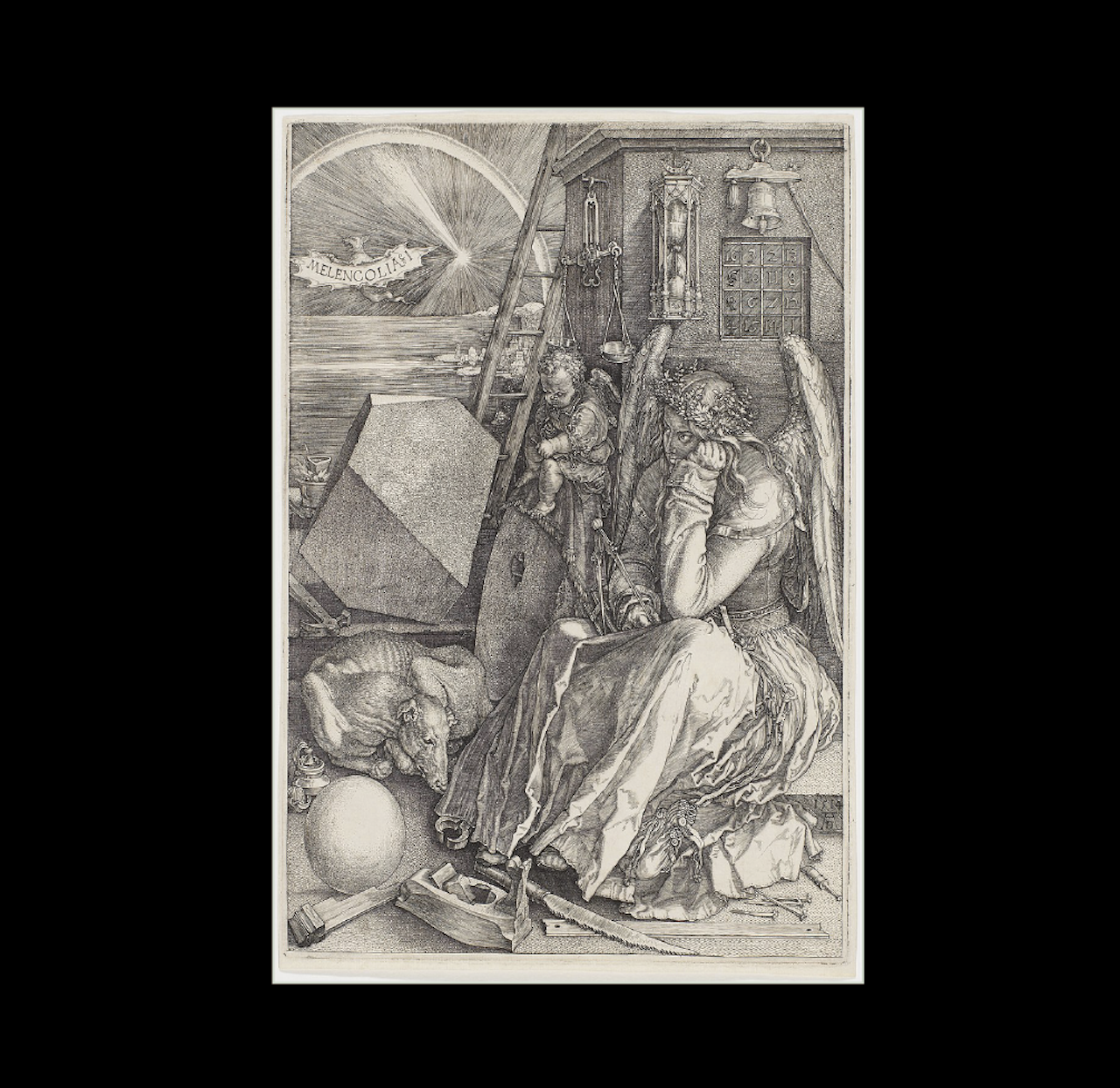
It is a winter afternoon. Rain falls over Avenida 18 de Julio in Montevideo. With this rain, the city becomes opaque; not in the sense that it disappears, but in that it ceases to offer itself to the gaze of those who pass through it. Everything is in its place, as always: buildings, cars, people hurrying so as not to get wet, neon lights beginning to glow, yet nothing seems to hold together entirely. I walk along Montevideo’s main avenue, where my life has not yet drawn a route, where I still do not sense any smell of the past. No one here is concerned with my presence, and I understand that. I am a ghost who does not belong to this city, who slips through it without disturbing it. Despite the haze, on days like this reality, rather than dissolving, weighs.
And it is in that weight upon the city that an old image by Gérard de Nerval appears, one that has obsessed me for years: “the black sun of melancholy.” It is not a decorative metaphor, nor does it belong to the novel or exceptional in Romanticism. There are moments when light still exists, but, having fallen into the abyss, no longer guides. Thus we see it spilling indifferently over the just and the unjust. The center does not disappear; it suffers beneath rubble and no longer organizes anything. Nerval knew this when he wrote: “I am the dark one, the widower, the inconsolable…” This is not a Romantic poet’s pose. It is an existential condition of one who has been left without a center, without a bond that orders the world. Robert Burton knew it too, for whom melancholy is a misalignment more than sadness. Perhaps: a tension between the finite and the infinite.
That black sun is not the night. It is something more unsettling: a cold clarity that neither warms nor illuminates. And this is what Nerval grasped with cruel precision. That is why there was never in him a will to beautify the fall, but rather the direct experience of a world that has lost its axis without losing its form. Everything continued, but without foundation. Everything continues, but without even an awareness of the path toward the dark hollow of the future. I believe that this is melancholy in its strictest sense: not simple sadness, but the misalignment between the presence of things and their capacity to signify for us.
Many years later, in another register and in another language, Chris Cornell sings “Black Hole Sun.” Time has passed, and so has history with its angel of devastation. It is no longer a matter of a sun that darkens, but of a sun that absorbs. The image is subtle, it changes sign like spilled blood: from the inversion of light in Nerval, to its total collapse in Cornell. It is no longer that the “solar black hole” leaves things without meaning; now, with the suction of a cosmological black hole, it drags them toward a point where meaning itself ceases to operate, to send signals we can decipher. The hole no longer attempts to correct the world or redeem it. Much less the word of a poet. What is desired is total erasure.
I believe that this is where Romantic aesthetics fails spectacularly. It seeks destiny in the wearing down of life. But what appears is drier: there are moments when the world—or the way we inhabit it—ceases to hold. Then the tensions that are unseen but have always been there emerge, waiting for their moment. Sometimes in a Paris alley without a saving Aurelia. Sometimes in the solitude of a hotel room after a concert, after speaking on the phone with the woman who accompanies us in life.
Yet to remain in that reading—the simple nihilistic and aesthetic gesture—may be attractive, but it would be insufficient. In Chris Cornell’s image there is a harsher dimension, perhaps, but one less complacent with dissolution. The black sun as a hole is not merely a call to any destruction; it is also the limit of what can—of what we can—be sustained without destroying ourselves. When Cornell repeats that call: “won’t you come,” that is, when he sings: “black hole sun, won’t you come and wash away the rain,” he does not necessarily invoke death as a Romantic escape, but the arrival of something that puts an end to a form of the world that no longer holds. It is an extreme gesture, bordering on disaster, yes, but not necessarily evasive. It is, if we wish to see it that way, the recognition that one must learn to bring an end to what destroys us.
This is a point where intuition intersects with something more ancient. Origen of Alexandria conceived apokatastasis as a final restoration of all things. But that restoration is neither continuity nor linear progress. It does not occur because the world functions well. It occurs because cycles have closed, the world has been exhausted, and everything seems to move toward a meaningless destruction. In Origen’s thought, in his dualism of Gnostic lineage, there is an uncomfortable idea: what has fallen—Creation—does not recombine through accumulation, but through its passage through ruin. Reintegration into unity does not avoid prior dissolution; it presupposes it.
Here is where the alchemical image of that black sun, in both Gérard de Nerval and Chris Cornell—that blackened sun of the nigredo phase—acquires its full weight. Not as esoteric or occult ornament, but as a vital structure of human experience. That is to say: before any recomposition or return to unity, there is decomposition. Before clarity, opacity. The diamond, José Martí said, before being light, is coal. It is a matter of recognizing this phase within the opus—and within existence—not of celebrating or aestheticizing it. That has perhaps been the error of dark Romanticism: turning collapse into identity, the wound into style. But what appears in Nerval, as in another way in Cornell, is a constatation, not a celebration. From that error, the line toward the subject of twentieth-century totalitarianisms began to move underground, unceasingly. It was a fine line, but it never broke.
Returning to 18 de Julio, under the cold rain, that constatation becomes concrete. There are no elevated symbols; there is basic experience. There are days—this is one of them—when reality loses its capacity to sustain us without ceasing to be present. And it is precisely at that point where the temptation becomes double. On the one hand, to romanticize darkness, to make of it an aesthetic refuge. On the other, to deny it, to force a light that exists only in our imagination. Neither option seems faithful to what truly occurs.
I like to think that the only honest position, perhaps, is another: to remain. Not in a passive sense, but in that of enduring without translating into words what still has no form. Nerval’s “black sun” does not ask to be interpreted, nor to be associated with any abstruse theory. Cornell’s “black hole sun” offers no exit; it signals a limit. Origen’s apokatastasis guarantees nothing in the immediate; it merely suggests that even the ruin we inhabit as life may be inscribed within a destiny of broader meaning, one we do not control.
We write this, seated in a room, at six in the morning, in a lost city of Uruguay. We write it, read it, reread it and correct it, while listening to Chris Cornell sing… Of course, writing it solves nothing. Saying it, even less; but at least, I want to believe, it orders the gaze. It allows us not to confuse the intoxication of an intense moment with truth, nor darkness with depth. And most importantly: not to look away when reality becomes opaque, traversed by a cold, fine rain beneath which we walk.
I continue along 18 de Julio toward the hospital: I must keep my daughter company in an illness turned into a family destiny; and this, without transmuting that moment into a symbol of existential exceptionality. To accept that there are moments when light does not illuminate—does not illuminate us—and that, even so, nothing remains but to hold oneself there, at that exact point and moment when everything continues to exist—and, though indifferent to us, demands from us another form of attention.
At some point in my life I read, or perhaps formed, a phrase that accompanies me, where Rimbaud and the Spanish mystics converge: to live fastened to the burning nail of reality. This is perhaps the closest thing to that nail that wounds our hands yet we cannot let go: not an answer, but a way of not withdrawing.
Image: Melencolia I (1514), by Albrecht Dürer.


