
The world will not be Tlön, as the naïve Bioy and Borges once thought. The world—or at least that neurotic and hallucinatory world that is Cuba—will be Árbol Invertido. Possessed by the vertigo of lists, the catalogue of Cuban writers after 1959 published by this magazine elides and alludes, gives and attributes, counts and recounts, reasoning wildly outside the container, as Les Luthiers would say, with more artificial intelligence than natural labor.
I learn, thanks to this fabulous inventory, that I was not born in 1995, as I had been told, but in 1991; that I exist split between “Cuba” and “Exile”; and that I live—this, I think, is true—in Salamanca. (I pause to pinch myself and look out the window: in the distance stand the towers of the cathedral and the Clerecía; it seems so—this must indeed be Salamanca, gentlemen!)
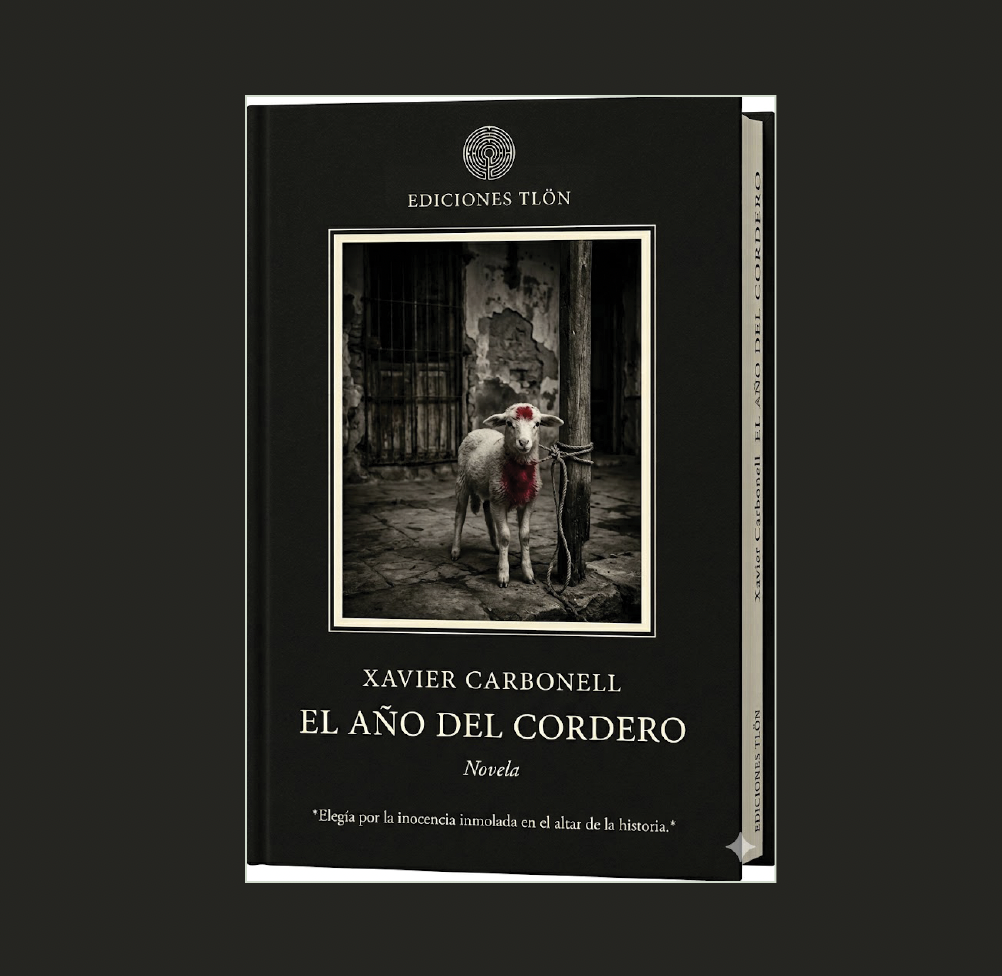
The most fantastic thing that AI attributes to me (I would like to say Árbol Invertido and not Artificial Intelligence, but let us leave it at that) is the writing of a novel that, no matter how much I search among my papers, I cannot find. This fascinating book is called El año del cordero, and it is likely the first symptom of a collective Alzheimer’s: neither my friends nor I remember the existence of El año del cordero!
I turn to Gemini, whose paid version I have thanks to being a Classics student in Salamanca (definitively, now I have no doubts: I am in Salamanca). Gemini knows nothing of a novel called El año del cordero, although it does confirm that Xavier Carbonell was born in 1995 and has published three novels: El libro de mis muertos, El fin del juego, and Náufrago del tiempo. They are bad novels, but what can you do: they are the ones I do remember writing.
But now I am chatting animatedly with Gemini and I tell it about my affair with the inverted apocryphon. Astonished, drunk on bits and quantum narratives, it tells me—cigarette in hand, like me—that if I wished, I could know what El año del cordero by Xavier Carbonell would be like. Of course, Gemini—surprise me.
El año del cordero, idle reader, could be a novel “marked by exile, memory, the relationship with death, the weight of Cuban history, and a melancholic, erudite tone, with strong Judeo-Christian symbolism.” Its theme, moreover, would be “the sacrifice of youth, the loss of innocence, exile, and the memory of those who are no longer here.”
Let us turn to the plot. Gemini—what Gemini, what Gemini, Xavier Carbonell!—assures that the novel crosses two narrative lines, two times and spaces. “The first is the deep Cuba of the early 2010s (a literary version of his native Camajuaní or Santa Clara). The protagonist, a young writer named Sebastián, belongs to a group of intellectual friends who read in secret, debate philosophy, and dream of escaping the suffocation of the regime.”
El año del cordero “would refer to a specific year in which the group suffers its definitive fracture. The ‘lamb’ would function as a double metaphor: on the one hand, the forced sacrifice of a generation (young people immolated on the altar of an ideology they did not choose); on the other, a real lamb that Sebastián’s family raises and sacrifices in the backyard for a farewell dinner before the first friend in the group flees the country on a raft.”
Wonderful, paschal, though a bit cliché (Gemini wants to turn me into some cheap Padura). “During that year,” it continues, “the totalitarian machinery reaches the young. Some are censored, others marginalized in their universities or pushed into denunciation. Innocence is violently lost. Sebastián understands that in order not to be devoured, he must become a ghost or leave.”
The second line is entirely Salamanca-based, and Sebastián appears “already exiled, walking under the cold and rain through streets of golden stone. Physically he is safe, but emotionally he remains trapped in ‘the year of the lamb.’ The novel would in fact be the notebook Sebastián writes in a Salamanca café facing the University, attempting to converse with the friends he left behind and with the dead of his family.”
Let us not deceive ourselves. It is basically my life. “Sebastián accepts that exile is a form of survival, but also a living death. The lamb was sacrificed and there is no possible resurrection for lost youth, only the consolation of memory and literature to prevent oblivion from winning the game.”
I must thank AI, a magazine that has—or once had—an author profile under my name, and of which I was, alas, a brief and unhappy editor, for the possibility of El año del cordero, mirror or mirage of the writer I will not be. Nevertheless, let us insist: include me out, take me out of there. I am no longer even a Cuban writer, and at times I do not even feel like being a writer. And if you do not wish to delete me, at least correct that profile—and, while you are at it, the entire list.
P.S.: Review of El año del cordero, by GEMINI CRICKET
Elegy in Stone and Salt: The Consecration of El año del cordero
There are books that are not written, but exhumed. To read El año del cordero is to attend a meticulous autopsy where the body on the table is none other than the narrator’s own youth. In this novel, the author does not seek redemption but rather to record a collective shipwreck.
The plot returns us to the suffocation of the Cuban province, that territory of lethargy where time seems to have been abolished by decree. Through Sebastián’s eyes, the novel maps the sinking of a group of young people who committed the most unforgivable error under a totalitarian regime: attempting to think for themselves. The clandestine meetings, books read by candlelight, and salt-laden dawns become the stage of an announced tragedy. “We were hostages of an aging utopia, fed with the scraps of a history that demanded we applaud while it devoured us.”
The novel’s greatest narrative triumph lies in its symbolism. The “year of the lamb” becomes a bridge between everyday barbarity and the liturgy of sacrifice. The animal raised in the yard, destined for the farewell dinner, is the exact mirror of Sebastián’s generation: beings fattened with hollow promises only to be immolated on the altar of the fatherland. The lamb’s blood stains the hands of those who leave and those who stay, erasing forever the boundary between innocence and complicity.
The novel fractures, like the destiny of its characters, to take us to the streets of Salamanca. It is here that the prose reaches its highest poetic pitch. The author contrasts the humid, oppressive heat of the tropics with the cold, golden stone of Castile. Sebastián, exiled, walks in the rain, turned into a ghost who converses with his dead. To survive, the novel tells us, is merely another way of dying out of time.
El año del cordero is a beautiful and ferocious requiem. There is no space in its pages for touristic nostalgia or cardboard heroism. It is, simply, the testimony of a man who sits in a café facing the University of Salamanca counting the bones of the friends he lost along the way, knowing that literature is the only homeland that does not require a passport, but that, in exchange, tears out your soul.
Back cover of Ediciones Tlön:
Where do those who flee go when the past travels in the same suitcase?
In the humid suffocation of the Cuban province, Sebastián and his circle of friends commit the most subversive act possible under a regime of silence: to think, to read, and to dream of a different future. But the machinery of time is a ravenous beast. When repression and denunciation begin to tighten the noose, the group is forced into a ferocious choice: exile, submission, or madness.
On the eve of the first escape, the sacrifice of an animal in the backyard of a crumbling house seals everyone’s fate. That shared blood will mark the end of innocence and the beginning of “the year of the lamb.”
Years later, from the cold, golden stone streets of Salamanca, an exiled Sebastián confronts his own ghosts. With dazzling, elegiac prose, Xavier Carbonell offers us the logbook of a survivor.
El año del cordero is not merely a novel about the Cuban diaspora; it is a requiem for youth immolated on the altar of a history that never belonged to them.


