
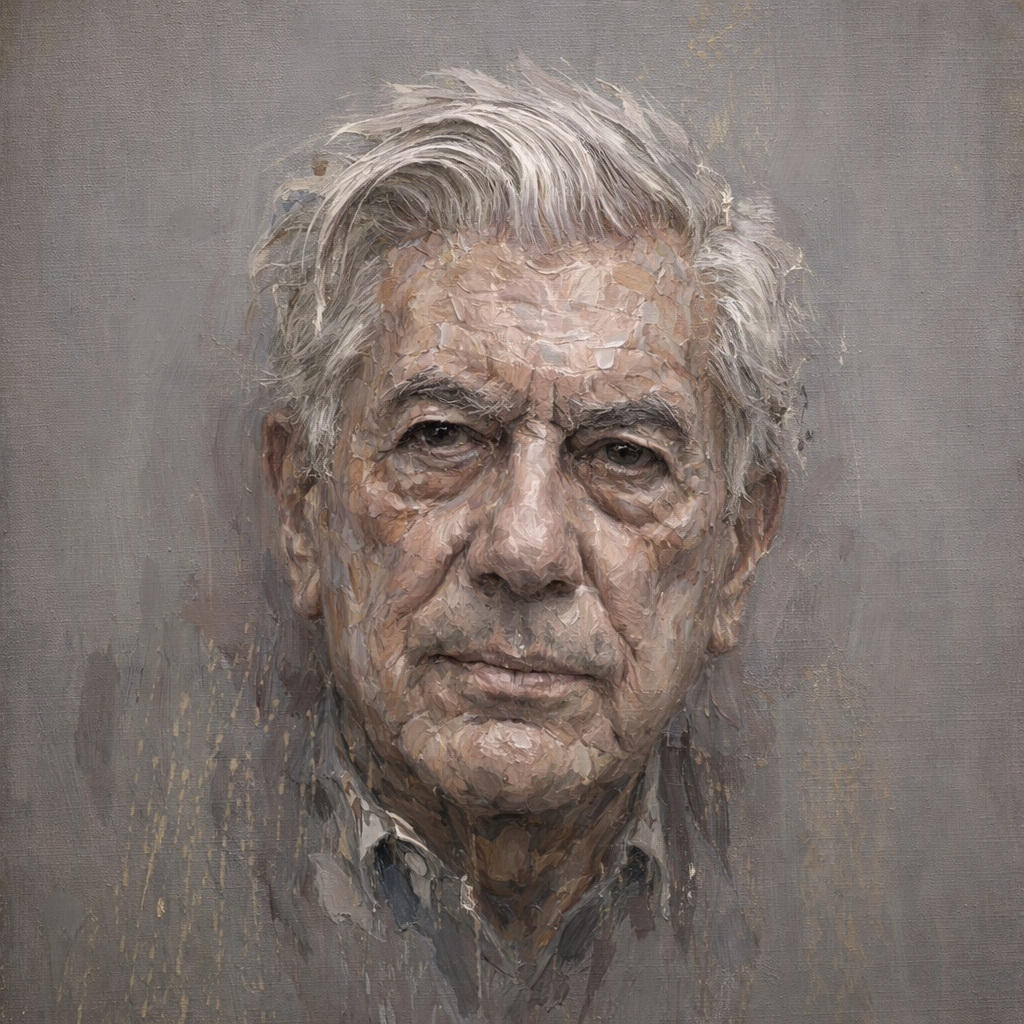
Citario. Derived from the Latin citāre (to quote) plus the suffix -ārium (repository), similar to bestiario. A 21st-century neologism coined by Spanish-speaking scholars at Bookish & Co., with roots in ancient anthologies and florilegia. «Citario» is related to medieval books of commonplaces (such as those by Erasmus of Rotterdam) and 19th-century proto-examples, such as Familiar Quotations. This «Citario Vargas Llosa» celebrates the 90th anniversary of his birth through an archive of others’ perspectives that trace his figure within the literary tradition.
Of the three figures who could be called (in terms dear to Carlos Fuentes) the “leading lights” of the Latin American literary boom—the other two being Julio Cortázar and Gabriel García Márquez—it is indisputably Mario Vargas Llosa who has maintained a more consistent body of high-quality literary work, despite its sheer volume. We never find in him such stark highs and lows as in Cortázar’s Rayuela and We Love Glenda So Much, or in García Márquez’s One Hundred Years of Solitude and Chronicle of a Death Foretold.
Vargas Llosa also represents for Latin America the difficult risk, the difficult courage of an intellectual committed solely to freedom, both in its artistic and political manifestations. Faced with seemingly opportunistic solutions cloaked in violence, naivety, or demagoguery, Vargas Llosa, rather than seeking a solution through partisan fanaticism that only breeds more violence and fanaticism, embraces the wise audacity of doubt and the proven advantages of democracy with all its numerous imperfections. For, as he himself has said: “It is not a matter of killing the patient to cure the disease.” Faced with the deceptive or self-serving attitudes of a García Márquez, who, while proclaiming the Cuban dictatorship as the best model for Latin America, prefers that his children study at Harvard or in Paris, Vargas Llosa aspires to a higher—and therefore more civilized—development within the dramatic Latin American landscape.
Faced with the cyclical horror of a history governed by intolerance, ambition, and terror (other facets of The Story of Mayta), Vargas Llosa seems to aspire to a Latin America where man is neither a monk, nor an alienated escapist, nor—for the exercise of freedom, which is the first condition for the exercise of freedom—a political militant, but rather an authentic human being, necessary to eliminate social inequalities, and the only one in whom every human being can channel their ghosts toward a creative dimension.
Reinaldo Arenas
◾️
To the internal Dominican scandal and the external debate on literature, writing, and politics sparked by the publication of The Feast of the Goat, a disturbing report from the EFE news agency, also dated in Santo Domingo, was added in early May, just days after the novel’s presentation at the Dominican Jaragua Hotel. “Dominican writer Lipe Collado,” began the EFE dispatch, “yesterday accused Peruvian Mario Vargas Llosa of intellectual theft from one of his novels to document The Feast of the Goat. Lipe Collado points to striking similarities between Vargas Llosa’s work and his novel After the Wind, winner of the Quinto Centenario Literature Prize.”
The article added that the Dominican Lipe Collado highlighted the striking similarity between the protagonists of both novels: in his, Después del viento, a man who returns to the country after a long absence and having broken with his past; in La Fiesta del Chivo, a woman, Urania Cabral, who also returns to the same country under circumstances similar to those of the protagonist of his novel, Después del viento. Collado warned, in the same press release, that MVLL “solved his problem by using my work as a tool for his own, to the point of turning it into intellectual plunder.” “I could hardly have been influenced by a work I haven’t read,” MVLL replied to Lipe Collado’s accusations, settling an incident that was already adding insult to injury, because by then some historians whose books the novelist had drawn upon for his fictional work had threatened to take him to court on charges of plagiarizing their works. Nothing new under the sun. After all, this murky territory of plagiarism was already familiar to MVLL when The War at the End of the World was published, just as many novelists and writers of universally recognized renown had suffered it—a storm in a teacup—before and after. As a final note, it is always appropriate in these cases, with the best intellectual intentions and setting aside hypothetical legal and judicial ramifications, to recommend to interested parties and scholars that they read and directly compare the texts in question, so that each person may draw, having firsthand knowledge of the possible and surprising coincidences, the appropriate conclusions in each case.
J.J. Armas Marcelo
◾️
In 2011 I visited Vargas Llosa in Lima, where he was performing, as both author and actor, a version of The Thousand and One Nights alongside Peruvian actress Vanessa Saba, directed by Luis Llosa, his brother-in-law at the time. He displayed boundless energy, which stood in stark contrast to García Márquez’s final years. Carmen Balcells, like those mothers who praise a child’s virtues and, without realizing the mistake they’re making, follow up their praise by listing her brother’s not-so-positive traits, often fell into making comparisons. Much has been written about a phrase from the literary agent: “Vargas Llosa is top of the class, and García Márquez is a genius.” She held to it until the end:
You just have to look at them. Anyone who knows them knows what I mean. Mario is an intellectual, someone with a very well-furnished mind, who possesses erudite knowledge on multiple subjects and, at the same time, is capable of creating great works. His intellectual discourse is of the highest caliber; he is top of the class, a summa cum laude. In contrast, Gabo is a genius in the sense that he is a creative force of nature, someone touched by the hand of God, who has a gift, and does not devote himself to developing theories or analyses of culture. It seems to me that this describes them without valuing one over the other. I am in love with both of them.
Xavi Ayén
◾️
I first read The City and the Dogs in 1979. At the time I was seventeen, roughly the same age as the Jaguar, the Poet, the Slave, and their other classmates at Leoncio Prado. The novel shook me to the core; I had never read a book like that before: a book that seemed to have been written with a hammer, where the corruptions and perplexities of adolescence—which I was still experiencing (and which, I only realize now, are not very different from those of adulthood). I said earlier that the ultimate purpose of Vargas Llosa’s novels is to construct with words a hermetic world, parallel to the real one but as potent as the real one, a world where the reader is kept locked away behind closed doors to make him live a vicarious experience that is nonetheless as intense—or even more so—than the most intense experiences of his own life; I would now add that, despite being little more than a spell or enchantment or deception—or rather: precisely because it is—that verbal experience must allow the reader to access a truth superior to the truth of facts, a truth no longer historical or factual but moral and universal, which enriches us by revolutionizing us from within and changing the way we see things. That is what The City and the Dogs did to me; that is what it does to the reader: it unsettles them, throws them off balance, casts doubt on their certainties, forces them to look at reality in a different way, forces them to feel things that make them uncomfortable and to ask themselves troubling questions with no answers, and ultimately forces them to live the adventure of the Jaguar and the Poet and the Slave and the other characters in the novel as their own adventure.
Javier Cercas
◾️
The Dream of the Celt—a seemingly good novel by Vargas Llosa—poses literary problems for me: isn’t it a fictionalized report, like, for example, the one Antonio Espina wrote nearly a century ago about Luis Candelas? I believe this type of literature (with all due respect, I include Cercas’s account of 23-F in this category) implicitly acknowledges the obsolescence of the novel. I miss something that I can only define as “literary” or “novelistic.” But what is that? A form of rhetoric? Inventiveness? Imagination? I know what I mean, but I don’t know how to say it (note: if you don’t know how, it means you don’t know what it is). The novels of Galdós, Tolstoy, and Balzac exude history; they are conscious of being themselves the fruits of history, while aspiring to tell it in their own particular way, yet they are something else: novels. This is not the case with Vargas’s so-called novel. The story of Roger Casement in Africa, in the Amazon, in Ireland, as presented to us in the book, doesn’t quite have that specific quality of the novel: it is a biography written by a historian with a certain literary sensibility and a good writing style. Nothing is shied away from, none of the burdens of composition and rhythm (what is that?) that the character’s biography demands of it within the historical code.
When I write like this, I wonder if what I’m actually asking for is a stale display of those tricks traditionally considered “novelistic.” But I don’t think so; when I say “the literary,” I mean that ability to arrange words so they become overloaded with meaning—so that words intensify their function. But doesn’t Vargas’s book denounce? Doesn’t it move us? Isn’t that intensity? So, what am I referring to? Doesn’t Martorell also break the rhythm when he takes Tirant from England to Sicily and Malta, from Constantinople to North Africa? And no one can deny that Tirant is quite more than the biography of a fantastical character. At this point in our journey, it seems we have reached the conclusion that a novel is anything that claims to be one.
Rafael Chirbes
◾️
Perhaps this somewhat impassioned tone bothers you. All right, I’ll tone it down and speak to you professionally, without forgetting the criticisms that come to mind—we’ll discuss them again when we meet. But since I’m also professionally interested in the novel, there’s something I have to tell you right off the bat and without the slightest hesitation: on a technical level, La casa verde is wonderful. I don’t know if anyone has ever used the technique you employ—flashbacks incorporated into the present-day action; I can’t recall any examples, and I think you invented it. When I first noticed it (Fushía and Aquilino are talking in the boat; Aquilino wants to know how Fushía escaped from prison, and right then a dialogue follows between Fushía and his fellow escapees, only to return immediately to the present-day dialogue, and then back again), I felt an almost dizzying sensation. I realized that you were achieving a télescopage of time and space, that you were sparing the reader a host of intermediate ideas and situations, that you were touching on the narrative’s essence—that selection of what is truly significant and necessary—which, in their own way, every great novelist achieves. To that first technical success, which continues to strike me as increasingly extraordinary, many other similar ones are added; the irritating, sometimes exasperating ambiguity of the temporal planes, which demands vigilant attention from the reader; the episodes that coexist in a single moment of the narrative because there is an analogical relationship between them and it is natural to bring them together (it is natural, but it had to be done, and it is difficult, as in the parallel account of Toñita’s death and Bonifacia’s abortion). It’s curious, but as I was nearing the end of the book, before the epilogue, I had a sensation I’ve rarely experienced while reading novels; that of a highly complex musical structure, in the sense that a symphonic poem involves themes interwoven in a way that the ear, which perceives them consecutively, can nevertheless grasp thanks to the distribution, the timbres, the developments, and the leitmotifs, something like a simultaneous structure, an enormous piece of petrified music in which everything that flowed is organized into an immense tapestry suspended before the eyes—or the ear, if you will—as a total and simultaneous experience.
I can’t explain it any better, but I think that as you wove together the themes, subthemes, and infinite recurrences and resonances of the novel, you entered—whether you knew it or not—a musical dimension. Don’t take this as an influence, of course (I don’t think you’re much of a music lover), but rather as a “structural” analogy. I, being an incurable music lover, can find no other way to tell you to what extent the plot of your book strikes me as a kind of enhancement, a projection toward that plane of sonic architecture, without which no human work (visual, literary, or poetic) can transcend its limitations. In any case, from the point of view of narrative structure, your book is one of the most complex and thought-provoking I have read in many years.
Julio Cortázar
◾️
Reading La guerra del fin del mundo helped me more or less organize a series of scattered ideas about what I intended to say at this meeting, under the theme “New Models of the Latin American Novel.” I must warn you that I am nothing more than a novelist who is still trying to master his craft, increasingly less infatuated with what I write, and more amazed by what others do. In other words, I am not, nor have I ever been, a literary scholar, an essayist, or a critic. And, even though there can be no writer who takes himself seriously who does not feel a great passion and respect for the literature that precedes and surrounds him, and who does not need to draw sustenance from both, I frequently betray that love, that obligation, by devoting myself to the search for materials outside of literature and which, with greater or lesser success, I sometimes use literally and sometimes figuratively.
(…)
I have heard it said that The War at the End of the World is a traditional novel. I do not know what they mean by this. With the Latin American naturalist novel long dead, and the rigid division between the so-called rural and urban novels also overcome, The War at the End of the World is, I believe, of a new model nourished, yes, by the work of the great writers of our continent who have dealt with historical issues, from Martín Luis Guzmán to Uslar Pietri, from Roa Bastos to Asturias, from Carpentier to Carlos Fuentes.
“One cannot help but be modern,” said Borges. Mario Vargas Llosa has shown us this.
Fernando del Paso
◾️
Mario Vargas Llosa provokes among his contemporaries a sense of unease that strikes me as similar to the one Thomas Mann provoked among his own. In the Peruvian novelist, everything is a yearning for perfection and a craft honed with admirable patience.
His impeccable appearance, the ease with which he allows journalists to follow him to Tahiti while he prepares Paradise on the Other Corner, and his political views—always sensible even when displaying radical courage—make Vargas Llosa an exemplary figure. This uniqueness makes him one of the last bourgeois writers, in the noble sense that places him alongside Victor Hugo, Flaubert, and Dickens.
Paradise on the Other Side is a novel written and conceived within the nineteenth-century tradition, recounting the parallel lives of Flora Tristán (1803–1844) and her grandson Paul Gauguin (1848–1903). As is customary with Vargas Llosa, both stories flow naturally and meticulously, turning the reader into a grateful spectator. Flora Tristán’s journey, less well-known than that of her famous grandson, unfolds into a rich panorama of a Europe of socialist utopias. Flora Tristán rebelled against her own marriage, an atrocity that led her to condemn the entire institution; she turned her private life into the fuel for the peaceful struggle for the rights of the oppressed, ultimately becoming an admirable precursor of both feminism and modern socialism. I was moved by the way Vargas Llosa brought Flora Tristán to life, portrayed as a Balzacian thirty-year-old woman who, far from bowing to the prudish world of rentiers and suitors, sets out to conquer the city in a direction opposite to that of the greedy opportunists in The Lost Illusions. To awaken the class consciousness of women and workers, Flora Tristán journeys, full of candor and strength, among the Saint-Simonians and Cabetians, the Fourierists and left-wing Hegelians, traversing that court of miracles with a missionary zeal that embraces a vulnerability not without humor. And in describing the slums where, in London or the south of France, the victims of the Industrial Revolution lived, Vargas Llosa, filled with immense compassion, achieves what he set out to do: to emulate Dickens or Victor Hugo. And since Vargas Llosa is a politician, these pages can be read as part of his liberal preaching: at its root, the insulting misery of millions of men and women remains the unsolved riddle of all freedoms.
Christopher Domínguez Michael
◾️
Four days after the Nobel announcement, Mario had scheduled a lecture, in Spanish, to be titled “A Brief Discourse on Culture.”
The day before the lecture, Mary, the head of the Nobel Prizes office, called me to strongly recommend that we move the event to Richardson Hall, the university’s concert hall, a venue with a capacity for five hundred people.
“But it will be a lecture in Spanish,” I told her. “Besides, it’s on a very specific topic. We have a room for a hundred people, and I don’t think we’ll fill it.
“How many Spanish speakers could there be at Princeton?” I asked her.
“You don’t know what a Nobel Prize is,” Mary told me. “People want to see it, they want to get close, they want to touch it.”
We listened to Mary and reserved Richardson Auditorium.
On the day of the lecture, we found a crowd packed in front of the entrance. There were five hundred people inside and at least as many who had been left out.
In his talk—which was later included in The Civilization of Spectacle—Mario criticized Michel Foucault and his concept of freedom, drawing a link between the French philosopher’s ideas and the anarchy currently plaguing public schools in France. It was an argument that could be read as a frontal attack on American academia, where Foucault’s work remained, after so many years, a key reference for students and professors. The discussion with the audience—I thought—would be intense.
But everyone in the room listened to Mario’s words with smiles that never left their faces. When it was time to open the floor to questions from the audience, a long line formed.
“I’m from Iquitos,” said a man, leaning close to the microphone, “and although I’ve been in this country for twenty years, I want to tell you that this Nobel Prize is an honor for all Peruvians; it’s an award that raises our country’s profile.”
“I’m from Lima and I work in construction,” shouted the second person in line when his turn came, moving the microphone aside, “but in my spare time, well, I write poetry. And I’d like to show you some of my poems, Don Mario.”
“I cried,” said a woman, “I cried, Mario, when I saw the Nobel on TV. I cried because it’s a source of pride for all Peruvians; it’s the most beautiful thing that could happen to us.”
When Mario finished signing, a security guard—a blond, uniformed young man, very tall and very handsome, who didn’t look to be more than twenty—escorted us off the stage. There were too many people outside, he told us, and it would be better to use the musicians’ exit, which led to the back of the building. From there we could walk to the street, where a car would be waiting to take us to the restaurant where we had agreed to meet the novelist Joyce Carol Oates.
We followed the guard, and when we exited through the back door, we heard, in the distance, the voices of the crowd gathered in front of the main entrance. Out of nowhere, a voice shouted, “There he is!” and in a second, the human tide reached us and completely surrounded us. There were hundreds, thousands of Peruvians crowding the campus while the blond security guard, armed with a walkie-talkie, tried to clear a path for us.
Where had all those Peruvians who threatened to crush us come from? Mario told me that in Paterson, a town in New Jersey, lived one of the largest communities outside the country, numbering nearly one hundred thousand.
Well, it seems those hundred thousand have come en masse to Princeton, I thought.
Rubén Gallo
◾️
The other poet whose writing lies as a very deep substratum in The City and the Dogs is Baudelaire. It is striking that he has not been mentioned, but the coincidences are surprising—so much so that they do not seem coincidental.
The young Vargas Llosa, we can infer, did not read only Rimbaud, but was also well acquainted with Baudelaire’s poetry. The French poet also operates within binary rhythms: the contrast between the permitted and the forbidden, between light and shadow. What interests him is transgression, and, on the other hand, he has a strong attraction to the ideal. But he stops at that imaginary line; he is more skilled, and knows the world of prohibition better than paradise itself: lesbian women, drunken ragpickers, consummate murderers. Aspiration to the divine and description of life in hell. With crystal-clear precision, he said he sought the unknown—heaven or hell, what does it matter—at the bottom of the unknown, to seek the new. The new, in Spanish-language literature in 1962, was La ciudad y los perros. The book was an ascetic endeavor, a true descent into hell to find freedom. The miracle of the well-written word is that, though it is made of time, it remains of pristine beauty for today’s youth. Vargas Llosa, who, at the time of writing his first novel, believed in the tenets of Sartre’s theory of engaged literature, obviously did not adhere to those dictates when he wrote it. The image of Balzac lingers in our minds—a fervent believer in the monarchy and an absolute republican in his writing.
Marco Martos
◾️
It is hardly surprising that The City and the Dogs has been attributed a rather long list of antecedents, influences, and similarities found in many literatures; its characteristic bildungsroman theme, the borrowing and invention of diverse modern techniques, and its classic dilemma between the individual and society are aspects that, in one way or another, link this work to the general concerns of the contemporary novel. Without attempting to debate or expand upon the extensive list invoked by critics, we merely wish to highlight some of the direct and genuine influences (sometimes acknowledged by the author himself) that shape the novel, as confirmation of certain observations made earlier in this regard. These stem from three fundamental sources: the thought of Sartre, with his ideas of “situated freedom” and commitment; the contemporary American novel (Faulkner and the fiction of the Deep South, in particular), which reveals to him the tragic side that everyday reality can possess; and the European novel of “existential action” by Malraux and others, which shows him the desperate beauty of the individual human adventure and the visionary ways of expressing it. Perhaps the best thing that can be said about The City and the Dogs is that it proves worthy of this enormous universal legacy.
José Miguel Oviedo
◾️
In Conversation in the Cathedral, dialogue is the basic instrument of the narrative; but it is not the successive and chronologically ordered dialogue found in the novels of Ivy Compton Burnett, or her French disciple, Nathalie Sarraute.
In Vargas Llosa, the dialogue between two men (master and servant) in the bar called “La Catedral” is, in reality, a diachronic collage of dialogues. The author not only transcribes the actual, real dialogue of these two characters, but through association, analogy, and reminiscence, he creates a simultaneous montage with other dialogues, other people, and other places. Without abandoning the dramatic present of the dialogue in “La Catedral,” Vargas Llosa simultaneously traverses all the time periods of his story and completes (in two massive volumes) a spoken portrait of Peru during the time of the dictator Odría. Here the level of experimentation with language is more limited than in Cortázar or Fuentes, but the experimental intent is no less bold and explicit.
Emir Rodríguez Monegal
◾️
Washington 23
Later that afternoon, Mario Vargas Llosa appeared at the Wilson Center, where he will be staying for the year to write his novel about the Canudos episode that inspired Da Cunha’s novel, Os Sertões. Annoyed at having to speak in English—using correct English but visibly translating from Spanish—he recounted the episode and then explained the reasons he perceived for his attraction to the subject, having previously acknowledged the darkness of these forces.
Most evident is his fascination with fanatical attitudes that attract him to the same extent that they organically repel him, and which he did not fail to link to a behavior still prevalent among Latin Americans, with explicit reference to today’s intellectuals, where one can perceive the impact on him of harassment by leftist groups since his departure from pro-Castro positions. Beyond his responses and his independence, it is evident that this harassment has “demonized” him, that is, fixated him on that situation.
But he was also drawn, in the story of Canudos, to the total incomprehension between the parties speaking two languages that could not communicate: some fighting against an anti-republican political conspiracy and others seeking the kingdom of God on earth.
However, the most visible attraction, according to his story, lies in the singular characters: when he speaks of them, the intensity of his writing rises; the curiosity and fascination that these original beings evoke in him dominate his entire interest. It is the knowledge of distinct and original beings—where various striking traits converge—that fuels his passion as a writer.
He is ceasing to be the “young heartthrob” he once was, and on his face, in his subdued intensity, the wild energy that drives him has become more visible—a brutal violence, like that of a Balzacian character, barely concealed by good manners.
Washington 24
Yesterday Mario [Vargas Llosa] and Patricia were at home: there is no way he can let himself go, relax, into casual conversation. He is always on guard, composed, attentive, and on the prowl. He has not yet discovered how to be happy, nor how to accept the world by accepting himself. All those uncertain things he writes about the writer and the world within him are concrete reality, an experience of rupture, the vision of the animal on the prowl.
Ángel Rama
◾️
July 4 [1971]
Mario Vargas Llosa over for lunch at home, with Patricia and their two children.
One of the many sporadic encounters in recent years, ever since, let’s say, he jumped on the celebrity bandwagon. Difficult communication, despite the presence of Alfredo Bryce. In MVLL there is an affability, a cold cordiality, that immediately establishes (it has always been this way; I realize this more and more) a distance between him and his interlocutors. I also noticed this time a tendency to impose his voice, to listen less than before, and to easily interrupt the flow of a conversation that could have gone far. Perhaps this sort of indifference or Olympian ability to float—to be present and at the same time not to be—is a privilege of talent. All of this naturally makes him an impenetrable person. I have the impression that when one achieves a certain degree of fame, one lives more for the articles, the mediated relationships of the news item, the correspondence, the crowded discussions at a literary conference, the interview, etc., than for direct person-to-person relationships. Between the famous man and the world there stretches a world of paper, a bookish, literary curtain of comments, quotes, glosses, and exegesis that ultimately contain and isolate the man from reality, placing him on a sort of Olympus from which it is difficult to bring him down to the level of ordinary humanity. All of this, of course, is coupled with great poise, a confidence that renders even his most casual observations apodictic. MVLL gives the impression of never doubting his opinions. Everything he says is self-evident to him. He possesses—or believes he possesses—the truth. Nevertheless, conversing with him is almost always a pleasure because of the passion and emphasis he brings to it and his tendency toward hyperbole, which makes his discourse entertaining and convincing.
Julio Ramón Ribeyro


