
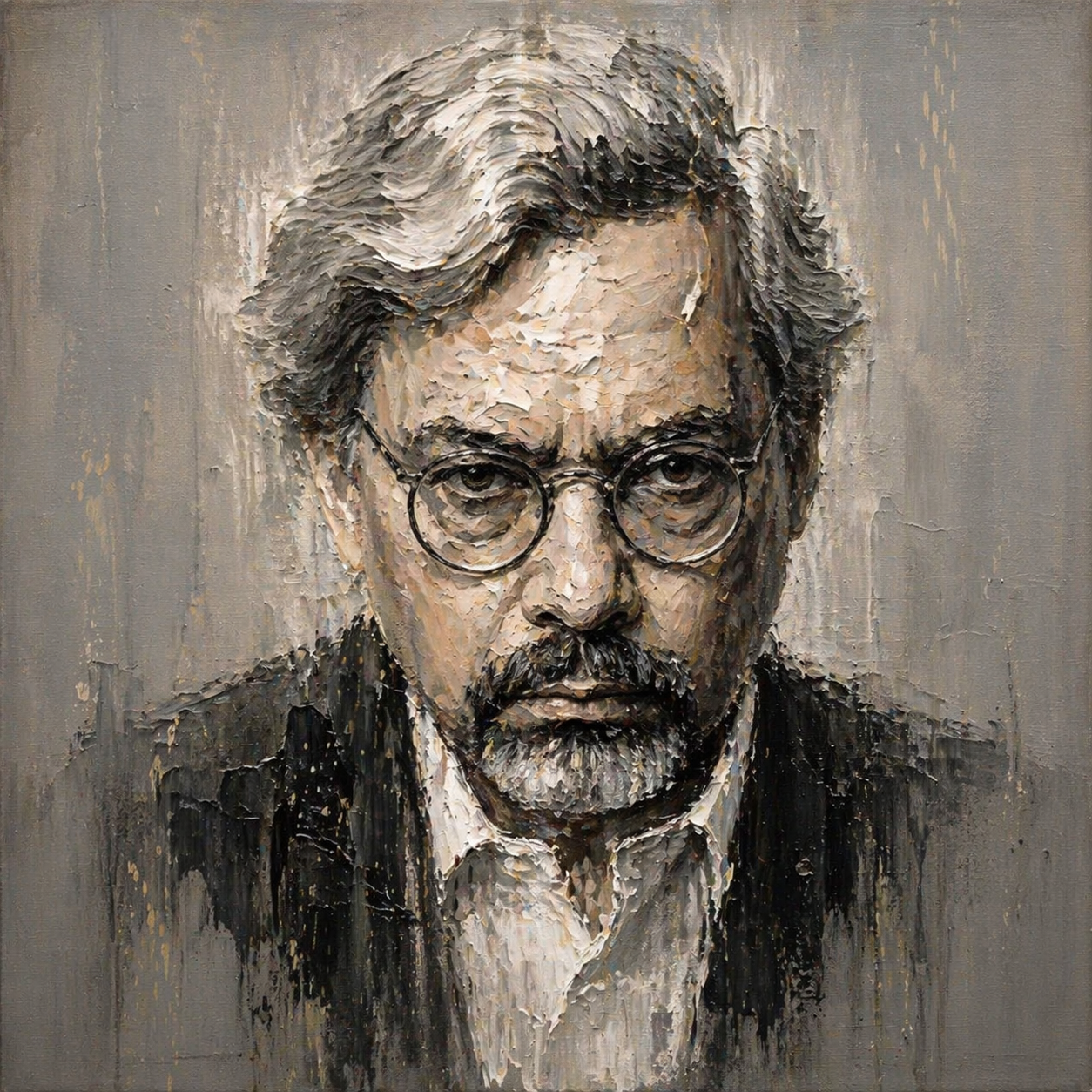
Citario. Derived from the Latin citāre (to quote) plus the suffix -ārium (repository), similar to bestiary. A 21st-century neologism coined by Spanish-speaking scholars at Bookish & Co., with roots in ancient anthologies and florilegia. “Citario” refers to medieval books of commonplaces (such as those by Erasmus of Rotterdam) and 19th-century proto-examples, such as Familiar Quotations. This “Citario Cabrera Infante” celebrates the 97th anniversary of his birth through an archive of quotations about his persona, prose, and verbal legend: a repertoire of readings that place him at the crossroads between wit and digression, between a remembered Havana and a reinvented language.
The award-winning and censored novel was finally published in Spain in 1967, heavily revised and under the title Tres tristes tigres; now freed from his obligations to his country’s government, the author eliminated the lengthy political commentary, leaving only the narrative substance, crafted in a language rich in colloquialisms, alliterations, and puns. The author has explained the emotional genesis of this novel, which the first version betrayed: to pay homage to (and bear witness to) ways of life—Havana’s nightlife—doomed to extinction by socialist morality.
His second novel, published much later, also pays tribute to this quasi-ethnological mission of preservation. La Habana para un infante difunto (1979), a drawn-out autobiography of youthful years—or rather, loves—was received with reservations by critics, but it eventually came to be appreciated for all its worth, which is considerable. His prose is languid, explanatory, peppered with parentheses and asides, distracted by occasional alliterations that make it even more languid. The exclusion of interests other than the erotic (“erotic, that is to say, memorable,” says the author) contributes to the fascination—no less intense for being diluted—that the book can produce. It could be considered the definitive epitome of exile literature. Devoid of plot, progression, or structure, its sole purpose is to remember, and to give objective form to memories.
(…)
After La Habana… twenty years passed without the author publishing any new books. Like Léautaud, Cabrera Infante seems to be one of those writers who need lived experience as a stimulus for writing, and exile closed off the possibility of that experience, at least in terms of its value for literary transmutation.
César Aira
◾️
Cabrera Infante is already a classic of that transcendent literature that draws from popular sources. Three Sad Tigers is a verbal and formal revolution. A novel crafted not only with all the possibilities of the Spanish language, Cuban speech, Havana slang, and the voices of the night, but also with the new possibilities and new languages that the author invents.
A work to be reconstructed and read aloud, always taking into account (like someone driving an Alfa Romeo) its various shifts in speed and (like someone singing in an opera) its multiple registers. Cabrera Infante embraces that culture rooted in intuition, spontaneity, and song—in suggestive, corrosive, and precise words. That is why the characters in this novel transcend the very pages of the book, radiating such vitality and irreverence that one fears they might at any moment step out to confront us and correct even what I have just said—which, naturally, would be best for all of us—. Here, the profound is expressed playfully, precisely so it does not become an academic diatribe and be taken too seriously. Popular music, wordplay, characters from the cinema and the then-prominent Havana entertainment scene, close friends and enemies are all transcended here, fixed in the indestructible universe of invention.
Cabrera Infante takes on the voices and longings of an entire people. What was perhaps a fleeting urban costumbrismo, more or less alluring spectres of the early morning, has become a poem. The insular-popular (that way of walking, of speaking, of offering oneself) is here an ethereal rhythm, a floating song, a nostalgia that finds no place to rest in the face of the memory of a city (Havana) that is already fading against its sea.
In Havana for a Deceased Infant and in Three Sad Tigers, sex is a fundamental part of a game, a quest, a wager we make with ourselves. We take to the streets to try our luck in love (that is to say, erotically). And in the end, our Don Juan emerges triumphant, for although he does not return on the arm of Doña Inés, he does carry a novel under his arm; an exact and magnified reconstruction of the city and the faces (and bodies) traversed… Like a true discoverer and conqueror, Cabrera Infante, just like Columbus, just like Hernando de Soto or Bartolomé de las Casas, is left with only words (the great treasure). They construct and reconstruct what may never have existed and, perhaps, because it is impossible, it becomes clearer.
Reinaldo Arenas
◾️
The Balcells agency had also represented Guillermo Cabrera Infante (1929–2005) from 1965 until well into the 1970s, when, according to his widow, Miriam Gómez, “Guillermo, wanting to distance himself, left Balcells against my will. There were too many people from the boom there. They were all Castro supporters. He believed they weren’t doing anything for him; I told him not to do it, but he left.” In the agency’s records, he appears as a client again starting in 1985 and, at various intervals, through 2007. The first book listed is the unpublished *Vista del amanecer en el trópico* and is dated 1965.
I have a casual memory of Miriam Gómez, one night, as she was making spaghetti in the legendary London home where she lived with her husband, at 53 Gloucester Road. I visited the place again one afternoon when we had tea, and what comes to mind are high ceilings and, above all, a prodigious wooden bookshelf that stretches across all the walls, covering them organically with stacks of books. In this woman’s extroversion, there are still echoes of the actress she once was, and in her speech—which interweaves side-splitting anecdotes with maternal superstitions and learned fears—Guillermo Cabrera Infante is always present, like an invigorating ghost. Because if there is anyone who arouses the animosity of supporters of the Cuban Revolution, it is, of course, him. A short, sparkling genius upon whom every epithet has been hurled, from “rat abandoning the ship” to “intellectual worm,” although the latter allowed him to ingeniously rename himself “a worm turned into a butterfly.”
(…)
Guillermo Cabrera Infante died on February 21, 2005, at Charing Cross Hospital in London, where he had been transferred from Chelsea and Westminster, where he had previously been admitted for a hip fracture. To comfort him on his deathbed, Miriam Gómez told him that he had been admitted to a hospital in Hollywood and that the other patients were movie stars. According to his widow and the writer’s second daughter, Carola Ash, the cause of death was a staph infection contracted at the first hospital. With this short Cuban man, with round glasses, a neatly trimmed goatee, and a furrowed brow, the most anti-Castro figure in that group of writers passed away. His ashes rest in London, awaiting the day they can return to a free Cuba.
Xavi Ayén
◾️
I just finished reading Three Sad Tigers. A curious book, full of magnificent things, but a total failure as a novelistic structure, as a book. Wit is sometimes talent’s worst enemy, and in this case, Cabrera Infante could not resist the almost infernal wit that inhabits him. Now that I think about it, I find myself falling into the same trap I criticize many critics of Rayuela for—stubbornly preferring the essentially dramatic and novelistic chapters while setting aside the rest; in Tres tristes tigres, the novelistic chapters (all those titled “She Sang Boleros”) strike me as the best part of the book. What if I’m wrong? Why do to Cabrera’s book what I don’t like done to mine? In any case, the novel has wonderful material, and people like you and me (“cultural cosmopolitans,” as you know, defectors from the earthly) take great pleasure in the intricate system of allusions, wordplay, quotations, and boomerangs across various languages and mental planes.
Let me know what you think.
Julio Cortázar
◾️
But Cabrera Infante wasn’t just the heritage of exiles nostalgic for a Havana lost in time and distance. We need only recall that reader of Cabrera Infante we were on the island. With our friends, we roamed the half-ruined Havana of ’94 with the other Havana, that of the late Infante, in hand, trying to reconcile those crumbling walls of our reality with the luminous decadence emanating from the places the book named. We felt what we imagine that child in Dalí’s painting felt as he lifted the skin of the sea: an intimate and total dazzlement. We were learning to understand all the splendor he had enclosed within those premature ruins.
Cabrera Infante did not fulfill that role for all Cubans. For the authorities, Cabrera Infante in exile was “The Man Who Fucked Around Too Much,” the Anti-Castro, the fire and the (word)play that never ceases. The official silence surrounding his death is logical and predictable, a silence that, deep down, sounds like rejoicing at the end of his most relentless and prestigious opponent. On an unofficial level, the rejoicing is disguised as posthumous generosity. Thus, even Lisandro Otero, former cultural mandarin of the Castro regime and today a sort of independent Fidelist, decided this time to rein in his old grudge against the now-deceased Infante. If, while he was alive, he went so far as to say that Cabrera Infante had not “managed to understand that his verbose and dehumanized verbiage is not true literature,” now Otero condescends to declare that with Infante’s passing, Cuba has lost “one of its most ingenious, imaginative, and talented writers.” It is well known that death improves people once we are rid of their presence. What we didn’t know was that it would have such dramatic effects on literature—something that, after all, doesn’t go to the grave with its author. Perhaps Lisandro changed his mind in the hope that something similar might happen with his books. And we wonder, how many times will Lisandro Otero have to die before he is considered one of our most talented writers? Just thinking about doing the math makes one dizzy.
Enrique del Risco
◾️
Doesn’t this contrast between the genders appear, after all, dramatized in Three Sad Tigers? In this novel, the women—even if they say things like “etá bien mi amiga”—always have something ideal about them, though also something fatal, and even something of the prostitute, while the men—Arsenio Cué and Silvestre, above all—appear, like Horacio Oliveira, immersed in a perpetual quest; the wordplay to which they devote themselves with such relish fails to conceal their metaphysical anguish,
while their vulgar or incorrect speech denotes their lack of depth—precisely what makes them naive, as flighty as La Maga. They are whores, very much so, but in a certain sense they are virgins; they are everything that man—alienated from that ellipse of water whose poles are Eve and Mary—cannot become. The car ride in “Bachata” is, in a way, the straight line that never converges. And Vivian Smith Corona, the only one of the nymphs who comes from the upper bourgeoisie—is she not an illustrious descendant of the kleptomaniac? The princess with the strawberry mouth no longer devotes herself to theft but to warming up men’s underwear in the Focsa pool.
Significantly [sic], it is only after she has disappeared that this world of boleros and 1950s starlets enters the realm of great literature with that monumental requiem that is Tres tristes tigres. Cabrera Infante does not cultivate pop culture for a merely avant-garde or playful purpose, in the manner of the camp theorized by Susan Sontag, but rather as an act of reaffirming that culture erased by the regime: “P.M. by other means.” In TTT, the promiscuous world of Havana’s nightlife, where despite the neon lights the contours of things dissolve somewhat, makes possible the encounter between intellectuals and that mass culture which, in the figure of the Estrella, reaches its maximum authenticity, like the candle that shines brightest just before going out.
Duanel Díaz
◾️
With GCI, a type of literary hero dies—one not easily found in our time, whose lineage traces back to the romantic exiles (Madame de Staël persecuted by Napoleon I, Victor Hugo in Guernsey) and continues in so many of the victims of 20th-century totalitarianism, in those who made literature the sole form of resistance, the uncrossable line. It was Cabrera Infante, that great writer who, possessed by the genius of language, placed it at the service of the cause of freedom and, in doing so, far from degrading his literature into propaganda, what he achieves is to penetrate, corrode, and tear down the language of tyranny. It is as if Ramón Gómez de la Serna (who did not do so) had turned his aphorisms against Franco, as if a boisterous angel had visited Orwell as he described totalitarian language and had given him what was needed to undermine the wooden language before it took over the world. Free Cubans (those who have been able to read GCI) have been very fortunate to have in him an instrument of language capable of locating, pointing out, and highlighting, in the tyrant’s discourse and in the protocols of his idolaters,
those lines and paragraphs where his destruction beats. St. Bonaventure was granted the grace to continue writing his memoirs after his death, and Chateaubriand asked only to return from beyond the grave to proofread the manuscript. Given this background, I see no problem whatsoever with a pagan like GCI (he liked the way the initials of his name sounded) appearing at the hour of epitaphs to mark the tyrant’s grave.
Cubans, as islanders often are, possess a circularly obsessive intelligence, and one of those obsessions is José Martí, a figure who has ended up annoying me thanks to the zeal with which all his compatriots—Tyrian and Trojan alike—strive to elevate him to the status of a morning star. That is why I find it curious (and paradoxical) to speculate on the possibility that GCI might be the writer who ultimately takes Martí’s place in the prophetic imagination of the free Cuba that is bound to come: from one modernism to another. An uncompromising and incorruptible man, GCI will not only be remembered as a moral conscience, but as something more: an avant-gardist who, emerging from the very heart of the twentieth century (from its cinema, its music), distilled and stored a literary brew as intoxicating and restorative as that of Joyce, as that of Nabokov. That concoction, despite the bitterness of the exile that nourished it, will make the journey through the new century happier, and whoever drinks it will share in the dynamic reverie, the adventure of language that brought happiness to this earth for Guillermo Cabrera Infante.
Christopher Domínguez Michael
◾️
In what language should one write the novel of absence? None of us has become a Nabokov or a Beckett. To illustrate this crucial point about language, I want to speak briefly about Havana for a Deceased Infant, Guillermo Cabrera Infante’s most recent novel. This novel of absence lacks the literary glory of One Hundred Years of Solitude or Rayuela, or even that of Three Sad Tigers, Cabrera’s previous work. In those works, the vernacular of each country—remembered and recreated abroad—undergoes the mystical transmutation of becoming the metaphor itself. In these novels, the vernacular simply is; it neither can nor needs to be explained to serve as the subject of the metaphor: its semantic field either resonates with the reader or it does not. *Havana for a Deceased Infant* is a long, monotonous narrative about the young author’s love affairs with a seemingly endless string of Cuban women whose identities he barely sketches. The spontaneous Cuban vernacular of Tres tristes tigres has been left behind; it belongs to the past. Language is a form of action, and if the writer does not want to lose his ability to control it, he must exercise it continuously. Cabrera no longer seems to fit into this sense. The vernacular is no longer the main focus; it is not the novel itself. Nevertheless, he obsessively reconstructs an autobiographical Havana suspended in the past, full of small details. A temporal void settles between the period of the narrative and the late 1970s, when he writes the novel. That temporal void is equivalent to the spatial void separating Havana from London, from where he writes. He can no longer return to his Ithaca because an irate, bearded Poseidon has banished him from his island. And a strange silence fills this spatiotemporal void. It is the sad silence of the loss of the vernacular, the absence of the genuine Cuban Spanish that made Tres tristes tigres what it is. The Cuban Spanish of a social class and an era was the very marrow and nerve of this novel, the code in which it was written. Something different happens in *La Habana para un infante difunto*: it is written in plain, colorless Spanish, though it does contain some of Cabrera’s characteristic puns. When he includes the vernacular, he does so in the dialogues, or even more interestingly, viewed from the outside: Cabrera has to justify it, explain it. This fact defines the territory of the author’s absence. For example, Cabrera explains in detail what the Cuban expression amor trompero means: “Amor trompero, as many as I see, as many as I want. I haven’t heard it in a long time, but I haven’t forgotten what it means.” *La Habana para un infante difunto* is the anecdote but not the metaphor of “amor trompero,” since in the absence of the vernacular, everything must be explained from the outside. The writer’s homeland is not really a place but a language. Not even a language, but rather a section, the fraction of that language with which one identifies. The journey back to Ithaca is an attempt to recover the vernacular when the silence of the years and space become impotence, an attempt to reconnect, even while living abroad.
José Donoso
◾️
If Caín wanted to shorten a long story, he would simply say: “I’ll give you a synopsis.” When referring to an event that took place at the exact same time and place, he would identify it this way: “This sequence…” One October 12th, he was talking to me about movies; someone arrived and said, “On a day like today, Columbus discovered America.” Cain interrupted the intruder violently: “Don’t come introducing that flashback into the conversation!” On one occasion, I visited his home. Upon arriving, I caught him framing my figure with his hands, making a square with his index fingers and thumbs. I continued on my way, and Cain stopped me with an exclamation: “Don’t move! You’re going to step out of the frame.” Cain was born in 1953, when, upon his release from prison, Cabrera Infante was forbidden from using his name to sign articles: so he combined the first syllable of his first and second surnames, in a new play on words, to sign with a pseudonym.
The cursed son of some Adam, he establishes his connection to the biblical figure: “The first Cain was characterized by his jaw; our Cain, by the absence of it. The first Cain committed an irredeemable evil against the human race: he invented crime. The second Cain did almost irreparable harm to the viewer: he believed he had invented cinema.” And to those who have described him as a cynic, he has responded cynically: “It must be because I go to the movies a lot.” The truth is that for the Cuban, the 20th century cannot be understood without the seventh art, and in his specific case, his training in that field has helped shape a unique vision of the world, of culture, and even of how to understand and write literature. Because—he asserts—“cinema is the great storyteller of our century; cinema is even a better storyteller than the novel.”
Much time has passed since those furtive visits to the Havana newsstand near the Hotel Plaza, where, still a teenager, he avidly read *Time Magazine*, and where he once found a review of the film *Hamlet*, written by a great critic, which made him realize that the critical article was much freer than what he was used to reading: the commentary on the film was an open door to discuss any topic (literary, current affairs, political, ethical), and with an almost infinite freedom of style. From then on, he began writing texts of that nature and thus took a step toward discovering his literary vocation. He tells me this, his memory brimming, sitting in the almost circular armchair of his London apartment, with one leg crossed over the other’s knee and accompanied by a huge cigar, while also telling me that he has made an exception for me—for which I am deeply grateful, since he rarely grants oral interviews, much less at his home: he prefers to answer them in writing and send them wherever necessary. But he also realizes that a young, unknown journalist must be treated well. He recalls that in the mid-1950s, when he was 24 and working for a little-known magazine, he went to interview Marlon Brando—without much hope—at a time when the press was constantly hounding him, and, against all odds, the famous actor granted him the interview. Cain becomes Abel like hard stone into soft melon.
Ángel Esteban
◾️
Guillermo Cabrera Infante: Censorship weighed on him for decades, and at a certain point, the Ministry of Culture began to signal a willingness to publish one of his books in Havana. He was visited in London by the couple Senel Paz and Rebeca Chávez, as well as by his old friend Antón Arrufat. Each of them carried an olive branch as a sign of peace. It was peace between the censored author and the Cuban publishing system that they were proposing to him. Through that agreement, his novel Three Sad Tigers would be published in Havana. It would be as if Havana were entering Havana. “Curiouser and curiouser,” Alice would have murmured. There is no book in Cabrera Infante’s work (and I would venture to say in all of Cuban literature) that owes as much to censorship as Three Sad Tigers. And not just to Castro’s censorship.
To begin with, it had a different title (which was used for a later book): Vista del amanecer en el trópico. And the events the book recounted were different, with the narrative centered on episodes of the struggle against the Batista dictatorship. It was with that content and that original title that it won the Biblioteca Breve Prize in Barcelona. It had to be submitted to Francoist censors, and the publisher Carlos Barral took care of that. It so happened that Cabrera Infante, a diplomat in Belgium, traveled to Havana for his mother’s funeral, and it was the last time he visited the city. He was astonished by how much it had changed, transformed into a ghost capital. He compared the people of Havana to zombies. He recounts this in *Map Drawn by a Spy* (Círculo de Lectores, Barcelona, 2013): how he was prevented from returning to Belgium, how Havana became a trap from which he had to find a way out. Meanwhile, the censors in Madrid ruled that the novel would not be published. Added to this was their determination to remove anything that smacked of a tribute to revolutionary power. So the book changed, and not just to circumvent Francoist censorship. Because in Spain there was a power that blocked the path to what he had written, but in Cuba there was a power that toyed with individual freedom and zombified people. From that double onslaught of repression and censorship—in Madrid and Havana—Tres tristes tigresemerged. Caros Barral once again took charge of maneuvering around the censor, and it became necessary for the author to address a letter to those authorities. This time, Franco’s censorship was more lenient. With a few snips of the scissors, the novel became publishable. They cut out breasts in the name of Catholic morality, they cut out allusions to the military and to deicide, and, most crucially, they cut out a handful of final sentences. Decades later, when it was republished in its entirety without those cuts, the author kept the ending that had been achieved thanks to the censors.
Fermín Gabor
◾️
I read Three Sad Tigers. Rarely have I enjoyed myself as much as I did in the first part, but then it all fell apart for me; it became more clever than intelligent, and in the end I was left wondering what it was they were trying to tell me. Cabrera, with his superb talents as a writer, is, however, off-kilter.
Gabriel García Márquez
◾️
From different angles, Almendros and Cabrera Infante pursue parallel careers in film: Almendros soon gives up on his dream of becoming a filmmaker, of directing a fiction film himself, such as the project he says he is writing on the “spiritualist theme” (letter of August 14, 1969),
and manages to carve out a niche for himself as a cameraman and director of photography. Meanwhile, Cabrera Infante continues his literary career while writing screenplays for the cinema—scripts he doesn’t seem entirely convinced by, even though some of them have, over time, become cult films, such as the aforementioned Wonderwall (1968) by Joe Massot and Vanishing Point (1971) by Richard Sarafian. He put this work on hold after the tour de force that was Under the Volcano in 1972 and would not return to it until many years later, in 1990, when he wrote the screenplay for The Lost City [La ciudad perdida] for Andy García.
As in any friendship, this relationship has its ups and downs and moments of tension, caused, as is often the case, by misunderstandings amplified by distance, but, in general, a cordial relationship between the two emerges, despite some differences, particularly in temperament: Cabrera Infante comes across as more nervous and irascible, with reactions that are sometimes disproportionate, while Almendros seems to take things in stride. Exile does not affect them both in the same way. Their shared interests and affinities are, at times, the trigger for these differences between them, as is the case, for example, in the anecdote experienced by Almendros involving a cane, supposedly stolen, which Cabrera Infante would include in his aforementioned novel, Tres Tristes Tigres—in the chapter titled “The Visitors”—and which the Spanish cinematographer would also recount in images in a short film, first titled El bastón, then La distraction, and finally La confusión. As Almendros would insist, and as Caín well knew, what matters is not the subject but how it is treated, the manner of telling the story, so that Cabrera Infante’s text and Almendros’s film can be read as two variations on the same theme.
In any case, the cinematographer always shows great admiration for the writer, as he openly expresses in a letter dated May 1, 1967, after reading Three Sad Tigers:
I finished it: Bravo! Bravo! Bravo! I’m delighted. Finally, the work I always expected from you, in your image and likeness. I no longer have to defend you: now I’ll tell them, read it. It will be the book that puts everyone in their place. There are many people one admires, whom one knows are worthy, who have genius, even if there is no work to prove it; this was your case before Three Sad Tigers…
Dunia Gras Miravet
◾️
What Guillermo feared most was not the loss of his short-term memory—which was the danger posed by the electroshock therapy he received in the 1970s—but losing his identity and his past, as happened to him the day he went mad. I still remember with horror when he first told me about it. It happened in Barcelona, right after he got into a taxi to go to a meeting with his editor. When the driver asked him for the address, he realized he didn’t know who he was, where he was, where he was going, or what he was doing there. To make matters worse, he began to hear a very serious announcer on the taxi radio, with a deep voice, saying the following: “The writer Guillermo Cabrera Infante will write no more, the writer Guillermo Cabrera Infante will write no more…,” and it kept repeating. That was what he was truly terrified of.
Shortly before his death, I flew to London, accompanied by my daughter Mari-Claudia, specifically to see him. He was very quiet and impeccably dressed. He had lost a lot of weight, and that gave him an air of vulnerability he had never had before. Miriam served some appetizers and opened a bottle of Veuve Clicquot to try to cheer us up. My daughter—whom he was very fond of—told him anecdotes to amuse him, but it was obvious that everything tired him out and that he was making a great effort to try to maintain an air of normality. We talked, as usual, about movies, Cuba, the political situation in Spain, and how much Gloucester Road had changed since the last time he’d visited. It was late in the afternoon, and I mentioned that we had to leave because some friends of Mari-Claudia’s from school—who happened to be in London—were waiting for us for dinner. A moment later, he slowly rose from his chair and accompanied us to the door. As he walked, he staggered a little. As we said goodbye, we hugged. It was then that I realized how frail he was. “Good night,” I said, imitating Hitchcock’s British accent a little. He smiled. I never saw him again.
Elizabeth Mirabal and Carlos Velazco
◾️
If there was one thing that came easily to Cabrera Infante in his version of Dubliners, it was the punctuation of the dialogues, because James Joyce hated “perverted commas”—as he called quotation marks in his variation on English inverted commas—and wrote them as em dashes, as if they were already in Spanish. The Cuban did not translate the Irishman by luring him into the ambush of a national register. There is no jarring of traditional gestures in the result; on the contrary, it welcomes all readers. But the complicity of the language can be perceived on several pages.
When explaining his affinity for Joyce, in a 1979 conversation where he dismisses *A Portrait of the Artist as a Young Man* and *Finnegans Wake* in favor of *Ulysses* and the short stories, he says of *Dubliners*: “when I translated it, it was a double pleasure to read it that way and to reproduce it in Spanish, or in my version of Spanish.” This personal conception of language continues in another interview with his English translator,
where he recalls his youthful readings of translations “riddled not only with Americanisms, but with Argentinisms, Chileanisms, Mexicanisms”: renderings of American and French novels that retained opaque, resistant-to-reading passages, within the singularity of a language that presented itself as legible, already translated.
In one of the most oral stories in the collection, “Dos galanes,” Cabrera Infante decisively places the Havana accent on the map of Dublin. The friends converse in a language of macho innuendos that are resolved in a code of complicity among down-and-out pimps. When in “Una madre”
Mrs. Kearney encourages Mr. Holohan to drink more wine and hands him the carafe (“Don’t be afraid! Don’t be afraid of it!”), and the translator proposes: “¡Sin miedo! No fear at all!”, which is, doubly, a possible version and one of exact local spontaneity, it becomes clear that the best way Cabrera Infante had to translate these Dubliners was into Cuban. He translates “I was very happy” as “I felt just fine”; a tiraflechas, a matavacas, soda crackers, and cakes appear; espejuelos instead of gafas or lentes; “tomado” for “borracho”; “carmelita” as a color, a usage that a Cuban would consider common and which is, for other readers, a rather far-fetched touch. He strings together expressions like “He lost a garment. .. Polly, of course, was flirting with the young men… Gretta caught a nasty cold… we arrived at a little shop… She had him wrapped around her finger… They’re wild!… When they found out I was from Ireland, man, they wanted to eat me up… the sparse hair on his little head… the divine cup…“. In a bar, a character says ”sio sio“ to tell someone to shut up. As a farewell: ”See you tomorrow, guys.” The Liffey quay becomes a Havana landscape: “I hurried up the Malecón… I used to walk the Malecón in search of used bookstores…,” or the snow-covered Malecón that appears in the landscape of “Los muertos.”
Osdany Morales
◾️
And here, from this sort of catharsis, emerges the Cabrera Infante who has come down to us today. Sarcastic, caustic, sharp. A 20th-Century Profession is more than a mere collection of reviews; it contains within it a text of just over forty pages, divided into three parts: “Portrait of the Critic as Cain,” “Manuscript Found… in a Milk Bottle,” and “Requiem for an Alter Ego,” which forms the truly creative part of the work:
the birth, evolution, and death of the character Cain. The rest of the book consists of a first section, which is a selection of reviews published in the magazine Carteles, divided into two parts, from 1954 to 1957 and from 1958 to 1960; and a second section, which is a sample of the reviews published in the newspaper Revolución from 1959 to 1960.
Cabrera defines his character in a Shakespearean manner: “Cain was made of the stuff of dreams,” and those dreams are a repertoire crafted from encyclopedic erudition. From the classics of silent cinema to Machado de Assís, from Herostratus to Sherlock Holmes, from Boswell to Pirandello, a veritable amalgam of names, veiled allusions, double meanings, and wordplay, rooted in the most avant-garde writing of the Surrealists and in the mystery of a suspense novel centered on that G. Cain whom Guillermo Cabrera Infante tries to get to write a prologue for the book.
Let us remember that we are talking about a book written and compiled in late 1961. Our author had just published another magnificent text in issue 128 of Lunes that heralded this shift in tone in his writing: Ella cantaba boleros.
Compare this with the Spanish-language literature being written at that time. Probably only Julio Cortázar—with whom, over the years, he would have sharp disagreements for political reasons—could come close to the style of writing practiced by Cabrera Infante. But Rayuela, a work that so surprised critics with its experimental literary character, would not appear until 1963.
Antoni Munné
◾️
Guillermo Cabrera Infante’s work is a good example of the presence of historical and biographical discourse in narrative, which allows us to explore the way fiction assimilates historiographical tropes, such as those studied from different perspectives by Hayden White, Lionel Gossman, and Paul Ricoeur. In Cabrera Infante’s case, this dialogue between literature and history is intensified not only by the use of vignettes and portraits as means of challenging an official history but also by the appeal to biographical and memoiristic texts as a testimony to the exile’s grief.
(…) From his earliest narrative texts, written on the island and from political positions aligned with the Revolution and socialism, collected in the vignettes of Así en la paz como en la guerra (1960), Cabrera Infante showed a marked interest in appropriating stylistic tools from genres such as the chronicle, memoir, and biography. In his historical and political articles, in Lunes de Revolución, between 1959 and 1961—recently studied by Carlos Velazco and Elizabeth Mirabal—this interest in writing profiles and sketching portraits of politicians, artists, and writers from Cuba’s past is also evident.
That inclination would become more clearly defined in Cabrera Infante’s major works: the novels Three Sad Tigers and Havana for a Deceased Infant, the historical narratives of In Peace as in War and View of Dawn in the Tropics, the essays in Mea Cuba, and, specifically,
the literary portraits of dozens of Cuban writers in *Vidas para leerlas*. In some of Cabrera Infante’s posthumous books, published in the last five years, such as *La ninfa inconstante* and, above all, *Cuerpos divinos* and *Mapa dibujado por un espía*, this interplay between chronicle and biography, memory and fiction, highlights a tendency toward the literary portrait as a motif of his writing. The vignette and the portrait, which appeared disconnected in Cabrera Infante’s early texts, are juxtaposed in his later work, where the interweaving of history and fiction is now inseparable.
Rafael Rojas
◾️
A novelty is his intimate effort, uncommon in Spanish-language literature, in which, unlike in France or England (countries where people are reluctant to speak of themselves, but in which, paradoxically, there is a rich body of literature of this kind), memoirs and autobiographies tend to be elusive and circumlocutory, especially when it comes to taboo subjects. I cannot recall any book in Latin America in which, in the first person, a more explicit account of sexual awakening is offered—one that describes with such detail, sincerity, and grace the erotic initiation and the torments, doubts, prejudices, stimuli, deviations, and wonderful discoveries that might accompany it in a society like ours. (He speaks of Cuba in the 1940s and 1950s, but almost everything he recounts could have happened in Peru and, I am sure, in the rest of the Spanish-American countries. Although, undoubtedly, such an experience must seem exotic and barely comprehensible in any Anglo-Saxon country).
But despite this frankness—which is often crudeness—the book could hardly be called an autobiography; for, by focusing on the erotic theme and setting aside everything else, it presents a truncated, distorted silhouette of the narrator. There are two particularly glaring omissions: literature and politics. The latter deserves only a few disparaging mentions, nothing more, and this is perhaps justified by the fact that what Cabrera Infante recounts in his book takes place in his political prehistory, before that revolution of which he would first be a supporter and then a victim. With literature, something different happens in his book. There is in it a ostentatious anti-intellectual stance, and its pages abound with mockery, mockery, and invective against people who—some out of naivety, others out of ignorance, and still others out of limited intellect—discuss cultural matters, attempt to turn literary readings into models of behavior, and make efforts, whether well-intentioned or misguided, to occupy their lives intellectually.
These are, for me, the most uncomfortable pages of the book, the least credible, coming from the pen of an intellectual who, if not in every line then in every paragraph, makes allusions in three or four languages to books and writers, and whose jokes are often convoluted, jumbled quotations from history and poetry. It is, of course, a mere pose. But it is a subliminally pretentious pose: only those who feel cultured despise culture; only the most refined literary figures play at doing away with literature.
Mario Vargas Llosa


