
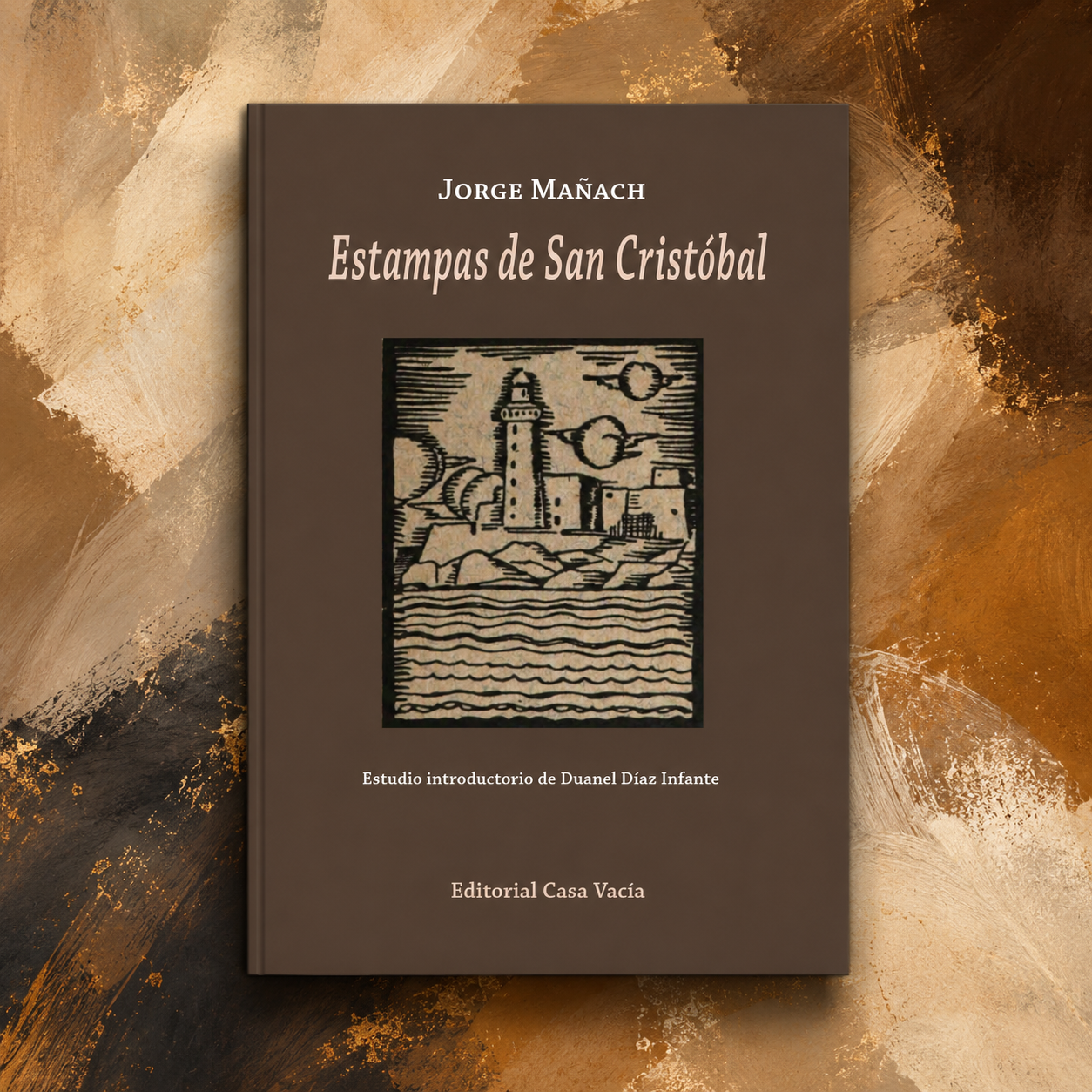
A group, or rather a sect, of writers has for years been seeking in Jorge Mañach its spiritual father. The doctor —der Doktor?— achieved the complicated blend of American civility and European culture that we Cubans like so much, and he did so with an elegance that still unsettles. Perturbación is the key word for reading Mañach now that his books are turning one hundred years old.
It is unsettling to look into Estampas de San Cristóbal —published in 1926 and now gathered by Casa Vacía— and then remember what Havana in particular, and Cuba in general, looks like today. From the Paris of the Caribbean it became the Tegucigalpa of the Caribbean, Sergio Corrieri innocently said in 1968. Now it does not even reach Gomorrah.
“Mañach sigue siendo la República,” Duanel Díaz Infante states categorically in the prologue. One is tempted to agree with him, because deep down one wishes the Republic had lived up to Mañach: born in Sagua, educated at Harvard, doctor in Paris, senator in Havana, dead in San Juan. A “repatriado ambiguo, injerto de español y de criollo.” But Mañach is not the Republic, but rather the print of the Republic, a disturbing and not at all didactic print one hundred years after all that and seventy years after the Castroist monstrosity.
Although, well, it may also be that the eleven million Cubans —there is no longer even any certainty about how many there are— suffer collectively from the golden age syndrome. After all, Mañach is the father of Cuban nostalgia: he was the first to teach us how to long for something! The Estampas are an exercise in longing, as unsettling for him as it is for us now to read his republican diatribes on the “deseuropeización” of Cuba: the Sevilla-Biltmore against the Prado, as Díaz Infante says Marcelo Pogolotti used to say.
What was missed was the “experiencia colonial del espacio” —Villaverde’s barrio del Ángel, Casal’s brothel-lined alleys, Mialhe’s engravings—, a phrase by Díaz Infante that makes me think. No one has been more jealous of Havana than the provincials, the “últimos criollos,” no matter how much the Habaneros dislike it. Only someone from Villa Clara or Bayamo would know how to smoke a cigar slowly and look at the big city with amazement. “Un tipo curioso de la villa,” Mañach says, “de esos que vemos todos los días sin darles importancia, olvidando que son el documento humano de nuestra cubanidad.”
To stroll through the city, Mañach invents a companion, the procurador Luján. Like Don Quixote, the doctor cannot talk to himself forever, and so Luján, the old criollo, the last criollo, serves as his counterpoint. Luján searches, like any good Cuban, for his tema-para-todo-el-día, which may be a story, a character, a collapse, or the weather. One has to talk about something; that is the first commandment of the criollo.
Luján exists only as Mañach’s mirror, and the two exist only as the two halves of the Cuban: “Él es viejo y yo soy joven; él ama sobre todo la tradición; yo, el progreso; él es irónico y caudaloso; yo, directo y sobrio; él en ninguna hechura de los hombres se ilusiona ya, y yo todo lo tomo en serio.” Mañach sits with Luján on the Malecón, with his back to the sea or facing it, and one cannot help imagining him in a dark suit, the Gothic ghost Mañach, seated on the Malecón —“muro que huele a mar y, en sus esquinados repliegues, a otros líquidos igualmente salobres”— while people pass by.
“Me pregunto, hijo, qué haríamos nosotros si no tuviésemos el Morro,” Luján says, comparing the lighthouse to the Eiffel Tower and the Statue of Liberty, which means that Cuba is like Ellis Island for Jews —“turcos” and “polacos,” Sephardim and Ashkenazim—, for Black people, or for the Chinese who continue to enter through the bay.
“Verdad, Luján. Cuando uno está ausente de Cuba y quiere visualizar nostálgicamente la capital amada, surge en el recuerdo la farola como un asta mágica,” Mañach answers Freudianly. That conversation defines them and also defines the reader, who will not find this new edition of Estampas de San Cristóbal in a bookstore in Santa Clara or Santiago, but probably on the internet, “ausente de Cuba.”
Both of them walk through Havana, stop —that moment when the two halt their stroll and look is crucial— and then speak. They walk down Obispo “por la sombrita y evadiendo el embiste de un Ford vacío,” offer an “elogio de la bodega,” and are startled when they see a bus, a “medio de locomoción urbana que no logra revestirse de pleno prestigio.”
In some of the sketches, Mañach is funny precisely because he is solemn, and I believe he knows how to laugh at his solemnity: “¿Y estos pobres cañones, estos tristes cañones veteranos, valetudinarios, inservibles ya, que apuntan hacia el blanco blanquísimo del pasado como si quisieran dispararle su innoble contenido de residuos plebeyos?” For me, that is the best Mañach.
The Estampas help us understand the sometimes ridiculous complexity of the country we lost. Luján bursts out, for example, against the “maternidad polaca y semítica, cubanitos con kas y eins en el apellido para el futuro; por lo pronto, idilios incomprensibles cada noche en el muro pasmado del Malecón”; the “diálogo gargarizado y arduo” of the immigrants; the “leyes xenófobas de exclusión que han votado los yanquis, de rechazo, que nos inundaron a nosotros de polacos, de judíos, de turcos.”
The Cuban as ever, annoyed because the United States turned Cuba into “una suerte de sala de espera para gentes europeas ganosas de entrar a aquel país.” The Casablanca of the Caribbean. Ingrid Bergman was Jewish on her mother’s side, by the way.
I would be lying if I said I did not feel a certain nostalgia for Havana after reading Estampas de San Cristóbal. Mañach stirs things up and manages to pass on his bad temper to the reader. Perhaps the history of Cuba is that eternal transmission of bad humor from grandparents to grandchildren, more than from parents to children. Reading this book far from one’s country, without one’s feet firmly planted on the ground, can be deadly, unless one is —like Mañach— cured of enthusiasm.
After reading Estampas de San Cristóbal, I had, like the delirious Saint John, a vision: the apocalyptic battle between exiles in Florida and exiles in Europe, and the Cubans who stayed, undecided between neutrality and action; and the setting for it all will be Havana, a two-faced city, as if it had been designed by Calvino, one half inspired by Madrid and the other by Miami, so that the Capitolio, the Prado, the Malecón, the Morro, and all the rest are ruins, but well-kept ruins, ruins with cachet, with luminous little signs, like Roman ruins. The great final battle of the últimos criollos. That would have pleased the doctor Mañach and would have given the procurador Luján something to talk about.


