
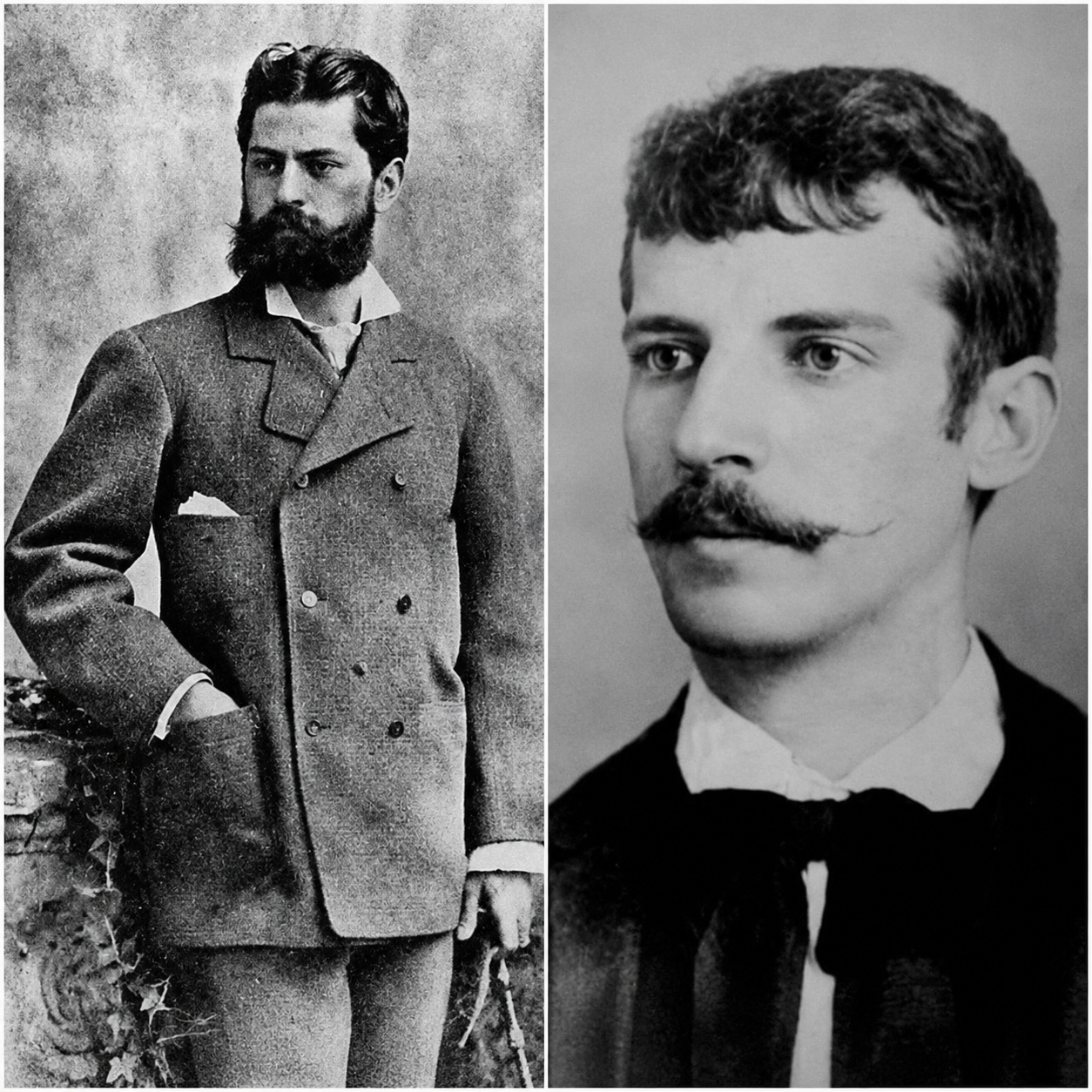
On June 24, 1888, under the pseudonym El Conde de Camors, Julián del Casal wrote about the Santiago-born painter Guillermo Collazo Tejada in La Habana Elegante. The future author of Bustos y rimas was 25 years old; Collazo, already recognized in the United States, was nearing 38. The year of Casal’s visit to the artist’s Havana studio is interesting, since he describes it in lavish detail:
From the moment one enters the studio, there are not enough eyes to contemplate the objects that attract our gaze. A broad, colossal panoply, lined with green cloth, supports a complete suit of armor, surrounded by all kinds of ancient and modern weapons. Beside the panoply, sumptuous pink draperies, artistically fastened, hide the bareness of the walls. Chinese vases, adorned with fantastic figures and animals; antique porcelains, of different sizes and varied colors; sculptural groups, now in marble, now in clay, inspired by mythological subjects; marvelous lamps, exquisitely crafted, suspended from the ceiling; antique furniture, upholstered in old and richly luxurious fabrics; Persian carpets, with large flowers and a diversity of shades; everything most precious that cosmopolitan taste has produced is scattered, as if by fairy hands, throughout the corners.
How could a painter who had made his career practically in the United States have a Havana studio with such characteristics? If one considers Collazo’s life trajectory—1888 was his last year in Cuba, and he had lived in Havana since 1883—he lived comfortably. Was this his second period of residence in his country? He was born in eastern Cuba, his taste for painting in Santiago was known, as were his beginnings with Federico Martínez, but, strictly speaking, he would be trained on U.S. soil from 1868 onward. He would not return to Havana after 1888. He died of an overdose in France, in his residence on Boulevard Malesherbes. It was September 26, 1896. The same year as the deaths of Juana Borrero, Antonio Maceo, and his teacher Sarony. His remains were buried before the arrival of the new century in Colón Cemetery. Today it is difficult to locate the tomb of one of the best Cuban painters of the nineteenth century.
When Casal visits Collazo, he is writing about a painter already important in the United States and for Cuba: “Mr. Collazo’s best paintings are in New York, where they are exhibited and sold at high prices,” Casal himself affirms. Collazo had been a student of the Canadian-American lithographer and photographer Napoleon Sarony. He had made an enormous gesture toward José Martí. He was the one who found Martí work as an art critic for the New York magazine The Hour. Martí was unable to thank him by commenting on the paintings of his fellow countryman, since he was not allowed to speak about artists who were foreigners, but in his notes he did express: “its main editors, Tiblain and Murphy, had commissioned a Cuban artist, a celebrated master of crayon, Collazo, to find an art critic. And here I am, with two palettes to see Museums—on my way to the collection of Mr. Stebbins and of the Wolfes, and obliged to write a critical review of them in English.”
The most innovative image of Collazo—beginning with readings, and above all from looking at his works—and no less effective for that, we owe to Lezama Lima, since perhaps the man occasionally reproached for a certain Frenchification “comes to present to us with the utmost elegant discretion how the Cuban is a sudden synthesis and not an accumulation of superimposed materials and cargo. That he lives many years in Paris, well, that makes him more finely Cuban. That he paints a visit in the French manner, well, the painting settles into the exquisite graces of a Cuban visit at the end of the century.”
Collazo is voluptuous; he knows no thematic limits. He is a master of portraiture, of landscape particularities both in nature and in human figures. He is not only a great observer of women. He is meticulous with the masculine image, principally with faces. And he is a very attractive man. Perhaps more so than Casal, who emphasizes him even above his studio. Collazo is the prince of the Count of Camors’s chronicle: “Everything that springs from his brush is refined, exquisite, and delicate.” Besides looking at him well, Casal must have spoken with him during this visit to the painter’s house/studio. At another point in the description of this particular space, Casal assures:
Mr. Collazo’s studio is the most complete one we know. Located on the top floor of a stern-looking house, it contains artistic treasures of inestimable value. Everything invites recollection and meditation. It seems the dwelling of a dreamer from ancient Greece, exiled from the modern world, who has hidden himself away in order to dream and create. The artist always seeks, like the lover, silence and solitude; because inspiration waits for the world to withdraw before it can enter.
No space was more suitable than the atmosphere of the capital for the tranquility of cultural activities. The period of the Fruitful Truce. The failure of the Little War… Manuel Sanguily, Ramón Meza, José Miguel Melero… each occupied with his own work. The West had not joined the War, and the capital welcomed the advances of the moment, such as the typewriter and the telephone. But where was that studio located? It is presumable that Collazo settled in El Cerro. Some of his creations from this period refer directly to the place, such as View from El Cerro and The Siesta, the latter perhaps the first whim of showing, as an aesthetic addition, a seascape—foreign to El Cerro, of course—from the domestic space of a home. There is much speculation about the woman portrayed and the possible place which, according to some, may have been inside one of those public baths so present in El Vedado. According to the painter and professor Antonio Rodríguez Morey (1874–1967)—director of the National Museum of Fine Arts from 1918 to 1967—the model was the painter’s friend Susanita de Cárdenas, and the house was in El Cerro.
In The Siesta, Collazo succeeds in bringing together all his preferred themes: the refined and well-dressed woman; the nostalgic and silent atmosphere of a Havana turned inward, behind closed doors; his palette flirts with pre-Impressionism, but the detail of everything surrounding the sleeping young woman in the portrait highlights him as the notable realist painter he was. It is a work that, with restraint, incorporates the Cuban through that tempered union between tropical light and maritime condition. Collazo was never interested in representing works of a patriotic character in the manner of Armando Menocal. Not at that time, nor before or after. Nevertheless, he contributed money to the war in preparation from his studio in France, a meeting point for the Cuban Committee to raise funds and weapons. Casal justly understands the essence of the creative discourse of the author of The Patio when he admits:
There will be few artists, like Mr. Collazo, so possessed by the ideal. Art is for him a kind of religion. Neither politics, which offers a wide field to human ambitions; nor mercantilism, which spreads like a filthy letter across our social body; nor his considerable fortune, which might have transformed him into a useless gilded man; nothing is enough to make him turn his eyes, dazzled by the glow of dreams, away from the ideal summits, where, at the end of the ascent, one reaches the golden laurel of immortality.
Because although The Siesta had been painted and apparently was no longer in the studio, what draws Casal’s attention is not only the Portrait of Mrs. Malpica—painted in 1883—but Collazo’s landscapes, which he legitimizes as works of art, not as faithful reflections of nature. The author of Leaves in the Wind did not disdain nature because he became absorbed before objects of civilization from man’s past and from his own contemporaneity, or as a consequence of his own imaginative subjectivity; rather, “the landscape does not have value on its own, but is covered with the wrapping of representation. The landscape is animated only by the creative will of the subject, who arranges and adorns the folds of a seductive fabric,” which implies that there is no radical denial, nor does the poet take happy or easy pleasure before nature. Casal also knows that the landscape belongs to nature, but is not nature. That is why he specifies, looking at Collazo’s work: “But it is not in the portraits, but in the landscapes, that he can most be admired. All of them recommend themselves through the truth of tone, the fineness of the brush, and a delicate feeling for country life.” And here: “The first landscape found in the studio has charming details. It is the hour of midday. There is neither much light nor much shadow. The tropical plants, faint from the heat, bend their leaves. A light mist, gilded by the sun, floats over the fields.” In painting The Patio and Storm Squall, Collazo contrasts the landscape of a suburban context with a specific state of the weather. They are two different atmospheres, where the human eye has reconsidered the composition of landscapes based on their dependence on and independence from nature.
When the painter Guillermo Collazo settled for five years in the Cuban capital, his work, of a post-Romantic and realist character, developed alongside the different pictorial proposals of San Alejandro, where figures such as Melero, Luis Mendoza, and Valentín Sanz Carta stood out. Julián del Casal, as an art critic, knew how to examine with rigor and passion what an artist of technical strength and estimable aesthetics always suggests: humanity, poetry, and idealism.
Upon leaving the house/studio and facing turn-of-the-century Havana, he ends his chronicle: “art provides all pleasures… even that of forgetting!”


