
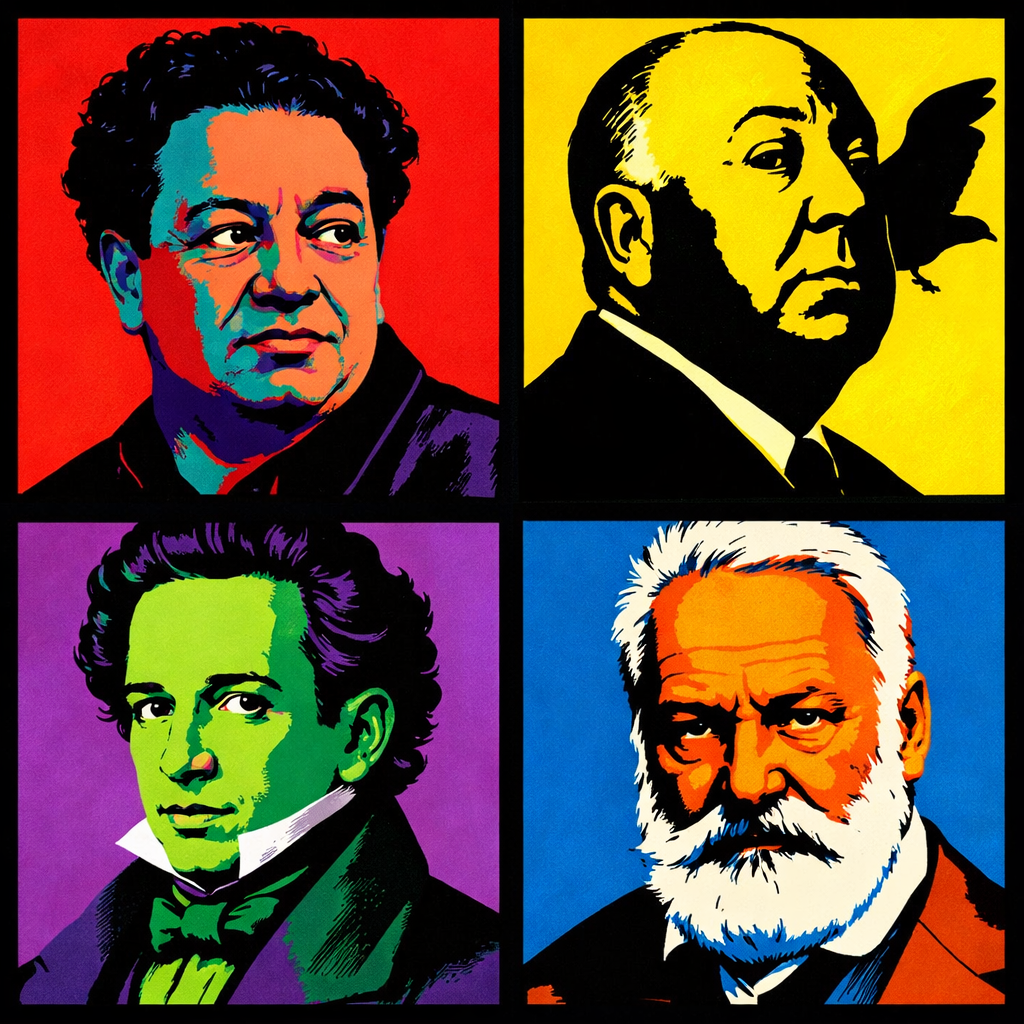
Weighing over 130 kilograms, Diego Rivera dominated every space he occupied. His appetite was as insatiable as his murals. Frida Kahlo, who called him her “toad,” had to climb up the scaffolding carrying baskets of tacos, mole, and tortillas to keep that biological machine running while he painted the history of the class struggle. That same Retian voracity saturated his frescoes: in the Tlatelolco Market mural, he painted Mexico’s past as an immense pre-Hispanic pantry, where the geometry of corn, turkeys, and chilies unfolds with a sensuality that transcends ethnography to become an aesthetic of visual gluttony. However, he earned his place in the universal history of gluttony in Paris, with a confession that oscillated between surrealist boutade and clinical truth. In his autobiography, he claimed to have participated in a dietary experiment based on corpses from the morgue, declaring with a gastronome’s detachment: “Human flesh is the most delicious of all; similar to pork, but sweeter, more tender, and more digestible.” For the ogre who wanted to visually devour the entire history of Mexico, cannibalism was the logical consequence of a voracious and indiscriminate love for matter.
♣
He built his career on fear, but his own private terror lay on the plate. Although Alfred Hitchcock turned his silhouette into one of the most recognizable graphic icons of the century, he lived with his physical bulk through a mixture of guilty pleasure and Victorian revulsion. “I am an armored pig,” he once confessed, acknowledging that his fat was a barrier against the outside world. His relationship with food was one of contained violence: he ate beef steaks and ice cream for breakfast, but had a pathological phobia of eggs (“that white, round, hole-less thing… have you ever seen anything more repulsive than the yolk breaking and spilling its yellow liquid?”). Toward the end of his days, neurosis won out: after drinking tea, he would fling the cups backward over his shoulder so they would shatter, unable to bear the sight of the “remnants” of his own pleasure.
♣
Giacomo Leopardi is proof that gluttony does not necessarily require a giant body, but rather an empty soul. Hunchbacked, frail, and infinitely bitter, the poet of cosmic pessimism despised existence as a mistake of nature. Yet he had a weakness that contradicted his nihilism: sweets. In his retreat in Naples, while writing about the vanity of all things, he devoured beignets, pastries, and ice cream with childlike eagerness. His biographer, Antonio Ranieri, recounts that Leopardi demanded sorbets with maniacal frequency, convinced that sugar was the only thing that made the “pain of living” tolerable. The irony was fatal, as the philosopher who longed for death did not perish from his metaphysical melancholy. A massive ice cream-induced indigestion—during a cholera epidemic—fulfilled his greatest desire, proving that even for the saddest of men, pleasure can be a deadly trap.
♣
More than a biological necessity, the act of eating became, for Victor Hugo, a territorial annexation. The author of Les Misérables behaved at the table like a “stomach with eyes,” a force of nature incapable of distinguishing between gastronomy and geology. His contemporaries watched in horror as he crushed his food: he mixed cutlets, beans, oil, vinegar, and mustard on the same plate, creating a shapeless sausage that he devoured with the voracity of a cyclops. He left nothing behind: he ate the skins of fruits, crushed the shells of shellfish, and even swallowed whole oranges. Omnivorous and totalitarian, he digested the world with the same blind force with which he assimilated history into his novels.


