
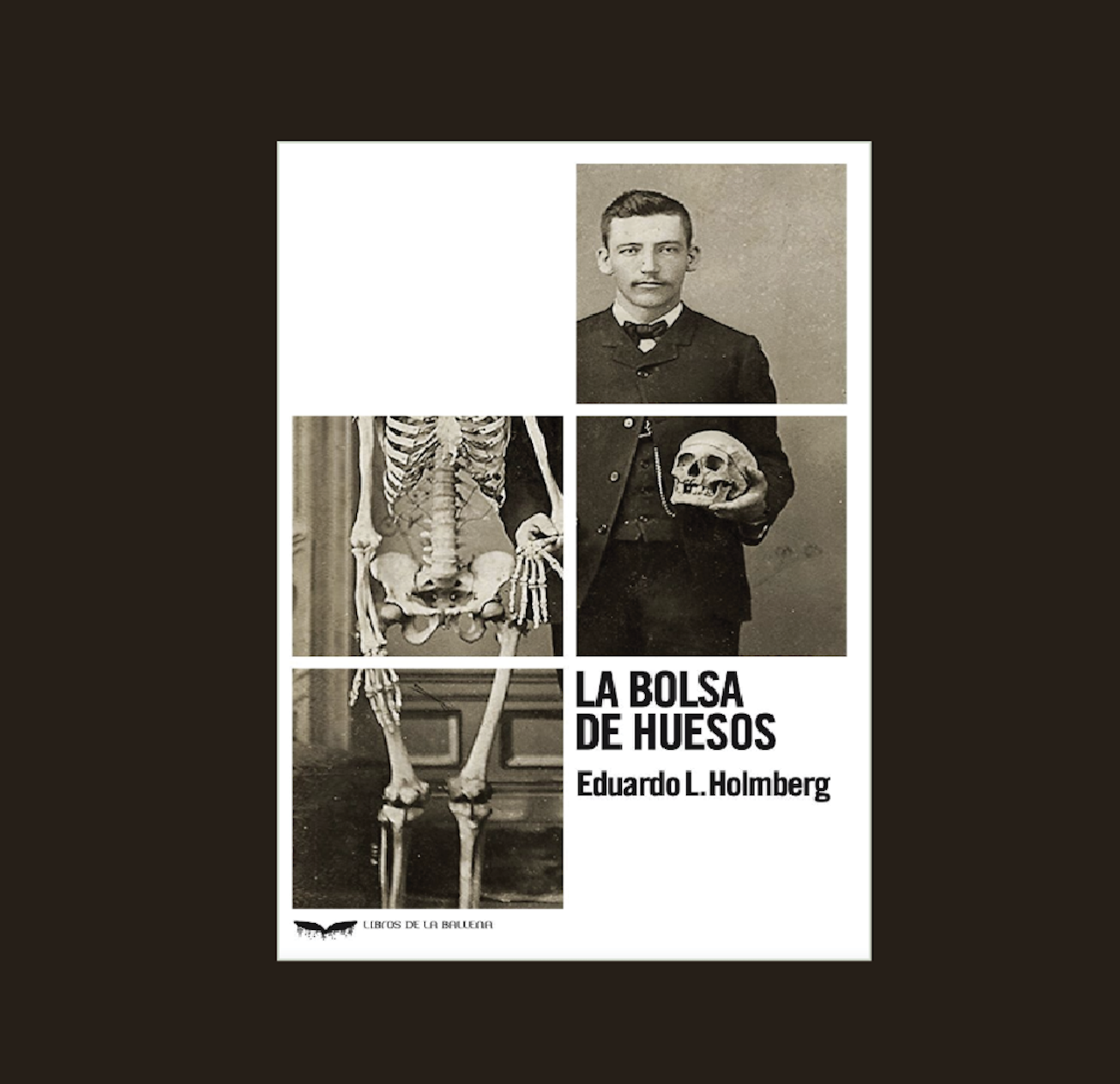
La bolsa de huesos (1896) belongs to the most singular core of the narrative work of Eduardo Ladislao Holmberg (1852–1937), a key figure in late nineteenth-century Argentine literature and one of the first Latin American writers to consistently articulate the detective story with the fantastic and scientific speculation. A physician and naturalist, Holmberg transfers into fiction procedures drawn from the scientific knowledge of his time—not to affirm them as closed truths, but to test them within a narrative structure organized as a genuine novel-enigma.
The story adopts the form of a first-person narration by a doctor who, after returning to Buenos Aires, receives a bag containing human skeletal remains. A meticulous examination of the skeleton reveals a precise anomaly—the absence of a rib—which reappears in another set of bones studied by a colleague. From this unsettling repetition, an investigation is set in motion, grounded in anatomical observation, comparative hypotheses, and movements across various urban settings. The development follows a logic of rational inquiry but departs from institutional detective fiction: there are no police or courts, only a private investigation sustained by scientific method and intellectual curiosity. The resolution, involving a female criminal in disguise, introduces a zone of disturbance that destabilizes both moral order and full confidence in science.
The characters are outlined with a functional economy that reinforces the experimental nature of the narrative. The narrator concentrates the analytical and reflective gaze; the phrenologist who accompanies him—representative of a now-discredited but historically plausible body of knowledge—expands the field of interpretation of the enigma; the figure of the murderer, far from serving as mere sensational effect, condenses social tensions related to the body, identity, and the transgression of norms. Rather than a modern psychological development, Holmberg proposes characters who function as nodes of ideas and conflicts, integrated into the narrative apparatus of investigation.
The style of La bolsa de huesos is marked by a clear and restrained prose, where reasoned exposition and technical description alternate with moments of progressive unease. The narrative advances with an appearance of logical certainty, yet that same logic gradually reveals its fissures. In this sense, the novel distances itself from dominant naturalism and approaches an early form of intellectual fantastic: the strange does not arise from the supernatural, but from the internal limits of scientific knowledge when it attempts to encompass the complexity of the human.
Published in a context shaped by the consolidation of medical and forensic sciences in fin-de-siècle Argentina, the novel engages critically with the positivist optimism of its time. Holmberg displays the instruments of modern knowledge—classification, observation, deduction—but also exposes their blind spots. As Cristina Macía notes in the prologue to contemporary editions of the work, La bolsa de huesos does not propose a naïve celebration of science, but rather a narrative exploration of its scope and its zones of uncertainty.
In relation to other detective nouvelles by the author, such as Nelly (1896), the novel shares a similar aesthetic operation: the hybridization of investigative narrative and the questioning of evidence. While Nelly emphasizes the fragility of testimony and moral ambiguity, La bolsa de huesos shifts the focus toward the body and science as sites of enigma. Read together, these narratives configure a foundational moment in Argentine detective fiction, still removed from stable formulas and open to formal experimentation.
Holmberg’s relevance as a narrator at the end of the nineteenth century lies in this pioneering condition. His work anticipates lines that would later be taken up, in different historical and aesthetic contexts, by authors such as Leopoldo Lugones—whose stories turn science into a source of unease—and Jorge Luis Borges, who would push further the idea of rational investigation destined for error or paradox. Without the need to establish direct filiations, La bolsa de huesos can be recognized as a decisive precursor of a Latin American tradition in which detective fiction and the fantastic function as tools for thinking about the limits of knowledge and of modern reason.
La bolsa de huesos
L. Holmberg
Libros de la ballena, España, 2021


