
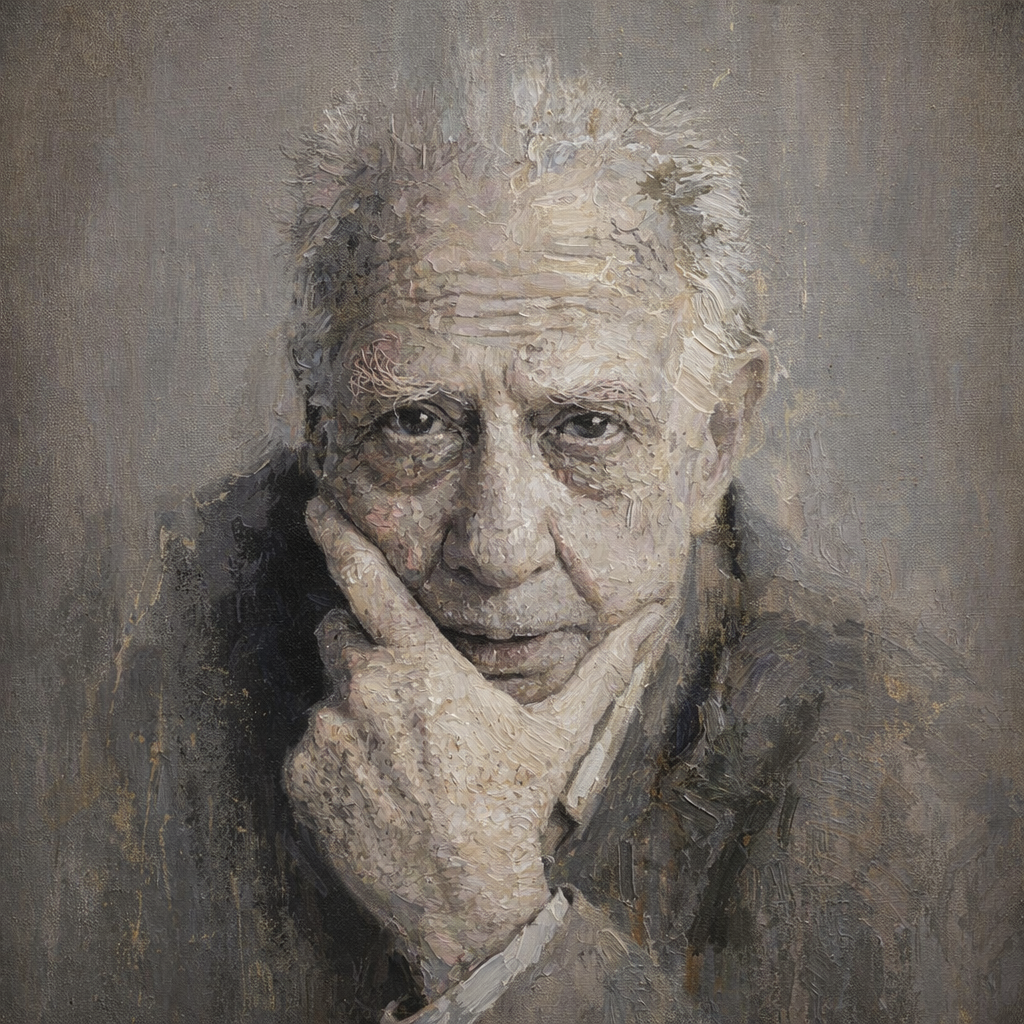
Onduras. Derived from “onda” (wave, movement of water), from the Latin “unda,” plus the abstract suffix “-ura,” which denotes a quality or effect. A word that suggests depth, resonance, and propagation: something that leaves a mark as it spreads. A neologism coined by the editors of Bookish & Co. to name certain literary works. These Onduras by Sergio Pitol form a tapestry of quotations: each one, a tiny wave that reverberates, displaces, and spreads its cadence. Modulations, shifts, interplay between memory, fiction, and reading. On that surface, the writing spreads in fragments that, far from coming to a close, resume their drift.
If I were forced now to answer the eternal question of why one writes, I would simply reply that one does so out of an inner necessity, to avoid going mad, to remember and clarify the meaning of certain episodes that have startled us or wounded our imagination, to, perhaps, try to get to the bottom of language and find that common source that binds us to the rest of humanity. Sometimes, to face a challenge, to shape in “a form” material that seems resistant to any absorption; other times, for the sheer pleasure of evoking places and friends; still others, out of the need to denounce hypocrisy. I believe that implicit in my discourse there is always a condemnation of the insensitive, of any triumphalist and vulgar situation. I have always found it embarrassing to answer the questions: why?, for what purpose?, and for whom do I write? The answers would be excessively tainted by that thick, dark miasma found in the subsoil of expression, in the underground passages of language. For me, there is always a small group of people—a few friends scattered across the world whom I somehow envision as potential readers, people I appreciate and with whom I would like to communicate. But such a relationship does not exist in the conscious mind. Ultimately, those people have little to do with the reason that has led me to spend entire weeks wrestling with a chapter of a novel or a short story. My work is a solitary endeavor.
“Sobra la escritura” (El tercer personaje, Ediciones Era, Mexico, 2013)
◾️
I can explain the predominance of Italian cities in my memory. All my family branches come from Italy. My first contact with that country occurred during my adolescence, and it was dazzling. Within hours of arriving in Rome, I had the revelation that that architectural splendor, that astonishing world of columns, palaces, and perfect gardens, those layers formed by various cultures superimposed over the centuries, belonged to me in the same way that Uxmal and Teotihuacán, the sacred cities of the Maya and the Aztecs, did. Living in Rome was a luminous experience, a blend of intoxication and clarity. Traveling to other Italian cities, discovering Siena, gliding through the canals of Venice, and tirelessly wandering its narrow streets complemented that experience. Contemplating the walls and landscapes was like an immediate and resounding certainty of the dreams and longings of my grandparents, my great-grandparents, all my ancestors.
“Warsaw Conference” (The Third Character)
◾️
Don Quixote is a masterpiece, though even the most educated readers failed to understand it for a long time. The form, the structure, the characters, and the theme of madness are innovative; all of that would already make it interesting, but Don Quixote is the work of a writer who has woven together all the phases of his life—Renaissance Italy, the barracks, the hospitals, the front lines, the baths of Algiers, the multitudes of diverse nations and languages, the thousands of leagues traveled by mule over thirty years of humiliating labor, and the baseness, the infamy, the persecution of those who had treated him—but also the exaltation, the happiness, the laughter, and the grandeur of the world; all of this stirs within him. Invisible, Cervantes becomes the third character alluded to by Harold Bloom, alongside Don Quixote and Sancho Panza.
“The Third Character” (book of the same name)
◾️
When exile is entirely voluntary, the stay abroad is not conceived as banishment; on the contrary, the distance from the distant homeland can be conducive to literary or artistic creation. Consider the emigration of the English Romantics to Italy: Percy Bysshe Shelley and Mary Shelley, Robert Browning and Elizabeth Barrett Browning, John Keats, Lord Byron, William Beckford, and so many others traveled through the Mediterranean countries, and almost all of them ended up settling in Italy for long periods. Nothing of that Renaissance fascination, of that sumptuousness of forms, of fabrics in lavish colors, of physical naturalness, of grace and sensuality that Italy lavished upon them had they ever known in rainy England—the industrious, practical, sober, Protestant, utilitarian England. Italy thus became a dream fully realized.
“Imagination and Identity” (The Third Character)
◾️
“The eyes are the mirror of the soul,” noted her school reading book. “One cannot presume to know people until one has managed to penetrate the innermost recesses of their eyes,” she had once heard her father say. “Eyes are blue or green, brown or black,” his grandmother once exclaimed angrily, “and I know of a child whose eyes turned red because of his insolence, like the blood that gushed out when he cried and ran down his cheeks, staining his clothes and spilling onto the ground in a viscous, repulsive pool that trapped his feet, leaving him no chance of movement; and people passing by learned that the child whom God had punished so severely had killed a little dog, and that was why blood flowed from his eyes, which now resembled waterfalls, do you remember the one we saw from the train when we went to Veracruz?; and some children threw stones at him as just punishment for his crime, while others—perverse, liars, deceitful, and hypocrites like you—considered him their hero, a hero of the wicked homeland of sinners, for their instinct made them gaze with pleasure, delight, and jubilation upon a child whose eyes were just as yours will be if you continue trying to deceive me”; though he could not figure out what lie had so wildly fueled the old woman’s imagination.
“Eyes are swords, they are flints, they are the most insidious instruments a man can use to insult a woman,” his mother had remarked some time ago, her hands trembling and her eyelids reddened.
“Grandfather’s House” (Cuerpo presente, Ediciones Era, Mexico, 1990)
◾️
The moment they met seems strangely vague to her. She vaguely recalls a figure who would appear from time to time at the Mascarones café and sit down to chat with her sister’s teachers. As if through a fog, he remembers going—with whom?—to a reading of a few chapters from his novel (yes, the novel had already been born by then!) at an apartment in the Roma neighborhood, near Plaza de Miravalle. Neither of them was interested in fostering a relationship. Their circles were not close. Carlos was several years older than him; he was one of the young writers beginning to make a name for themselves; he, on the other hand, had only just finished high school.
He admits with regret, with a certain remorse, that deep down, when he heard of his death, he felt a certain relief; he regarded it, just like all his old friends—“all” was an exaggeration, it suggested a crowd, a gregarious acceptance; it would be more accurate to say the few friends—perhaps he was the last, the only one, though after the split in Belgrade he couldn’t even say he had remained so—as something natural, as the only natural thing that could happen to him. Different versions circulated for some time. Someone asked for information at the newspaper where he worked; the response was vague: an accident in the mountains, he thinks they said; he doesn’t recall who mentioned that the death was due to a cirrhosis attack, nor who said he had died in a mental health clinic. An acquaintance of his, a secretary at the Embassy, sent him news after some time that was so confusing it was impossible to deduce anything certain from it. In Belgrade, the letter said, he was no longer to be seen. He had asked that any correspondence be sent to a café in Kotor. In Mexico, his death went uncommented. Carlos was not news. He had become a yellowed relic of the past. And in that town in Montenegro, where he had tried to take him a few years earlier, and which he located on a map south of Dubrovnik, his bones would undergo slow decomposition in an unmarked grave, like yet another mockery of the longing for light that had sustained him in the years when everything was promise. A longing for light? Did he ever have it? When had he lost it? Who could pinpoint the moment and determine the causes of the fall?
The Sound of a Flute (Editorial Anagrama, Barcelona, 1986)
◾️
It was the year 1965. I had been living in Warsaw for two years. One day the mailman handed me a letter from Vence, a town in the south of France. It was signed by Witold Gombrowicz. Could it be a joke? I found it hard to believe it was genuine. I showed it to some Polish friends, and they were stunned. A letter from Gombrowicz received by a young Mexican living in Warsaw! What an excess, what an anomaly! I nodded and rejoiced. “Like everything in Gombrowicz’s life,” I told myself.
In the letter, he explained that someone had given him the Spanish translation of The Gates of Paradise by Jerzy Andrzejewski, and that he had found it satisfactory. So much so that he invited me to collaborate with him on the translation of his Argentine Diary, which would be published in Buenos Aires by the Sudamericana publishing house. It marked the beginning of a considerable improvement in my living conditions. Suddenly I began receiving offers from various places. My sources of income in Mexico were Joaquín Mortiz, Era, and the University of Veracruz Press. In Barcelona, Seix Barral and Planeta; in Buenos Aires, Sudamericana. In the past, I had only managed to place a few translations sporadically. From then on, working just three or four hours a day, I was able to earn a steady income, which in Poland at that time amounted to a very respectable sum. More than Polish literature, I received requests to translate English and Italian authors. Over the next six or seven years, I was primarily a translator; that profession, which I had begun in Warsaw, supported me entirely in Barcelona and partially in England.
Recalling that era does not make me think that “I was living another life,” as is usually said, but rather that the person I am referring to was not entirely myself; he was, in any case, a young Mexican who shared my name and some habits and quirks.
“Everything is in all things” (The Art of Fugue in Trilogy of Memory, 2007)
◾️
A chronicler of reality, a novelist—and the more talented, the better—Dickens, for example, conceives of the human comedy not merely as a vanity fair, but, building upon it, shows us a complex clockwork mechanism where extreme generosity coexists and interacts with vile crimes, where the highest ideals conceived and realized by human beings fail to distance them from their endless blunders, their pettiness, and their perennial displays of indifference toward life, the world, and themselves; with his pen, he will create admirable characters and situations. With the immense sum of human imperfections and the more limited and, it must be said, grayish range of their virtues, Tolstoy or Dostoevsky, Stendhal or Faulkner, Rulfo or Guimarães Rosa have achieved results of supreme perfection. Evil is the great character, and although it is generally defeated, it is not entirely so. Extreme perfection in the novel is the fruit of our species’ imperfection.
From what delirious alchemy might the most perfect books I know have emerged: The Children’s Crusade by Schwob; The Metamorphosis by Kafka; The Aleph by Jorge Luis Borges; Perpetual Motion by Monterroso?
The Journey (Trilogy of Memory)
◾️
The book performs a multitude of tasks, some superb, others deplorable; it distributes knowledge and misery, enlightens and deceives, liberates and manipulates, exalts and demeans, creates or cancels life choices. Without it, obviously, no culture would be possible. History would vanish, and our future would be shrouded in sinister clouds. Those who hate books also hate life. No matter how imposing the writings of hatred may be, for the most part the printed word tips the scales toward light and generosity. Don Quixote will always triumph over Mein Kampf. As for the humanities and the sciences, books will continue to be their ideal space, their pillars of support.
There are those who read to kill time. Their attitude toward the printed page is passive: they grieve, they amuse themselves, they sob, they writhe with laughter; the final pages, where all mysteries have already been revealed, will allow them to sleep more peacefully. They seek the spaces where the casual reader usually finds solace. To satisfy them, plots must produce the greatest excitement at the cost of minimal complexity. The characters will be unambiguous: either excellent or terrible; there is no possibility of a third way; the former will be excessively virtuous, magnanimous, hardworking, observant of every social norm, and extremely kind-hearted, even though their superficial philanthropy sometimes tarnishes the whole with overly cloying sentimentality; by contrast, the wickedness, cowardice, and meanness of the indispensable villains will know no bounds, and even if they attempt to reform, a malevolent instinct will overpower their will and never leave them in peace; they will end up destroying those around them and then turn against themselves in a quest for ceaseless destruction. In short, readers addicted to this battle of good versus evil turn to the book for entertainment and to kill time, never to engage in dialogue with the world, with others, or with themselves.
The Wizard of Vienna (Trilogy of Memory)
◾️
It was time to leave that faraway Mexico behind. If anything was keeping him on his feet for the moment, it was a keen interest in studying a series of materials that were already vying to form a new book. A few months earlier, while still in Bristol, he had discovered the correspondence between the manager of an English oil company in the Huasteca region and its headquarters in London, during the oil conflicts that led to the expropriation of the companies and the subsequent breakdown of relations between England and Mexico. He extended his curiosity to the continuation of those difficult relations—whose resumption the war had made possible—and to the visits of prominent British intellectuals and journalists to General Cedillo (iWaugh, no less!), who stubbornly saw him as the noble savage in whom the seeds of catechization had indeed taken root. The man needed to defeat chaos. The world press spoke without the slightest sentimentality: if Cedillo refused to lead the rebellion, or if he was defeated, the only path forward had to be armed intervention. To put an end to the disorder. He then took some notes; he had reviewed and expanded upon them in Mexico. And just two or three weeks earlier, shortly before the end of the year, he ran into a former classmate, Mercedes Ríos, with whom he discussed his current readings and spoke of some still-vague work projects. Mercedes lent him some photocopies of a file regarding the more or less clandestine activities of certain German agents active in Mexico during that same period. They had belonged to an uncle of his, a high-ranking official in the Ministry of the Interior during the war, and he assumed they might prove useful, since they were somehow connected to his topic. He had originally envisioned a more limited investigation: the actions of oil companies against Mexico, the outbreak of World War II, the country’s participation in the Allied cause; de facto solutions to the problems created by the expropriation, etc., but reading those documents made him realize a thousand new possibilities.
He decided to broaden the scope, to study the Mexican situation in relation to the international context, and not only with respect to the countries to which the expropriated companies belonged. A very stimulating period. Elsewhere, she began to find materials that renewed her interest in that pivotal era, which, despite its proximity in time, seemed as remote as the one in which José María Luis Mora attempted to adapt the theses of the Enlightenment to the country and bring Mexican history closer to the Age of Enlightenment. Mercedes had been right about the interest such documents would spark in her. She immersed herself in them over a weekend. A bitter scent, that of mystery, emanated from those terse biographical notes. In some way, they recreated the atmosphere of certain films, of certain novels, which one was accustomed to setting in Istanbul, in Lisbon, in Athens, or Shanghai, but never in Mexico. There were just over fifty pages. She read them on a Saturday night, and her excitement was such that she could no longer sleep. On Sunday he studied them again, taking notes, reflecting on those details. Because of that reading, he was there, in the courtyard of the bizarre red-brick building, gazing vaguely at a corner of the first floor, where he supposed—though he was no longer entirely certain—that his bedroom had been thirty-one years ago, during the months he spent at the home of his aunt and uncle, Dionisio and Eduviges. Dionisio Zepeda and Eduviges Briones de Díaz Zepeda, as she liked to point out.
The Parade of Love (1984)
◾️
Literature has never felt at ease amid dogmatic constraints; it rebels even against the very canons it has created when it deems them unnecessary. It also resists being confined to a single region. The desire to abolish cultural borders arises the very moment someone establishes real borders—those necessary for the tribe, for reasons of state. The Renaissance circulated ideas, themes, styles, tones, and manners. One of its highest attributes is universality. Marsilio of Padua and his disciples translated Plato; Shakespeare reworked texts by Bandello; Cervantes was seduced by Italian innovations and also, as we now know, by the Arabic narrative forms of which he learned during his captivity in Algiers; our Juan Ruiz de Alarcón wrote a masterpiece, *La verdad sospechosa*, which Corneille rewrote under the title *Le menteur* and much later Goldoni under the title *Il bugiardo*; there were variations of *La Celestina* in many languages; Garcilaso and Boscán introduced Italian meter to Spain, though not without receiving the occasional rebuke from the guardians of the language. Later, during the Romantic fever, what poet did not want to be Manfred, Lara, the Corsair, and Don Juan? Good and mediocre, prodigious and despicable, confined to a gloomy student room, or settled in the library of a magnificent palace, in Puebla or Morelia, in Lisbon or Coimbra, in Paris, in Petrópolis, in Vilnius, in Milan, in Seville, and in Naples—whether in great metropolises or in remote villages—
Byron’s verses dazzled, illuminated, and drove mad an ardent youthful constellation enamored with poetry and also with their own youth, with love and with death. The Spanish-American modernists at the end of the 19th century began to imitate the French Symbolists as a form of apprenticeship, only to later discover their own voices and thus transform poetry in the Spanish language. Among us, the influence of Darío, Borges, Neruda, Lezama Lima, Vallejo, Rulfo, and Onetti—to mention just a few names—has produced a vast legion of imitators, most of them surely poor, but what really matters is that their work sets standards of quality that are impossible to ignore. It would be absurd, after reading Rubén Darío, to accept that the Spaniard Núñez de Arce is a great poet. One can—and should—write in a manner distinct from, and even antagonistic to, theirs. The mere existence of a great creator overshadows many of his contemporaries and a long line of predecessors whose mediocrity is only revealed upon the emergence of a greater figure.
I defend the freedom to find inspiration in the most diverse cultures. But I am convinced that such approaches are fruitful only where there is a national culture slowly forged by a specific language and customs. Where there is nothing or little, subjugation is inevitable, and the only thing created is a desert of vulgarity. Those who have never hidden their contempt for the risks involved in a living culture, their distrust of imagination and play, may feel satisfied. Vulgarity becomes the norm. But I am convinced that not even the absence of readers will be able to banish poetry. Without that conviction, I would find it intolerable to go on living.
“Except for instinct, the rest is trivial” (A Buried Autobiography, Editorial Almadía, Mexico, 2010)
◾️
I have decided to visit Havana only on Saturdays and Sundays, after leaving the clinic. The day before yesterday was our first Saturday; I went with Paz to the Museum of Fine Arts to see the superb collection of Wifredo Lam, we stopped by the Meliá Hotel to buy El País, we walked through the heart of Havana, and at the book stalls I found some marvels: the complete poetry of Gastón Baquero and Emilio Ballagas, the nearly complete narrative works of Lino Novás Calvo—whose devoted fan I was in my youth—and a Mexican edition, which I’d never seen in bookstores in Mexico, of that book considered cursed for many years, Hombres sin mujer, by Carlos Montenegro, which César Aira compares to the most provocative Genet in his Dictionary of Latin American Authors. Old Havana is a marvel; it adds the popular energy of the Caribbean to its tourist cosmopolitanism. Musicians swarm everywhere. When I first visited Havana, tourists came from the United States; today, those speaking English in the squares and restaurants are Canadians; but you also hear French, Italian, a lot of Portuguese, and plenty of Spanish from Spain. The language of Blacks and Mulattos is almost unintelligible to me, an extraordinarily melodious papiamento, as if drawn from the early poems of Guillén, from Ballagas, and from the stories of Lydia Cabrera. It could be that on my first visits to Cuba, before the revolution, mulattoes did not circulate through the streets of Old Havana in such numbers, or that in those days they made an effort to speak Spanish with a standard Cuban accent so as not to be looked down upon by whites, or perhaps my memory retained other aspects of the city that were more appealing to me than the vernacular.
Suddenly I found myself in front of the Floridita, the bar where Hemingway, as is well known, used to stop for his daiquiris upon arriving in Havana; next to it is La Zaragozana, the best restaurant in Cuba and one of the oldest in the city, opened in the mid-19th century. I entered there as if summoned to decipher a part of my past, to play the defendant, the prosecutor, and the judge all in one. The decor of La Zaragozana, which I entered on Saturday, was unfamiliar to me. It seems to me that the first time I was there, its interior architecture was in the style of the 1930s or 1940s, with an echo of Alvar Aalto, the Finn, or even Adolf Loos, the Austrian. But I don’t trust my memory; that’s why I’m locked up in La Pradera. The restaurant’s walls are painted with facades of old Spanish inns, and that threw me off; on the other hand, the furniture, the uniforms, and the waiters’ style of service had all the charm of the past, like in the best scenes from Lubitsch. “When did you come here for the first time?” Paz asked me. I did the math and was stunned: fifty-one years! It must have been in late February or early March 1953. I was a young man about to turn twenty; I remember it well because I had to leave Mexico with a guardian’s approval.
“Diary of La Pradera” (A Buried Autobiography)


