
Few countries today can afford the luxury of housing a novelist.
It’s something like keeping a dinosaur in a dog kennel;
the poor beast can’t survive there, and the kennel can’t offer it asylum either.
Reinaldo Arenas, Necesidad de libertad
I have read Wendy Guerra with intention. In an effort to decipher a slippery enigma that resists even the most vigilant scrutiny, I have returned to her books, especially Revolution Sunday. From Everyone Leaves—a title which itself anticipates an “anthropological” inquiry—the autofictional displaces the algorithmic, generating a writing that resembles an apocryphal diary (or not), liquefying the ontological density of a multigenerational conflict.
However, from Everyone Leaves through The Mercenary Who Collected Works of Art, one perceives a determined effort to explore political fictions as well as the seminal traumas that have magnetized a reality meticulously crumbling—both in physical terms and in memory. Even a text like The Mercenary… not only deterritorializes and externalizes a conflict, but recontextualizes the understanding of a “left” that “dies”—embodied in the figure of Gabriel García Márquez—only to be reborn, rancid, progressive, and woke. This series of texts captures the symptomatology of disillusion, the fetid aura of hope, frustration, but above all the hissing fear that has repressed generations of Cubans raised under a totalitarian regime. I don’t know if they’re cult books, but they are undoubtedly essential for understanding what I’ve called “the ontological diagram of national memory.”
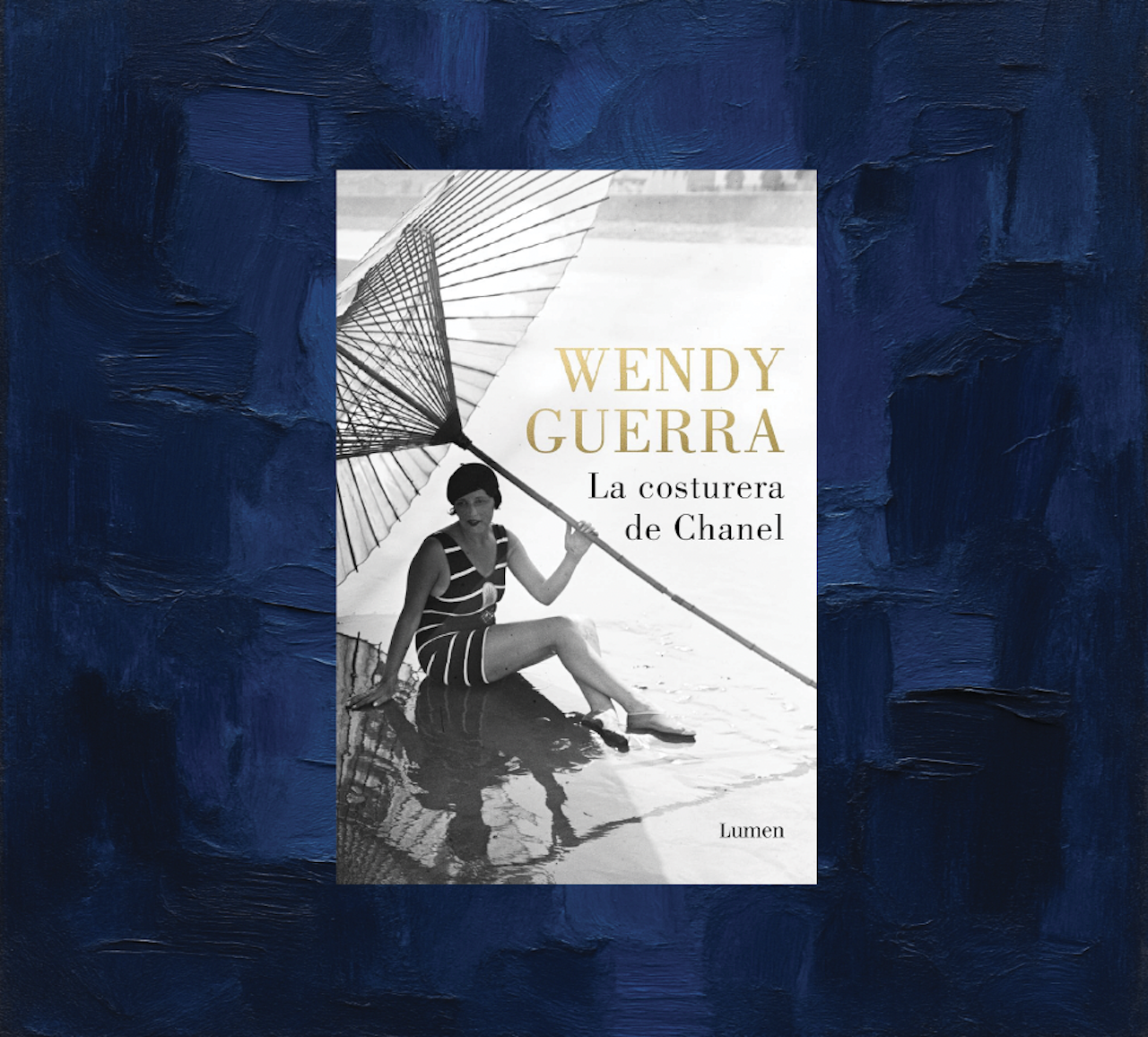
With La costurera de Chanel (2025), Guerra sets aside the conflicts, situations, and vicissitudes she once unearthed in a landscape encrusted with despair. La costurera de Chanel distances itself from her earlier output. Though carefully crafted in its atmosphere and characterization, it lacks the depth—perhaps even metaphysical depth—of her prior work. And while it gestures vaguely at political tensions, these remain mere statements, devoid of any propositional substance in the logical sense of discourse [1].
I don’t know what caused this sinuous disintegration, especially since her earlier texts—written from Cuba, that same Cuba from which Cleo, her alter ego in Revolution Sunday, tries to escape, and once escaped, is barred from returning—directly confront generational conflict, but more crucially, the ontological drama of living, surviving, and ultimately dying in Cuba. I know that Guerra left Cuba. What I don’t know is whether she has ended up as a diasporic writer, a part-time immigrant, an exiled author, or simply someone who lives outside the island. These are four states, four corners, four antipodes—and as antipodes, they are irreconcilable.
Cuba—more precisely, Havana—surfaces in this novel as a reminiscence, a fleeting trace. It is the hyperbole of a cinematic Havana, like Sergio’s in the movie Memories of Underdevelopment: a set piece, a cardboard city without an imperial eagle, but also without the dove Picasso was supposedly going to send, because it’s easy to be a millionaire and a communist in Paris.
And though La costurera de Chanel is being welcomed by critics and readers alike, for me, it remains a sinuous disintegration. It is so because what truly interests me is not the plot but the rhizome an author builds over time. And though Guerra has said—at Librería Alberti—that she tried to be “less Cuban” in this novel, I do not judge her. Cuba, for better and worse, is a burden, a corset—the same one that Gabrielle Chanel and Simone Leblanc burn in order to free themselves from all conditioning.
The issue is not shedding one’s Cubanness in pursuit of universality; the issue lies in how a certain Cuban literature, rooted in ruin as ontology, as a repository of memory shattered by totalitarianism, ends up—as Habermas noted—“aestheticizing the drama.” That is: the very historical exhaustion that produces the work generates an irresolvable tautology, a conceptual erosion, a gesture that becomes a kind of amnesia by those who manufacture souvenirs.
From unhealthy Havana to romantic, cinematic Paris, the shift is not just topological or narrative—it also expresses a disillusionment that cannot expose its ontological void without aestheticizing it. This transition is caught in a proliferation of media that, being merely descriptive and frivolous, signal the absence of ends. And that is the ethos of modernity in literature that claims an abrasive origin—it ends up polishing its jagged surfaces to deny everything, and does so shamelessly.
The exiles of writers—once again, I don’t know whether Guerra is an exiled writer—are processes of profound rupture. Let us remember that the narrative and poetic corpus of what has been called Cuban literature is a phenomenon largely generated from the exile of its writers. From José María Heredia to Abilio Estévez, Karla Suárez, Amir Valle, and others, little has changed—tyrants come and go, but only their names, not their essence.
Understanding where we come from may seem trivial, but it is the only thing that helps us know where we are going. I looked at the house, glanced at each book and every painting hanging on the walls. Everything held meaning.
I realized that the inner structure of Havana is erosion. My grandparents’ palace is in ruins; it needs a total reconstruction. If you don’t fight the erosion that steals the columns, the rust that bursts through the arcades, if you don’t hold back the sea, you lose everything, said Teresa, infecting us with the hope of her journey to that exotic place lost on the map, a place waiting to be reclaimed. [2]
When a country’s memory is choked with voids, with exile—when erosion and rust and ruins are not just evidence of the sea’s effects on bodies but also of the devastating impact of a political regime—looking away, especially when one has a voice, is to play along with those who have made forgetting into a norm.
Reinaldo Arenas, who ended up a misfit both here and there, found in suicide his true freedom. Writing, Arenas said, is an act of irreverence—both ethical and stylistic. Writing can only be an exercise in freedom, not always embraced by those gathered in the chorus of mourners. After all, exile—not only that of writers—is a painful realignment that gradually claims the consciousness and the body of the banished.
Escaping a prison—even when that prison is called “Homeland”—is always a triumph. [3]
La costurera de Chanel ends up—at least for me—as a cinematic novel, an episode from a series we watch, enjoy, and ultimately yawn through. And I say this with great respect, because Guerra had accustomed us to domains of greater nobility. When a city is full of streets named Anguish, Bitterness, Solitude, Souls, Perseverance, Inquisitor, Loyalty, Trocadero, there’s little we can do in Arcachon or Paris—these are places of which we have no memory.
When the subjects are illiterate, when there is short and long-term amnesia, when immediacy prevails, when caution reigns, when people avoid taking a stand, when political correctness becomes the rule, when lightness saturates a life where everything is disposable, then the fiction writer, I believe, faces a challenge—and if that writer is Cuban, then even more so. Mark Greif, in The Age of the Crisis of Man: Thought and Fiction in America, 1933–1973 [4], argued how fiction impacted social and philosophical thought in the United States. I hope La costurera de Chanel is merely a sinuous disintegration—and not the fevered and evasive device of a fiction writer, where the predominance of gesture and amnesia turns subjects into traffickers of souvenirs.
NOTES
[1] See pp. 293, 294, 301 on the creation of Chanel No. 5. Ernest Beaux, the creator of Chanel No. 5, was also, along with Auguste Michel, commissioned in Moscow to develop a new fragrance to commemorate the 300th anniversary of the Romanov dynasty. When the Bolsheviks massacred Tsar Nicholas II and his family in Yekaterinburg in July 1918—by order of the Ural Regional Soviet—the firing squad was led by Yakov Yurovsky, under the directive of Lenin’s government. It was then that Ernest Beaux returned to France, where he would meet Coco Chanel, while Auguste Michel remained in Russia and became one of the architects of the Soviet perfume industry. Chanel No. 5 and Red Moscow were the spearheads of two cultural models in the Cold War—just as Jackson Pollock’s abstract expressionism and Socialist Realism were. For more, see Schlögel, K. (2024): The Scent of Empires: Chanel No. 5 and Red Moscow (Acantilado). Similar references include the German military commander Otto von Stülpnagel—one of those responsible for the Nazi occupation of France—who committed suicide in prison in 1948 after being arrested by Allied forces; and Hans Günther von Dincklage, a German spy and merchant who had a romantic relationship with Gabrielle Chanel. After the liberation of Paris in 1944, Chanel and von Dincklage took refuge in Lausanne, Switzerland. See also: “The Exchange: Coco Chanel and the Nazi Party,” The New Yorker.
[2] Guerra, W. (2025). La costurera de Chanel. Lumen, pp. 269–270.
[3] Arenas, R. (1986). Necesidad de libertad. Ediciones Universal, p. 163.
[4] Greif, M. (2015). The Age of the Crisis of Man: Thought and Fiction in America, 1933–1973. Princeton University Press.


No magazine is safe from being heterogeneous and unequal…