
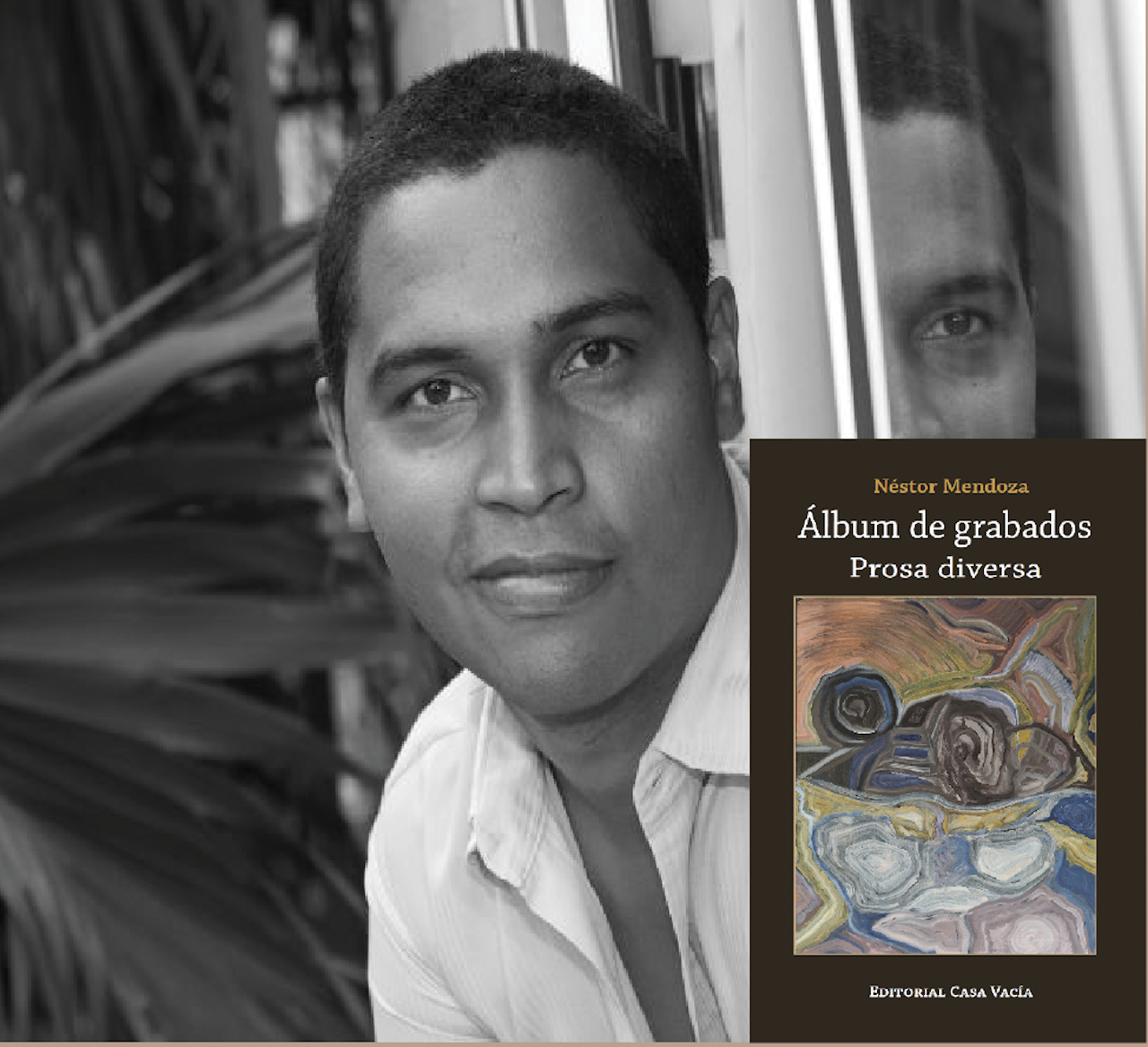
In Álbum de grabados (Casa Vacía, 2024), Néstor Mendoza (Mariara, Venezuela, 1985) brings together fifteen years of diverse prose worked as a set of plates: pages that demand a careful look to fix in time what reading and life reveal. From Venezuela and Colombia, a reader constructs his emotional genealogy with Mutis, Borges, Jiménez, Watanabe, García Márquez, and Duras. The book alternates between fragments, diaries, notes, and essays, seeking the difficult coexistence between unity and diversity. It also explores the prose of poets and touches on civic issues in “Espaldas y escudos”. These inquiries address the title and poetics of the album, biographism as a catalyst, critical admiration, the dignity of prose, and whether writing sutures memory and history. A dialogue that seeks to record against the transience of the screen.
The title of a work is its first threshold, a declaration of intent. You have chosen Álbum de grabados, a formula that evokes visual art and the work of the collector. Did you conceive this “diverse prose” as a series of plates that demand a careful, almost forensic gaze, in contrast to the fleeting nature of digital writing? Do you consider the essay a way of recording, of fixing in time what reading and life reveal?
I agree with the precision of your first question. It is a “close look” and also an individualized one. Each text had its time and its circumstances. Let’s remember that Álbum de grabados is a compilation that spans several years of writing and diverse territories: texts that I wrote between Venezuela and Colombia over the last 15 years. The title Álbum de grabados also comes from a photobook to which I dedicated an essay. I always wanted to bring together my prose writing. There is a bit of conceit in this, I admit. It is an effort to ensure that this writing overcomes the immediacy of digital platforms. I do not reject magazines and virtual spaces, as many of these texts were published there. But it so happens that after that “boom” in digital reading, these publications tend to be forgotten in the daily electronic avalanche. Hence the importance of moving on to a ‘unity’ offered by the publication of a book. And yes, with the essay I seek to “record” these reader’s tastes. A somatized reading, stained by the life of the author or work read and by my own life.
In the texts that make up the book, the presence of an “I” who reads, remembers, drinks coffee, and inhabits specific geographies is palpable. This method is similar to that of critics such as Sainte-Beuve, for whom the work was inseparable from the man. How fundamental is this personal anchorage for you? Is biographical circumstance the inevitable catalyst for your critical reflection or, on the contrary, a scaffolding that the essay must then transcend?
Reading and writing, as processes, always have an everyday context that invades them and, in many cases, conditions them. It is life that is there, at home (I always write at home), in that physically sedentary setting. It is sedentary because, in my case, I don’t usually read while traveling or while I’m out and about, except for strictly work-related matters. In other words, reading and writing for pleasure, which I do without the pressure of time or work schedules, that kind of exercise, is irrevocably anchored to the house, the desk, the sofa. So I would say that biographical circumstance (or biographism) ends up being the catalyst you talk about. Whether that process transcends that circumstance is something I cannot fully assess.
Your album is a veritable feast of literary presences: Mutis, Borges, Lerner, Watanabe, among many others. Beyond homage, what is the function of this constant dialogue? Is it about constructing a personal canon, an affective genealogy that gives meaning to your own writing? How does the critic distinguish himself from admiration so as not to fall into the same trap that you point out in Mutis’s work: a culture that “copies another poem” instead of being transformed and lived?
It would be a personal and circumstantial canon. Or rather than a canon (a canon has the stigma of being prescriptive), it would be a sample, a collection of small obsessions that appear at certain moments, when I am unable to put down certain readings, when they become one more pulse. That happened with the authors you mention, and especially with Juan Ramón Jiménez, who at one time attracted me, I’m not quite sure why; perhaps it was the interest in refuting him, in unmasking him, and in that way making him part of me. Sometimes one is “critical” because one is capable of admiring through prose. That admiration should not only be read, but also written: reading those authors and then writing something about them in order to establish that admiration.
In the essay ‘Expiación’ (Atonement), you reflect on “leap year essayists,” poets who transition to prose. Do you consider prose to be, as you state in that text, a “scapegoat” where conflicts that poetry cannot contain are resolved? Or is it, rather, a space with its own “dignity,” a workshop where critical thinking finds a freedom and discursiveness that verse, by its nature, tends to elude?
This comes from my own experience: I have noticed a bit of disdain, or a kind of veiled rejection, towards the prose of poets. And it is the poets themselves who deny this. Not all of them, of course. I once called a poet I admire a “poet and essayist” and he was a little upset. I don’t know if it’s because of that unnatural and unnecessary stance that we’re not always willing to digest. And this particularly concerned me because I quite often read his prologues and critical notes; this poet also writes real essays when he presents another author’s book, and even in the care he takes in replying to an email, his discursive will is evident. If that happens, it’s for a reason. Like a literary “endorracism.” The prose of poets continues to be a “scapegoat,” and perhaps there we can discern a poetics of negation or some inherited damage.
The book is articulated through fragments: notes, diaries, jottings. However, you praise the coexistence of “unity and diversity” in Mutis’s work. How is that tension resolved in your book? Does the unity of the whole reside in the persistence of a tone, of obsessions, or in the figure of the author himself, who acts as the thread connecting these scattered pages?
I think you’ve hit the nail on the head: I see that the self that “rehearses” in prose is a possible connecting thread. I approve of that diversity: the alternation of tones, rhythms, themes, and styles: the fragmentary nature of the diary, the narrative succession, the critical approach, the autobiographical notes. I like that perception of scattered pages, that the reader sees that apparent dispersion with some amazement. As for Mutis, he is an author who built himself up, and that “late” facet of him as a novelist defines him very well.
Nineteenth-century literary criticism often classified writers into “families of spirits.” If you had to define the lineage of your prose, where would you place it? Does it belong to the moralists, who explore the human condition through books? To the chroniclers, who bear witness to their time and their readings as an inseparable act? Or to the stylists, for whom the enjoyment of the phrase and the architecture of the paragraph are ends in themselves?
I think a little bit of all of them. And perhaps with more emphasis on the latter two aspects. When I reread my own prose texts, I am sometimes struck by the insistence on the autobiographical. It could be a flaw or distortion that comes from writing my diaries and that, without my realizing it, infects everything else. There is a determination to evaluate and judge, and that comes from a kind of “ethics” of writing; there is a willingness to look and tell, and that comes from chronicles and stories; there is a desire to polish, to speak with precision and “beauty,” and that is characteristic of an “aesthetics” of form.
There is a question that seems to float throughout the book, especially in the more personal texts such as “Intimidad exterior” (External Intimacy) and “Espaldas y escudos” (Backs and Shields): Is writing a way of suturing the wound between personal memory and collective history? Is the act of writing a book a way of ordering the past in order to inhabit an often chaotic and uncertain present?
The texts you mention want to record and want to be, modestly, personal memory. Of the whole book, “Backs and Shields” is the most social, the most civic, one might say. And it is the one that could have the most wounds. I wrote that text a couple of years before leaving Venezuela. One seeks a little order, everyday logic, meaning. And in part, this type of exercise offers that. I write of my own free will and eventually publish those texts. The past cannot be changed, but we can reinterpret it. I write for the pleasure of writing and sometimes on invitation. Those texts end up in some collective publications, in digital magazines, or unpublished; bringing them together in a book helps or contributes to bringing order to chaos. That chaos has many names. We know that chaos does not go away completely, but it can be controlled. That order brings a little peace.


