
I
According to an old tradition stemming from Romanticism, to be human is to be ill. And, paradoxically, it is within this peculiar alliance between humanity and the “genius of illness” that the human creature resides in its full and inviolate dignity. From the perspective of psychoanalysis—itself a metastasis of Romanticism—the American philosopher and critic Norman O. Brown wrote in his book Life Against Death: The Psychoanalytical Meaning of History that, within the biological world, there exists a disease called man.
If this strikes us as exaggerated or frankly pathological, it is worth recalling that the French philosopher and physician Georges Canguilhem—whom no one would accuse of irrationalism—emphasizes in his seminal work The Normal and the Pathological that diseases are simply the effects of mere changes in intensity: an exaggeration or disproportion regarding the normal phenomena of the biological organism—a difference not of kind, but of degree and intensity.
In other words: a quantitative alteration—hybris?—that does not entail a new condition for the individual; a “feeling of thwarted life,” reflecting a growth conflict in pursuit of a more accomplished and perfect form, concludes Canguilhem in his Writings on Medicine. Yet Canguilhem goes further than is sometimes remembered: the pathological is not the absence of a norm; it is simply another norm—a different normativity with a narrower margin of tolerance for error. The sick organism is not broken; it has adapted to the illness and established new rules of life.
This distinction is crucial: there is no ontological abyss between the healthy individual and the sick one, only a difference of degree, a tension of intensities between plateaus—if I may recall the thousand plateaus evoked by Gilles Deleuze and Félix Guattari. Health is a capacity, not a state that we lose at some point for some reason; health is the capacity to create new norms, to adapt, to falter, and to recover.
Within the field of philosophy, these ideas have also been a leitmotif for another French thinker, Gilbert Simondon. For Simondon, the individual is never a fixed, given entity but rather a process—a process of individuation emerging from tensions and a pre-individual charge that is never fully resolved. In his work Individuation in Light of Notions of Form and Information, Simondon describes the living being as a metastable system: a provisional equilibrium that is always at risk, constantly negotiating between internal and external forces. Illness is not an interruption of the individual but a crisis of individuation: the moment when the system loses its balance and gropes for a new order.
Closer still to the hard sciences are the concepts of dynamic systems and dissipative structures, as described by the Russian biochemist and Nobel laureate Ilya Prigogine. According to Prigogine, living beings are dissipative structures that maintain themselves far from equilibrium—which would equate to death—by consuming energy and matter exchanged with their environment. They do this to sustain their self-organization—that is, to sustain Life. Living organisms are not machines at rest; a state of rest, I repeat, would mean death. They are processes that sustain themselves precisely because they do not rest. When such a system becomes destabilized, it does not necessarily collapse. It may pass through a bifurcation point and leap toward a more complex order, remaining within the realm of Life.
To bring these two giants of thought together is to grasp a simple truth: bifurcation is a crisis—yes—a crisis that can also result in a richer, more complex individuation.
As studies in cancer biology suggest—regarding that disease which is not truly a disease, but rather a radical disorder of the immune system—this crisis reaches its most unsettling extreme and, at times—far too often—an extreme with no resolution. It is the individual’s own cells—bearing their very own genetic signature—that break away from the logic of the whole and proliferate without form or telos. Bifurcation—to return to Prigogine—does not produce a higher order; instead, it yields narcissistic self-absorption, pure growth devoid of differentiation or functional purpose, and proliferation without exchange with the outside: a deranged play of mirrors turned inward upon the organism, doing nothing but reproducing what is known as the cancerous clone. The biology of cancer is also the metaphysics of cancer.
Perhaps that is the gravest aspect: unlike other diseases, cancer involves no external invader to fight against. The “enemy” is indistinguishable from the “self”—as consciousness within the physical organism—and the individuation of the cell turns against itself. If we heed the American neurologist and pharmacologist Candace Pert—who suggests that the immune system is a myriad of mental fragments navigating the entire organism—we can begin to grasp the gravity of cancer and the difficulty of its “cure.” It is that very mirror, shattered into billions of fragments, that turns against the organism itself. It is those very fragments of a deranged “mind” that attack the body. A rebellion of the part against the whole, as Hans Jonas puts it in The Phenomenon of Life. Dynamis without energeia, Aristotle would say. Enormous potential, yet without purpose; the opposition of matter to form. In a theological context, the cancer cell would declare: *Non serviam*.
As a species increasingly severed from the natural world, we suffer from incurable diseases that—paradoxically—are precisely what make us human, “all too human,” to borrow the phrase from that great sufferer, the solitary figure of Sils Maria. To me, these incurable diseases are those in which body and soul intertwine—psychosomatic illnesses—assuming, of course, that such a thing as a “soul” actually exists.
Since I was but a child, I contracted several of these ailments. Or perhaps they contracted me. There is nothing far-fetched in what Proust observed: man takes refuge in illness to obtain the pleasure that life denies him. Though it is also possible that what I call my ailments were nothing more than bad habits—anxiety, a stutter, left-handedness—which I magnify out of vanity as I write these notes. Of course, there are others I do not mention out of modesty…
But of all these afflictions, perhaps the worst is this: I live watching myself. If I look ahead, I see myself: I am there. If I look behind, the view is less clear, yet I still see myself. Ahead, but without a future; behind, but without a past; on every flank, at every cardinal point, I am always there: a cloud of dust and rubble—a negative Narcissus, a contradiction. A Narcissus who desires to be timeless, yet is mercilessly destroyed by time.
What I am about to point out is a truism we constantly forget: the gaze can only see what is already within itself—an imprecise metaphor, yet an accurate one. Upon closer inspection, we cannot even be certain that anything exists beyond what we see, for all indications suggest that the visual cortex—as Ronald D. Laing observed in The Facts of Life—is itself merely another visual object within our limited visual field. If this is the case, then the visual world—what we see—resides within the mind.
This intuition finds a precise echo in the thought of the Chilean neurobiologist Francisco Varela, who, alongside Humberto Maturana, founded the theories of enactivism and autopoiesis. Before his death from liver cancer in 2001, Varela offered an intriguing reflection: serious illness—and cancer in particular—brings about a radical alteration in perception. The threshold of what is perceptible shifts. What we normally filter out—bodily rhythms, latencies, and internal textures—emerges with brutal clarity. Paradoxically, illness opens up perception in directions that health closes off. This is neither romanticism nor facile spiritualism; it is the phenomenological observation of a scientist. The sick body feels more, even if what it feels is at times unbearable.
In the Buddhist tradition Varela practiced and studied—evident in his work *The Embodied Mind*, co-authored with Evan Thompson and Eleanor Rosch—illness can become a path to knowledge: not in spite of the suffering, but by embracing that suffering as a middle way. Varela found a form of beauty in his own cancer—no longer aesthetic, but epistemic: the beauty of seeing more clearly, of inhabiting the body without the habitual anesthetics we use in daily life, which aim to artificially construct a homogeneous self.
Varela offers an indirect explanation of this in his essay “The Evocative Body: A Re-reading of Immunity,” included in his book The Phenomenon of Life (sharing the same title as the work by Hans Jonas). If immunity in a biological organism is the condition for its identity—and for what that organism can see and think—then the loss of this normative unity, which plays a role in the continuous production of that biological self, grants the organism access to “alien” contents of knowledge.
Another general rule seems to be that we do not love what we see—nor the way we look—when we gaze at ourselves insistently. We feel even less love for the shadow that appears mingled with a few glimmers of light; a shadow we can only see clearly if we consciously project it outward.
It is rightly said that our shadow darkens the world; and that, despite the perpetual fiat lux of the contemporary city—where there is no rest and screens never go dark—the world is increasingly submerged in its own shadow. This is a shadow that belongs to us, within an evanescent world that renews itself with every digital click.
Yet, we also need a world of twilight: a logic of feeling rather than of clarté—that clarity associated with harsh, vertical light and the sharp distinctions drawn by reason. Feeling, by contrast, is linked to the half-light and the undefined—to a soft, filtered light where the hardness and sharp edges of things dissolve; a maternal light that neither wounds nor harms, but rather embraces and cradles.
In her book Man and the Divine (El hombre y lo divino), María Zambrano wrote that tragedy—as a Greek literary genre—was the vocation of piedad (piety or compassion). Elsewhere in the book, she noted that *piedad* means knowing how to properly engage with “the other”—that is, with a reality distinct from our own human and historical plane of being. A compassionate reading of tragedy leads to this conclusion: man—as Baudelaire well knew—is a two-faced Janus, simultaneously victim and executioner. Sickness, hybris, and excess are symbols of humanity and, perhaps, its metaphysical key. Hence his dual nature: afflicted by illness, yet capable of expressing solidarity and compassion for the suffering other.
This is where the thought of Georges Bataille illuminates something that piety alone cannot name. For Bataille, the sacred is neither the pure nor the elevated, but precisely that which transgresses the profane order—that which exceeds, that which simultaneously horrifies and fascinates. In Theory of Religion, Erotism, and The Accursed Share, Bataille describes the sacred as an energy that shatters the boundaries of the individual, casting the self outside itself and bringing it into contact with something that transcends the logic of utility and preservation. Serious illness—and cancer in particular—produces precisely this experience: it casts the sick person and those around them out of ordinary time, out of the everyday economy of meaning. It is an involuntary, unchosen transgression, yet no less real for that.
Cancer, moreover, possesses a specifically Bataillean dimension: it is pure expenditure. Bataille conceived of life in terms of excess and squandering; the “general economy” is not one of accumulation but of expenditure without return. The sun expends energy without compensation; sacrifice expends life without utility. Cancer is a perverse and brutal form of this principle: the organism expends itself, consuming itself in a growth that produces nothing and is directed toward no exchange with the outside world. Yet, unlike the expenditure found in sacrifice or erotism—acts that open one up to the other, breaking the boundaries of the self outward—cancer is an inward-turning, autophagic, and enclosed expenditure. It is excess without ecstasy. Transgression without an exit.
Returning to the concept of compassion—and acknowledging that we are dealing with individual and biological phenomena—I believe it is not absurd to seek a social interpretation of them. This interpretation would entail knowing how to properly treat the other human being—the one who differs in terms of social and economic status, behavioral patterns, nationality, race, or culture—as well as knowing how to treat the sick and the illness itself.
It is evident that, as a species sharing a common destiny, we have made some progress in how we treat others—an attitude we outwardly express as love and compassion. Yet, we falter if, as individuals, we lack that same delicate and cordial relationship with ourselves.
More often than not, living seems to amount to little more than building a fortress to protect ourselves and surviving within it. Consequently, almost without realizing it, our feelings turn into antipersonnel mines—laid in a field where the child we once were still plays, only to be abandoned as we move forward with our lives. To keep going, we must step out of that space: we need to embrace ourselves and treat ourselves as “another”; we must practice hospitality toward ourselves—for only within that “other” can all other people truly be fully present.
II
It is four in the morning in this God-forsaken solitude, with the temperature at minus two degrees Celsius across the vast pampa surrounding me—flanking the quiet community where I live. In this frozen silence, the waking mind turns inward, gazing at both its outer and inner self. Like the heavy blanket of fog outside, insomnia seeps into every fiber of my body and memory. It is the dead of night, and I find myself in Cuba—a sort of tropical Hans Castorp—walking the long corridors of the Onco-hematology Ward on the sixth floor of the Juan Manuel Márquez Pediatric Hospital in Havana.
I walk, as I do day after day, barely glancing through the sealed windows into rooms that are almost always shrouded in shadow; these are the rooms where children with various onco-hematological diseases lie. There are rooms of absolute silence, their windows covered by green cloths…
In these rooms, where the silence is overwhelming, the doors stand ajar just enough to reveal tense, pale, and haggard faces—and an indefinable “something” about them, something I have no desire to describe in these notes. Here, the fluorescent lights never go out. That light—a terrible, stark white—stings the eyes of anyone walking the dim corridors. There is a fear of the darkness and of what might be lurking within it. It is the uncanny made real, not literary; a shock that casts you into what Susan Sontag called “the night-side of life.”
I know that, in a sense, I am turning illness into a metaphor. I also know that, in her essay Illness as Metaphor, Sontag lucidly warned against the temptation to turn cancer into a metaphor—a metaphor for repressed emotions, for unlived lives, for something that “consumes you from within.” That metaphor, Sontag noted, places the blame on the sick person, holding them responsible for their own destruction. And yet, the brilliant American essayist also knew—and experienced firsthand, having died of myelodysplastic syndrome—that serious illness brings about a radical shift in one’s existence. Her dark, romantic image of the “night-side of life” is not a poetic metaphor; it is a phenomenological description. The seriously ill inhabit an opaque present in a different temporal realm. The future shrinks, yet the moment—sometimes painful—becomes unbearably real. That existentialist concept of “being-towards-death”—an abstract possibility lending authenticity to existence—ceases to be abstract in an onco-hematology ward; it transforms into a concrete timeframe of life and hope, into a tangible, emaciated body, into a real, gaunt face seen through a pane of glass.
When we pass by these “marked” doors, a kind of almost sacred horror grips us. Here—as in so many children’s folktales that veil the horror and mystery lying at the foundation of the universe and of existence in its rawest form—one neither looks nor asks… we all know what it means.
That “almost sacred horror” is not a rhetorical flourish. It is the precise description of what Bataille understood as the experience of the sacred: the irruption of something that transcends the realm of the useful and the everyday. For Bataille—as for the German theologian Rudolf Otto—the sacred is neither reassuring nor lofty; it is terrifying. It is the energy that shatters continuity—the temporal thread of the individual and their consciousness—and hurls them toward something they can neither control nor comprehend. In that sense, those rooms with their green-covered windows are sacred spaces in the most forceful and real sense of the term: spaces where the profane order of life—daily routines, the logic of survival and self-preservation—is suspended. You may enter with your usual mental frameworks intact. But the person who enters—and emerges, as if from an initiation rite—carries something they did not have before. They carry what is, for humans, perhaps the most sacred thing of all: the awareness of death.
I walk down the endless corridors, glancing out of the corner of my eye. I walk, and though I want only to focus on my own problem, I cannot help but look and listen. What I see—beyond the massive Fowler beds holding diminished bodies, the oxygen outlets, the metal stands bearing multicolored chemotherapy bags, and the supplies of dark blood and platelets for the sick—is a total collapse: physical, emotional, and spiritual. Yet, paradoxically, I also see laughter and hear music; I even see mothers and children dancing…
Perhaps I had to traverse those long corridors on the hospital’s sixth floor for so long to understand that this age-old dichotomy—between light and shadow, health and illness, reason and delirium—might be nothing more than a false simplification. It is one of the many reductions upon which modernity has built the gigantic prison in which we live with “happiness.”
Through Simondon, we come to understand why that dichotomy is false at its very root. A living being is never a dual unit closed in upon itself; rather, it is a system in a state of constant tension, permeated by what Simondon calls the “pre-individual charge”—a reservoir of potentialities that is never fully resolved into any single individual form, let alone into some kind of duality.
Illness does not exhaust this charge; it redistributes and reorients it—and, paradoxically, sometimes intensifies it. That is why one of the most remarkable phenomena I witnessed was the surge of vitality sometimes seen in terminal patients; for it seems evident that illness and its final stage—death—do not entail a steady, continuous decline in potency. At times, there is a kind of condensation before the collapse, an ephemeral reorganization of vital forces.
Thus, I saw a fourteen-year-old boy, consumed by leukemia, lying in bed and suffering like a Christ painted by Matthias Grünewald; yet, a short while later, I saw him laughing and dancing, half-naked, in the ward’s corridor. He died the following day… One is led to think that there are patients who, on the threshold of death, become more fully themselves than they ever were in health. Not because illness is good—it is not—but because the crisis of individuation it triggers can liberate dimensions of being that ordinary life keeps repressed. Another example of this—now oriented toward Life—is found in those dancing mothers and children I so often saw in that ward. It is not the contradiction it might seem to an outside observer; rather, it is evidence that human individuation possesses resources that medicine—and the logic of fear—cannot foresee.
I am not naive about this need to look, this morbid curiosity to observe destruction and death—what psychoanalysis calls the “scopophilic drive.” It seems contradictory, yet psychoanalysis has linked this need to the urge to know, understand, and discover the world—to make it our own. The metaphor of Oedipus and its many associated themes fits perfectly here. His craving for knowledge—”intimate and total”—leads to lifelong blindness; and with that blindness comes a limit on our capacity to observe the uncanny: we are not permitted to behold everything.
It is difficult to look at and witness these contrasting images that refuse to leave one’s memory—sick mothers and children dancing—and even harder to find the adjectives to describe them, to give them their due and necessary weight. I believe human life is a fragile, tiny vibration, clinging desperately to a greater Life; a vibration of warm matter that—as the Gnostics well knew—can at any moment break free from that “pre-individual” vital space and fall into a cold, empty universe. That is what I think after so many years grappling with the Grim Reaper. To anyone reading these notes, I offer another possible interpretation.
Little by little, I came to understand that my duty—almost an obligation—was to look; and not merely to look, but to greet and even smile. To look outward, rather than just at myself. I have also learned that we have the right to be looked at and, above all, that we need to be seen.
I am reminded now of Hervé Guibert’s semi-autobiographical novel about his own experiences as an AIDS patient. For the French author, the most important thing was not to chronicle the progression of his illness, but rather the “crossroads of destinies” radically altered by the disease’s presence. Cancer, too, is a crossroads that strikes and shakes up everyone’s lives. It is said that, in one way or another, everyone in the patient’s circle falls ill. This, in my own case, reinforces what I noted in the opening paragraphs of these reflections.
Let me give an example: I had a dream when my daughter fell ill nine years ago. In that dream—or rather, nightmare—my daughter and I were hiding in an abandoned building. Amidst the total destruction and ruins of that building, metallic creatures with long, matte-sheened tentacles—resembling the alien invaders from H.G. Wells’s The War of the Worlds—were hunting us down in a setting that also evoked the peculiar camera angles found in David Lynch’s films. We eventually managed to escape. Interestingly, that was a novel I had read as a child. And, as is evident, here we find everything—or nearly everything—that makes us human: illness (my ten-year-old daughter’s leukemia), the violence the disease inflicts upon the body alongside the violence of those alien creatures, and repression and sublimation transformed into nightmare—in short, culture itself, to borrow a concept from Norman O. Brown. There is a saying we Cubans use to emphasize the necessity and inevitability of certain situations: there is no such thing as coincidence.
When you reach this crossroads of destiny, you realize your life is like drifting debris; yet, just as the pain begins to drag you under, in a split second you start to break free from that sense of aimless drifting—from that feeling of pettiness and misery that makes up the fabric of everyday life. And in some strange way, one is grateful for this; though I know it may sound “monstrous”—as monstrous as a cancer cell.
III
It is four in the morning, and I am in the southern part of the Americas, seven thousand kilometers away from Cuba, from Havana, from my home. Far from my dead, from my books, and from the memories that bind me to a specific culture; far from my daily routine—my morning coffee, the table and computer facing my small garden, the place where, day after day, the city would unfailingly wake up around me. It is the dead of night, and I find myself thinking about destiny and its absurdities. I have always suffered from mild insomnia, but I never imagined I would have to grapple with this inability to sleep in the middle of nowhere—a fact that only reinforces the inherent absurdity of my current situation.
I have just lost a piece I had just written about the Japanese poet Bashō, his Zen experience, and the haiku within the *ginkō* tradition—the practice of “walking and composing.” There was Bashō, the wandering monk, on an unremarkable afternoon—as unremarkable as any other—walking through a forest… in the cold of autumn.
I imagine him walking with a heart like an old tea bowl—broken and repeatedly mended with gold dust: a cracked, ailing heart, yet one devoid of bitterness. He walked mindlessly, as he often did, accompanied by that persistent, tenacious melancholy that defined him. Thus, at the edge of a small grove—an edge that was also the boundary of the universe and its terrible emptiness—he looked and beheld the dignity of a poet reduced to nothing, to no one. And with the clear, serene despondency of one who has suffered—a state of mind no longer anchored to any place, having instead taken root in the wind and the fleeting cloud—he arrived, in a single instant, at this Enlightenment, expressed in a haiku:
No one walks
Along this path
On this autumn evening,
This very day.
As if by an unbreakable chain, that lost text led me to these early-morning notes. And since I cannot bring myself to accept that life is merely a random arrangement of events, I would like to believe that the loss served as the pretext for this “little life” to write these lines—lines meant for looking and for being seen.
If I recall correctly, it was Eliseo Diego who, in an essay on Hans Christian Andersen, called this transcendent experience of looking and being seen simultaneously the “secrets of attentive gazing.” Of course, to have similar experiences, one need not practice Zen Buddhism, be a haiku master like Bashō, author the folktales that veil the horrible void underpinning the Universe like Andersen, or write the intimate, mysterious, and memory-laden poetry of Eliseo Diego. I know that the same thing has happened to many others, and that it is a universal human experience.
Losing the text saddened me. I looked at myself and thought: Nansen, you are attaching importance to things that are utterly inconsequential…! Sad is the loss of another life amidst the most absurd daily reality of a nation that, like Cuba, drifts aimlessly, without a destination. Sad is the extinguishing of another life—lives you have witnessed during these years of your daughter’s illness. And sad, too, is the fact that, as Juan Ramón Jiménez put it, we “depart,” while outside, the birds go on singing. That lost text and what you are writing now are inconsequential: you are not Bashō; you are no one. Above all, that is it: you are No One. That is to say, someone who, in the cold, sleepless early hours of the morning, looks… and wants to be seen.
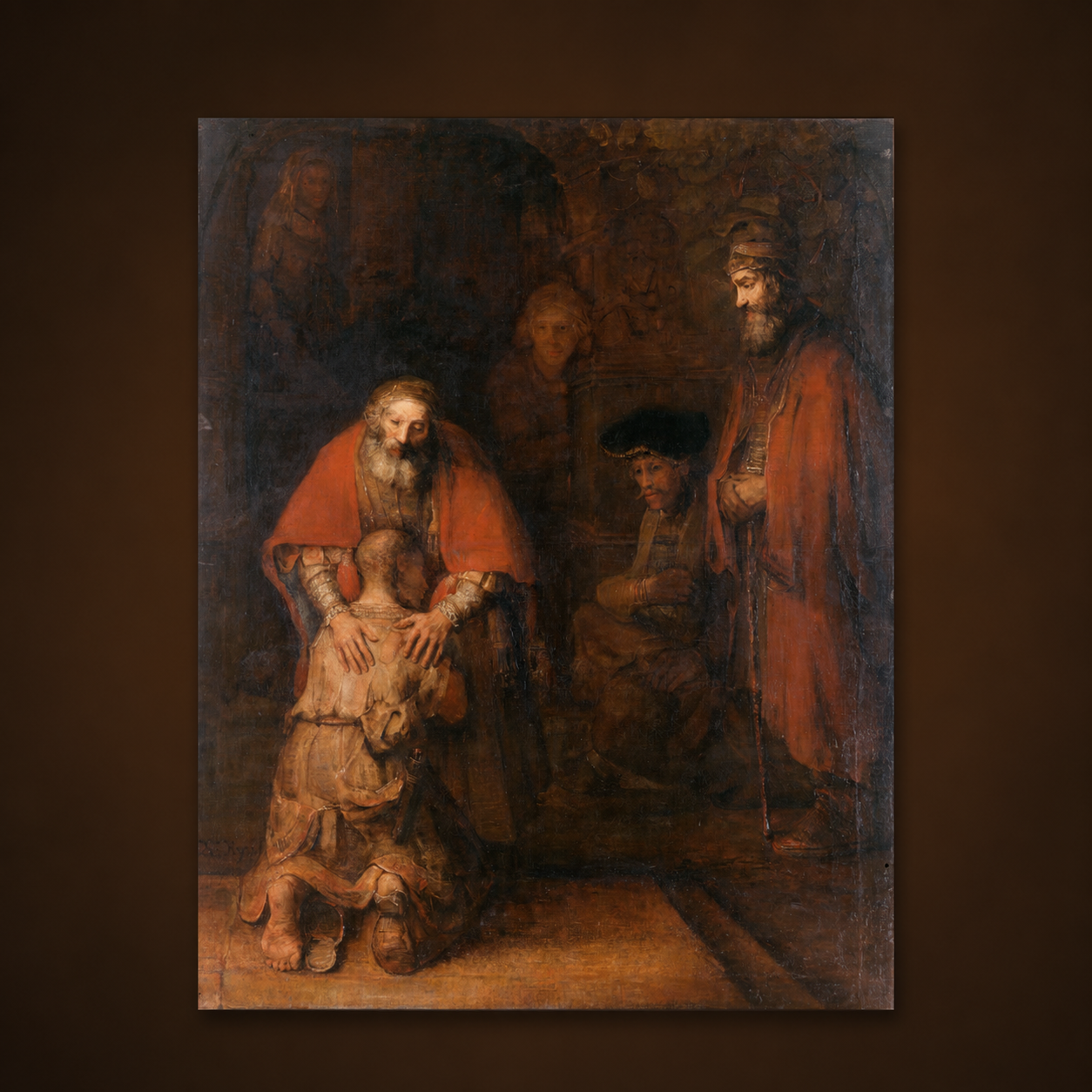
Image: The Return of the Prodigal Son (1661–1669), by Rembrandt.


