
Perhaps unintentionally, with Malincuor (2025), the selective publishing house Casa Vacía celebrates the sixtieth birthday of Peruvian poet, essayist, and editor Maurizio Medo. It also celebrates a promoter of the fragmentary as fracture, echoes, scraps… of contemporaneity.
At first glance framed by the testimony of everyday obviousness, the author of Manicomio and Backstage intertwines diverse cultural scenarios to expose even the unfinished nature of some texts, what they are and what they can be. Malincuor is a book of synthesis—not of farewell—that confirms a peculiar poetics, enlivened and defined more by the journey than by the destination.
By choosing Malincuor as the title, Medo also reaffirms the contrast, where past and present end up overlapping. The discomfort that might affect the lyrical subject for missing something too much is, nevertheless, a projection unrelated to melancholy. But how can one speak well of hard times without expressing resentment? By virtue of memory and, above all, imagination, the protagonist dialogues with history. Although he knows that poetry does not come about for that reason. Now it is a question of locking in not what is exact and verifiable, but what can be perverted, strictly speaking, to make it more real. Real? In section 21, he writes:
Better to take off my blinders and write another line:
my mother died.
Should I say instead that she was transformed into a song?
Mom is not dead.
She is with me.
She takes my orphaned hand, twice a mother,
and I bury the child who once dreamed of me.
Now it is dark.
I am also that song.
What is real and when does it penetrate the territories of the imagination? When writing in Malincuor about the father, the reader is told: “Language, he thought, is useless if what one seeks is to know the truth, since it allows only a desperate approximation, which will always be doubtful.” The ephemeral versus the imperishable then reverberates. But what, in principle, is imperishable in the face of the onslaught and unrest of images? What are images if not our multiple ways of looking at them? Images in the reconstruction of memory or the settling of oblivion that is barely mentioned: does it predominate because of its supposed absence? “What is remembered is what is not there.” Writing of possibility even from a distance: “Today we sustain a dialogue that arises from the absence that runs through the present, / abysmal in the infinitive of evocation, / the same that forces me to warn you: / better not come to my house.”
As for the extensive prologue by Uruguayan Eduardo Espina on contemporary poetry, it is not only acceptable for its amenity but also for knowing how to insert the estimated particularities in Medo’s poems at the right time. At one point he confesses: “What is easily assimilable and supposedly intelligent on a first reading free of demands is in vogue.”
Regarding the prologue—perhaps dispensable due to its influence—it is sometimes difficult to rearrange one’s own chain of images or even the collapse of them. Medo himself says:
I was born in the last car of a train called Europe.
That’s not exactly how it was, but I would have liked to start with a phrase of that caliber, one whose clamor is very similar to the sound of a dambura breaking the strict silence of the Balkan mountains.
Added to this is the weight of Espina’s words in his prologue, when he recognizes in Medo: “The visual resonates in the auditory. Consequently, the acoustics of the effort accentuate the veracity of seemingly incompatible planes. Optical lyricism, optimal acoustics diversified by similarities. Medo speaks. Hello, hello. Let’s listen with him.” It then becomes difficult to write. In attempting a review, one may be tempted to abandon a prologue of such magnitude and lucidity. Leave it for the end. That might have been the most convenient thing to do. But one is tempted to finish reading it.
A subject dear to Medo’s writing is his attention to the architecture of the book, whose structure he sometimes questions (“The idea concerning my father should have been at the beginning of the book”) or when he returns to it later: “The editor noticed that I repeated hero nine times. If I am repetitive, it is not out of euphoria; I cannot betray my ideals. I try to convince myself: it’s because I’m skeptical.”
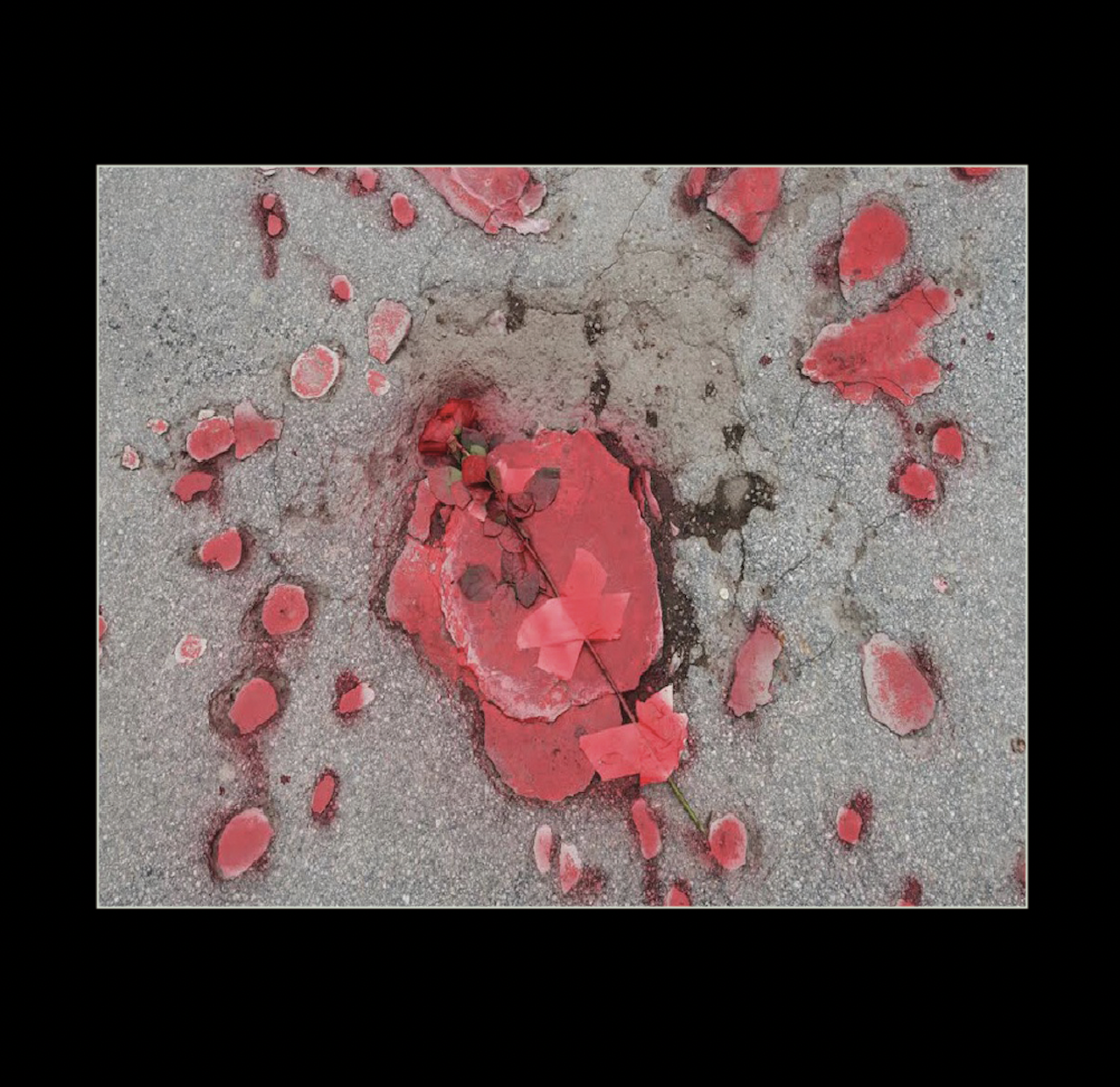
The book’s design is also attended to by the photographic record, which expands on the dialogue or, better yet, the play with the memory of memory that is photography as a substitute for experiential reconstruction. With all that this implies in terms of initiative and inventiveness. Initiative and inventiveness are nothing more than synonyms for imaginative wit or witty, fictional imagination. Isn’t imagination always an impulse of wit? Medo’s occurrences are based, as is well known, on insistent puns superimposed as interferences. But for him, imagination is noticing everything he sees in order to rearrange the unexpected in everyday life, in what is supposedly common and habitual in the eyes of the viewer, such as his direct and indirect conception of the landscape: people as landscapes in sourness or constantly reconfiguring themselves. The landscape likewise as present and past, as specific cultural spaces—see in it the cinematic references not only as mere memories but as ontological allegories—; history and writing itself as landscape: All languages rushed to meet me, though none knew how to say welcome, illuminating the perspective that was once promised to them.
Prose that mimics diary entries, the ephemeral instance with a thirst for the permanence of biographical moments, epistolary writing. Paragraphs like fragments of stories. Sentences like a collection of answers without questions.
The Remington was my first toy. It made presents.
Mom got lost in the woods of Loano.
War had broken out.
She never came back.
Not as she was.
The Remington was assembled around that same time.
Afterwards—or from the beginning—the leap from the external and internal experience of an atmosphere, for example, to the relationship with others. And, of course, time in its variable scenarios and, of course, the train as a vehicle, space, journey, dream… a metaphor for the passing of life.


