
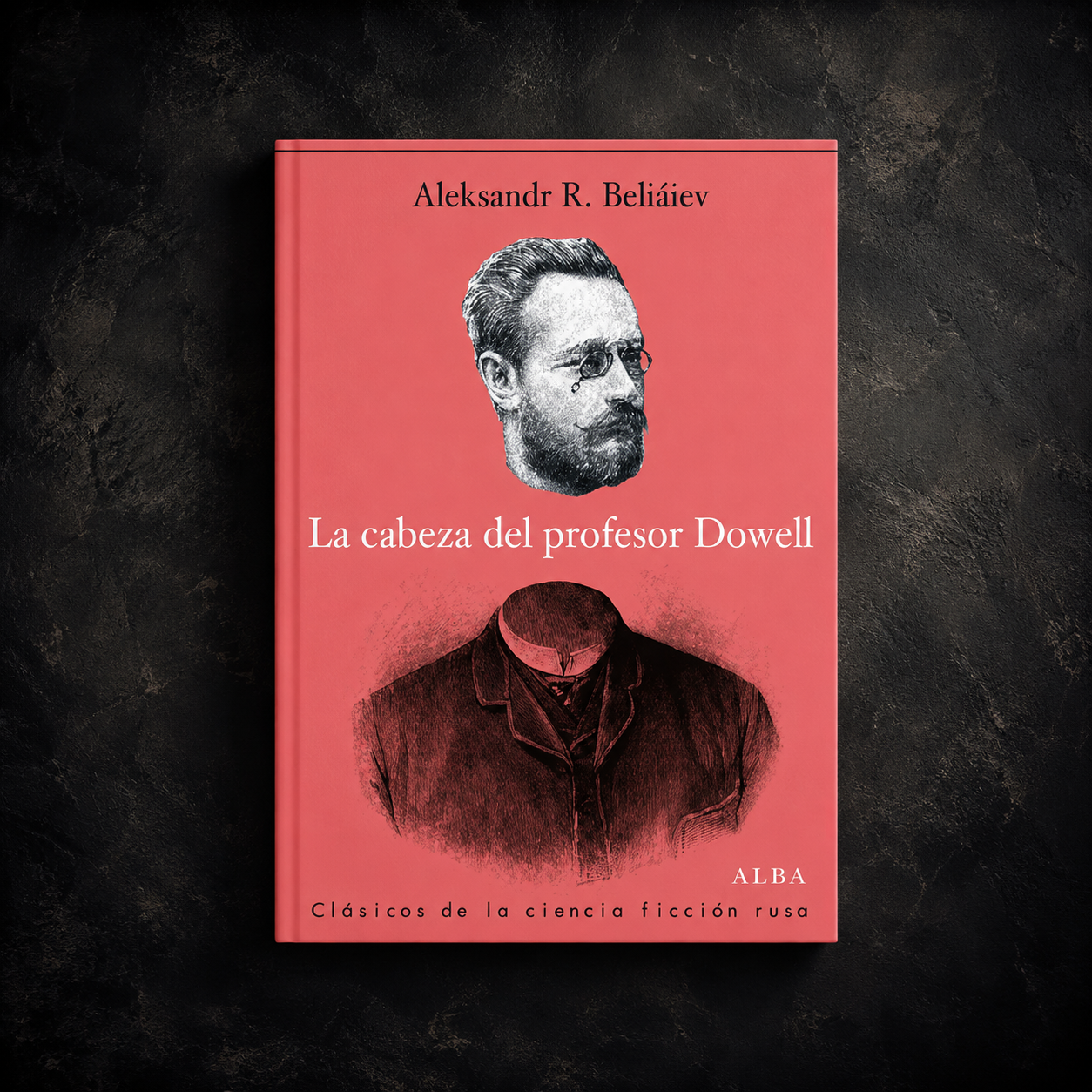
Professor Dowell’s Head, published in 1925, is one of the most disturbing novels by Aleksandr R. Belyaev and a central piece of interwar European science fiction. Its strength lies not only in the audacity of its premise—the artificial preservation of a living human head—but in how that idea unfolds as an ethical and narrative problem, sustained by precise prose and a remarkably effective structure. In Alberto Pérez Vivas’s translation, that original clarity is rigorously preserved, neither smoothing out the text’s conceptual harshness nor softening its deliberate dryness.
The characters are outlined with economy and precision. Kern is not a cartoonish villain, but a scientist consistent with himself, whose cruelty stems from an instrumental conception of knowledge. Dowell, reduced to a talking head, embodies one of the most disturbing figures of modernity: consciousness separated from the body, reason deprived of action. His voice, condemned to observe, functions as the narrative’s moral center. Marie Laurent, for her part, does not fulfill a romantic function, but a critical one: she is the point of friction where the experiment ceases to be abstract and becomes intolerable.
In the European landscape of the early 20th century, the figure of the amoral scientist is not exclusive to Belyaev. It also appears, with a more unbridled and adventurous tone, in authors like Gustave Le Rouge. The difference is decisive: where Le Rouge pushes science toward fantastic excess and limitless imagination, Belyaev subjects it to rigorous clinical logic and a precise ethical question. There is no lineage between the two, but there is a common problem addressed from opposite registers, which allows Dowell to be situated at a turning point between scientific adventure and modern reflection on the body.
Published in a context of intense debates over physiology, vivisection, and the limits of medical experimentation, Professor Dowell’s Head dramatizes real tensions of its time. Its impact was considerable and generated a line of subsequent stories centered on the fragmentation of the body and the artificial survival of consciousness, although few works achieved its balance between conceptual clarity, narrative tension, and moral density.
Belyaev’s singularity lies in having written science fiction without grandiosity, where horror does not come from the monstrous, but from the coherent application of reason when it emancipates itself from all human responsibility. Almost a century later, Professor Dowell’s Head, published in Spain in 2013 by Editorial Alba, remains an uncomfortable novel not for what it imagines, but for what it dares to think with exactitude.


