
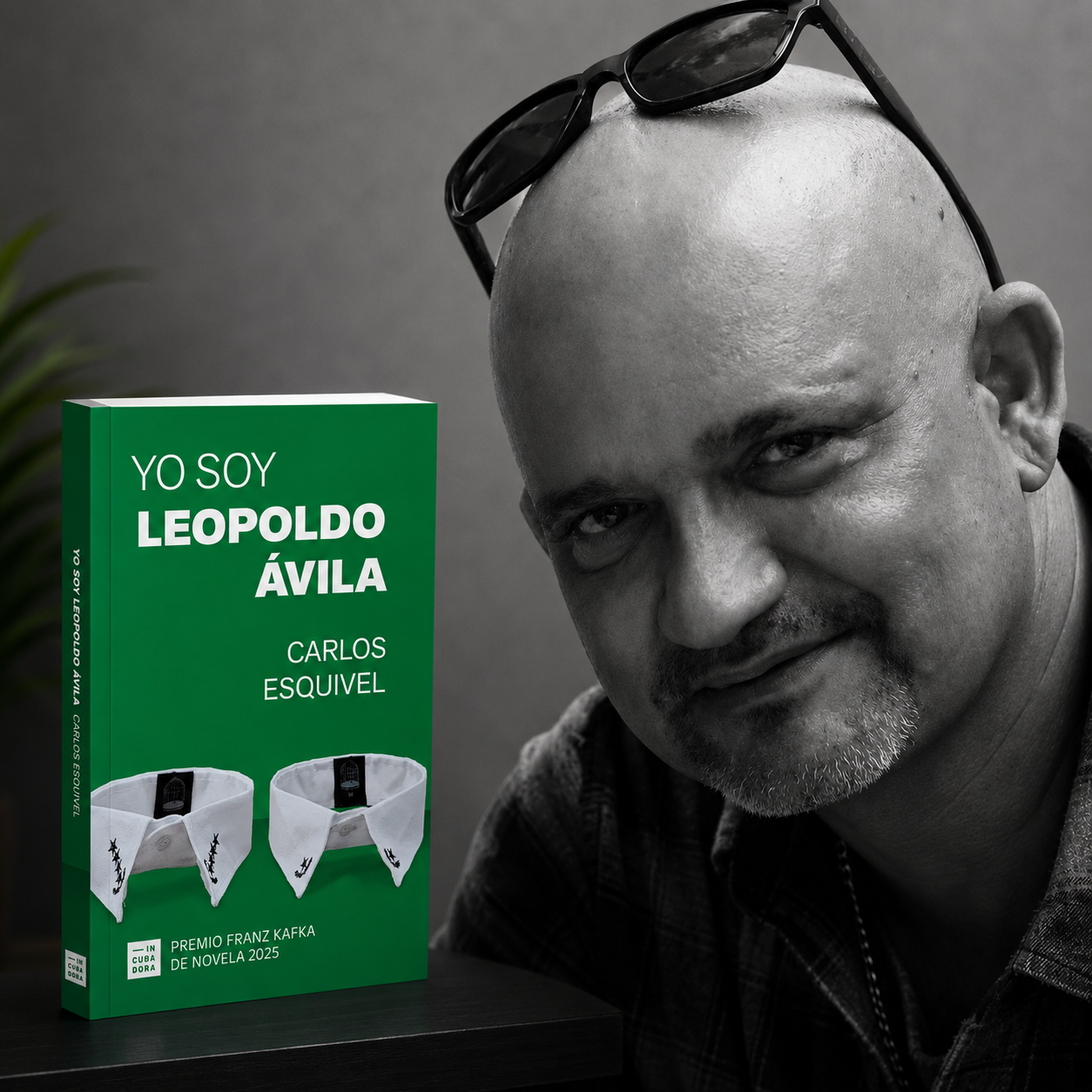
The Cuban poet and novelist Carlos Esquivel (Elia, Las Tunas, 1968), recent winner of the Premio Kafka de Novela 2025, answers questions from the editors of Bookish & Company.
Your winning novel retrieves Leopoldo Ávila, the controversial pseudonym used in Cuba in the 1960s to attack intellectuals. In the book, a character wonders what is true in his life. Is this novel a settling of accounts with historical memory, or an exploration of the fragility of identity under the weight of the mask?
I am a distorter. It is in my genes, and not only in the literary ones. So I am interested in taking so-me process from history, especially our own, and making it more difficult, stirring up those sphe-res. I have done that in several of my books, with greater or lesser fortune. Fiction is more captiva-ting when it seems false and real at the same time. That is what I want to believe. Leopoldo Ávila’s grandchildren go out hunting day after day, night after night. Disaster becomes splendid when tho-se who carry it out wear anti-idea vests. The hunt has not stopped; it abated at some point, then it looted, cloned, stirred things up again. The symbolic rash, ideologized beer, the punk riff of the limping, exemplary informant: furious snapshots of the national ghetto. Some of Leopoldo Ávila’s grandchildren have gone over to the enemy film; others have become disenchanted with the trade and recite poems about ecological pirates or absent-minded Greek nymphs.
People say of you that you are an author without blocks, whose writing flows as so-mething consubstantial with the act of breathing. How do you manage to sustain that tena-cious drive in an environment that, as you suggest in your book, often prefers silence, tedium, or obedience?
I do not like the obedient; I have said so everywhere. I do not like the submissive. I prefer co-wards, those cowards who adapt their territory to a more ungovernable seclusion. There are a few like that. With them I can share bands, join together to disbelieve the contrary lesson. The coward’s idyll dies in his own house; it cannot become anything else, or perhaps it can, but in the excess of that condition there is an overflow of strange courage. I am interested in describing the unbridled identity of the person who is alone, infected by disasters similar to my own.
Your biography also tells us that you come from a sugar mill town, now dismantled. This is the old topic of natural aging in the countryside set against the political voracity of the city. In what way has that landscape of emptying towns shaped the atmosphere of your cu-rrent narrative work?
Most of my literature is urban. And yet I am proud of where and how I was born, in a mysterious back-and-forth between nighttime roads and lost towns in Camagüey and Oriente, in my father’s car. There my mother launched me into the world, and perhaps that is why my contingencies have been so tempestuous, so kinetic. Mystery can fit inside a German television series or an infernal book by some infernal author. I am not going to correct the silhouettes of my birth, nor those of living, creating, growing up, from a little town I have loved with brothel-like intensity. As you know, I am a feverish reader, hallucinatory, I would say. From those readings I have spun fables about countries and places I never saw, even in Cuba. Perhaps I even invented them, though they already existed. It is a crude, traumatic, and beautiful theory I make use of when I want to seem more dazed than I really am.
In the pages of Yo soy Leopoldo Ávila, the protagonist states that death forces you to speak with the dead you knew in life. Do you consider your literature a kind of “Echokammer,” or echo chamber, where you try to preserve the voices of those who, like Heberto Padilla or Virgilio Piñera, were pushed to the periphery?
Dead writers, living ghosts. Collecting characters who serve a reality imposed from the most gro-tesque fabulation. Above all, I like to philosophize with the fate of many of them. I found them on the periphery, as you say, because they were reviled just as I have been, because I feel devotion to a form of irreverence that originates in the most subterranean stratum, in the most purulent one. Of course, my novel begins by saying that if you write things as they happened, you will end up lying. I believe one must tell the truth many lies so it will calm down. That dilemma between fiction and reality, for me, for my literature, has been entirely resolved. Reality and fiction united will never be defeated.
Those of us who know you and have read your books know that certain moments in your biography, such as the war in Angola, have left a deep mark on you. Is that experience still a scar that dictates the rhythm of your writing, or has it been transmuted by the exer-cise of fiction?
Personal traumas cannot be bribed, mine at least. It is a strange treasure. I went to war, and a war gives you other traumas. It does not take away the ones you already had. In Angola I began writing rough, simple-minded poems. Those poems are still behind me, just like the nightmares. I do not think such traumas are fascinating. Many people who sympathize with you believe they are. I have no intention of interrupting those delusions. One is not a better or worse writer because one goes through tense, horrifying situations. Perhaps what I am saying is not entirely true. I wrote a great deal of poetry on that subject and a story, “Los agujeros negros.” Three or four years ago I finished a novel about my campaign days (let us call them that) that is still unpublished. What the war did to me was to throw out of control my joy in the things I assumed were sacred. I was a mercenary and didn’t know it. I was a poet and didn’t know it.
In the book you mention that “ghosts disappear faster than the dead.” After receiving the Kafka Prize, do you feel that this recognition gives your work a “definitive visibility” against the anonymity sometimes imposed by the province, or by censorship and the limi-ted circulation of books by Cuban authors?
I do not think so, and I would like to tell you that it does not matter, but it does. I have been patient, measured, even proud, and none of that is of much use. I know several writers in this country who have nothing whatsoever to envy in figures planted in the diffuse hierarchies of our language. The blame was badly distributed; so were the talents. I am inspired to decompose any cycle that threatens me, including the one of supposed transcendence. Meanwhile, I write in order to despise my own tiny immortality.
There is the myth of a novel of yours recommended years ago for the Premio Herralde and then never heard from again. Is Yo soy Leopoldo Ávila part of that sediment kept for years, or is it a new “unwanted birth” that arises from your need to escape the damned cir-cumstance of silence?
The publishing world moves at a speed very different from that of a great many writers in Cuba. If you do not have a kind of manager or representative, a Curtis Brown, an Andrew Wylie, or, if you prefer, Antonia Kerrigan herself, to defend you—or, to a delirious degree, to grab the Jorge Mén-dezes, the Jonathan Barnetts at field level and get them to take a gamble on you—you have already lost half the battle. The battle in that league of virtuous publishers. No one is content to fight in the fourth or fifth division. La tumba del erizo was a finalist for the Premio Herralde, and I did not ha-ve, nor do I have, a representative, agent, manager, or anything of the sort. I missed the train, the promotion to the Liga de las Estrellas. I put the novel away and nine years later sent it to the Premio Italo Calvino, and it won. But it is not the same. Yo soy Leopoldo Ávila flows in a similar direc-tion, although it belongs to an almost systemic desire in my writing: the dissection of the anarchies of power over the masses and the absurd attire with which culture strolls its scruples and torments through those landscapes. I did that in Diario de Caín (2016), H (2020). Political novels? Perhaps as clandestine illumination, as symbolic indulgence. Politics does not attract me. Politics is the spectacle that always seats fools in the front row. I like to sit in the back.


