
I am a poor reader, or at least, one could say, an inconsistent reader. This statement could be taken as the modesty of another municipal sage who wants to be presented as a scholar, or worse, it could be taken as the insolent gloating of that boy who believes he does not need to read to compose his amazing lines, but I swear that I make this confession with all the force of truth that language allows. I have completed a master’s degree in literature and I do not feel that my reading has deepened much. On the contrary, some of my readings, now distant, have shrunk like vestigial organs. I say that I am an inconsistent reader with open shame and without seeking anyone’s pity.
I come, without a doubt, not from a generation of inconsistent readers, but from an era of lazy and inconsistent readers. Not only do most people my age, and those younger, read little, but even those who used to devote considerable time to reading have changed their habits. Of course, the gaps are less noticeable in them, because their past reading tends to compensate for the sterile hours of the present. And if we listen to them talk about books, it almost seems as if everything is in order. But if we pay close enough attention, we will realize that reading is difficult for them. In other words, they too suffer from this unheard-of syndrome of reading being an immense effort. Reading should not be an effort, and yet now it is.
If we exclude professional readers, that is, teachers and academics (for whom reading and the industrial production of papers is a means of subsistence), the number of people who read more than a couple of books a year falls to a painful proportion, further inflated by a type of reader who is benign but closed in their cheerful complacency. I am referring to the type of reader who does not go beyond one author or one genre, or at best one subject. I include here the reader of fan fiction and the reader of sagas, but also the activist reader and the self-help reader. All these habits, of course, are valid and have always existed, but they have the flaw of often restricting the horizon, concentrating the world into a handful of commonplaces. What is increasingly difficult to find is a cross-cutting reader, someone who delves into old authors for pleasure, gives new ones a chance, explores different languages without timidity, is able to tolerate different registers and conceptions of literature, and devotes themselves to reading not as someone who is fulfilling a tedious task, nor as someone who is seeking respect, but as someone who enjoys thinking in silence. I am not this kind of reader, far from it, but I am aware of their existence, and I wonder if their growing rarity (the rarity of “cross-readers”) is a product of segmentation in the publishing market, of a lack of time and energy, of the need for easier and more immediate stimuli, or of all these things together.
There is no shortage of pamphlet optimists who claim that the lack of reading is now compensated for by other intellectual activities, and that only the medium is changing, but what they do not seem to understand, or even glimpse, is what differentiates literature from other human phenomena, what differentiates language (these words, their flaws and successes) from the contemplation of images, for example. And it is nothing other than the fact that literature plays with the most important function that has distinguished the species. I will try to explain myself.
Painting and the visual arts play with a repertoire of instincts and learnings from our eyes and those of our ancestors. The pleasure of symmetrical images, of balance, the uneasiness of black and the fullness of white, the calm of open space, the glow of dawn, the distrust of cracks and dampness, and the fear of night, constitute evolutionary wisdom with many parallels in the animal kingdom.
Aesthetic sense is nothing more than the touch of a prehistoric memory, which is of course conditioned throughout life and experiences. Painting and the visual arts play with these wisdoms (happily misappropriating them), confirming or subverting them, in the same way that cooking plays with cravings for fat and sugar (scarce and useful resources in the wild), with the accent of salt, or with the confusion caused by spices. Sounds also hold memories, and music has been adept at exploiting them. Howls, gallops, and blizzards overlap in sound textures. Few human expressions have evoked such profound wisdom as music. And it was from music that poetry was born, but with an unforeseen contamination that would change our destinies: the contamination of language.
Words distance themselves from the ancestral wisdom of our senses and create their own domains, creating empirical knowledge, a “science” (I refer here to the etymology of “science,” which in Indo-European means cutting, dissection). Words, which taught us well to distrust appearances (of increasingly useless natural wisdom), classify and filter the world, but with a blinding arrogance and dangerous autonomy. A painting contrasts the natural wisdom of the species with acquired wisdom. A poem stands alone. Nothing (beyond what has been acquired) directly supports it in our bodies.
Literature plays with knowledge and the classification of the world in the same way that painting plays with the prudence of our eyes. Just as cave painting rethought the wisdom of our eyes, the ode and the hymn rethought the wisdom of words. That is why literature is different, because it is a second-order game, in which the faint ghosts of the world converge.
What I am about to say may sound very radical, but philosophy could never have emerged from painting or music. Rather, music and painting as we understand them (with the philosophies implicit in them) exist within the words that have explained them, and not outside them.
I do not mean (not in the slightest) that there is less merit in painting or music. I mean that only literature has created enough doubt in words (and what they entail) to change thinking throughout the different eras. Painting, music, dance, architecture, and cinema have not changed thinking, but rather the words that have accompanied and interpreted them (in silent cinema, the word is there, even if it is in ellipsis, in the same way that it is in a cartoon without speech bubbles). And I repeat: I do not believe that this makes them any less valuable. But they are not alone. They do not face the abyss of thought alone. What we fear, what we now seem to resist, is words alone. And I suspect that there is an intrinsic relationship between that fear and the fear of silence that justifies the constant, gentle murmur of podcasts, ambient music, and the voices of the television series we fall asleep to. I can speak about these issues with what we might call “firsthand knowledge.”
What I am trying to propose, then, is that the means of thought do not change, only the formats change. There is only one medium, the one that has always existed: language (in its strictest sense). But it is a medium that is now afraid to present itself in solitude, without other accompaniments. It could be argued that written language also has an accompanying format, the visual one, and much could be said about the effects of typography on reading (I, for example, find it difficult to read or write without the support of serif). But I feel that these effects are discreet in written language when compared to the importance they acquire in other formats.
In fact, the format of written language seems to want to cancel out such effects. The contrast between black and white in these lines is no coincidence. It seeks neutrality, it seeks the illusion that words exist without support and that they follow one another with the grace of a shrewd thought, with which we surprise ourselves. I suspect that with Braille (which is also written language, only tactile instead of visual) something similar happens: the marks have a minimalism that seeks not only efficiency but also neutrality. I would dare to say that in Braille, language could seem even more “pure” than in the Latin alphabet.
Written language even seeks to silence the sound memory of words, and although it does not entirely succeed, we must note that there is a substantial difference between words read silently and words read aloud. When we read silently, we feel the muscles in our throat more alert than normal, waiting for an instruction, our lips attempting futile movements, and we feel (through conditioning) the probable sound effects that those instructions would cause, but it is a faint memory, a phenomenological horchata. If these words are suddenly read aloud, the difference will be understood (and that is why poetry is the cord that separates literature from music). A film, a podcast, a song, do not seek that illusion of the state of grace of language. And without that illusion, the possible articulations of language will be much more limited.
If this sentence, which seeks to extend itself over several lines and which honestly implements the form of what it promulgates, were spoken aloud and we had nothing but our ears to retain it, we would surely find it confusing. But written language allows it to be learned without major difficulties. Like a contortionist, who needs to be seated to perform his best tricks, language feels freer in the written format. From time to time, language needs to sit on the floor. And not just to unfold, but also to achieve certain emphases, a certain clarity.
Forms are explained by how they harness the forces and qualities of matter to achieve a goal: the coffee cup makes coffee. Without its cup, without the gravity that holds it, coffee is a harsh liquid floating in a vacuum, or a growing stain on the cotton of a shirt. The cup and gravity allow coffee to be coffee, or at least something very close to coffee. The written format does that with language, allowing it to be language, or at least something very close to language. At a certain point, language produces the space for itself to continue reproducing and delving deeper. Language becomes both the coffee and the coffee cup. All the preceding paragraphs make this sentence possible in its specific meaning or in the appearance of its specific meaning.
I will say it once more: without accompanying texts, music, painting, and cinema are not capable of changing thought, because they are not means of thought. They are articulated perceptions that produce thought by invoking readings already existing in memory. That does not mean that we cannot speak of a musical, pictorial, or cinematographic language. Of course we can. We must simply bear in mind that they are not languages in the same sense, in the same dimension, as traditional language, whether oral or written. Nor should we interpret this as an elitist diminution of the other arts: on the contrary, it is poetry as we know it (without the accompaniment of the lyre) that was founded on a lack (that loneliness that the eyes never feel, even when faced with abstract art, nor the ears), and with it all Western literature (because all Western literature, understood as art, was historically made in the likeness of poetry).
Music, painting, and cinema can be (to a certain extent) “universal,” unlike literature. These lines are not universal. They are, in fact, incredibly fragile. Their link to the world could be lost in a couple of generations. Not only because of the possibility of the disappearance of language (and its translators), but also of the very meaning of words. There is always an uncertainty in the meaning of words that good style tries to calm. It may be that I am talking about something else, something that has nothing to do with what is read. “Paciencia” and “patientia” are almost identical words, separated by a few centuries, but their meaning has shifted profoundly: “patientia” originally referred to the condition of suffering, “paciencia” later meant the virtue of suffering, and finally the virtue of waiting, which is a type of suffering. One can read the word “patientia” in an ancient text, some codex, and completely misinterpret what it says. However, one can see the miniature of a rabbit on the same page and know that it is a rabbit. Perhaps we miss medieval nuances and symbolism, it is true, but at least we know that it is a rabbit.
If the miniaturist had a skilled hand, the image of the rabbit may arouse our curiosity or fascination, it may evoke memories and dreams, but we will not be able to complete the thought, we will not be able to bring those complexities to the certainty of the word, if the word was not already there. Ultimately, the music we listen to, the paintings and films we see, will be as complex and varied as the texts we have read or are reading.
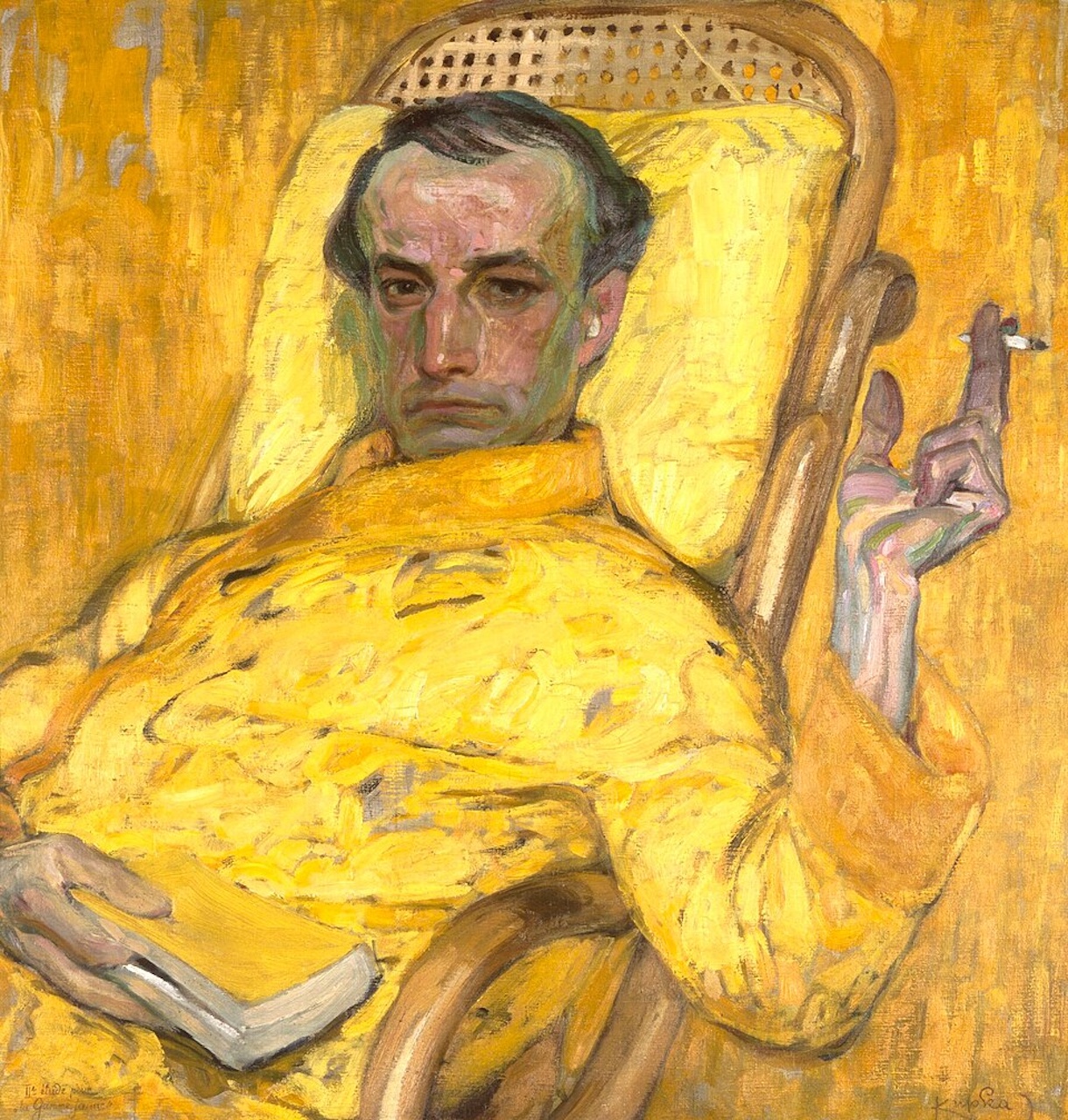
Image: The Yellow Scale (1907), by František Kupka. Museum of Fine Arts, Houston.


