
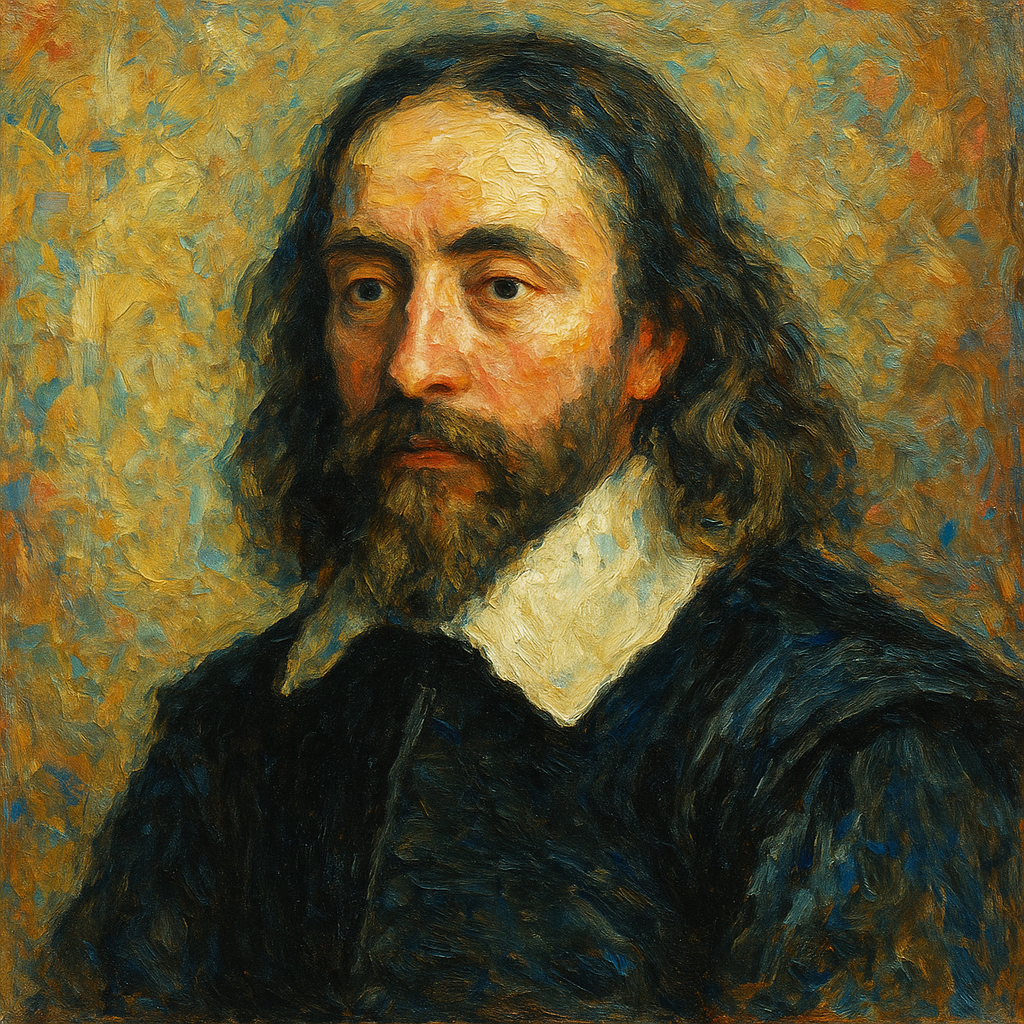
Like other English writers of the 17th century, Browne always carries with him all his erudition,
an enormous treasure trove of quotations and the names of all the authorities who had preceded him.
He works with metaphors and analogies that overflow widely and erects labyrinthine sentence constructions
that sometimes extend over more than one or two pages, resembling processions or funeral corteges in their bombast.
W.G. Sebald
His house in Norwich—famous for the double gift of its scholarly library and spacious garden—was adjacent to a church,
whose dark splendor of shadow and stained-glass illumination is archetypal of Browne’s work.
Jorge Luis Borges
What would Charles II of England and Sir Thomas Browne (1605-1682) have talked about when their fellow countryman, the writer and gardener John Evelyn, insisted that the monarch go and see the man who mastered various branches of knowledge, the author of The Religion of a Physician, Burial in Urns, The Garden of Cyrus… Perhaps they discussed what the polymath had yet to publish, perhaps the most interesting. Browne’s esotericism would increase when he died on his 77th birthday. It is not surprising, then, that necrophilia—necromancy? Excessive it would have been—towards his body was fueled by various admirers, such as the physician and priest Lubbock who, due to the unexpected damage to his coffin in 1840, deposited in the parish church of St. Peter Mancroft, as W.G. Sebald recalls in his seductive didactic work The Rings of Saturn (1995), Lubbock
bequeathed the relics to the hospital museum, where until 1921 they could be viewed among all kinds of anatomical curiosities under a glass case built especially for this purpose. Until then, the parish of St. Peter Mancroft’s repeated requests for the return of Browne’s skull had been ignored, and almost a quarter of a millennium after his first burial, a date was set for the second with the utmost solemnity. It is Browne himself who, in his famous treatise, half archaeological, half metaphysical, on the practice of cremation and burial in urns, has provided us with the best commentary on the subsequent odyssey of his own skull, in which he writes that digging up a dead person’s grave to remove them is a tragedy and an atrocity. But, he adds, who knows the fate of their own bones and how many times they will be buried?
Was it ironic that this should happen to someone who in his youth had witnessed the public autopsy of the criminal Aris Kindt (Adriaan Adriaanszoon) in 1632—considered by Rembrandt not in The Syndics of the Drapers’ Guild but in The Anatomy Lesson of Dr. Nicolaes Tulp? In a way, it was a matter of continuing to punish the corpse of the thug. Browne himself would be subjected to this spectacle of bodily dismemberment. Who can really control the whereabouts of their remains, as if they were books in a library vulnerable even to literate thieves? A dead man, and even less so a necrophiliac like him, could no longer care, for obvious reasons.
As Browne was capable of writing on almost any subject, it is not surprising, for example, that he wrote his Pseudodoxia epidemica or that, after learning about some funerary urns found in Norfolk, a place of pilgrimage, he wrote his Hydriotaphia. Funerary matters are a constant theme in a work dominated not only by antiquarian scholarship, but also by theology, medicine, and, of course, veiled symbolism. There is even a Browne museum, which is not strictly speaking a physical museum, but rather his wonderful treatise Museo sellado, Bibliotheca abscondita, Musaeum Clausum[1], which Sebald details at one point, saying that,
along with the most varied curiosities, one can see a chalk drawing of the great market of Almadiera, in Arabia, which was held at night to avoid the heat; a painting of the battle between the Romans and the Huns on the frozen Danube; a fantastic image of the sea meadows off the coast of Provence; Suleiman the Magnificent on horseback during the siege of Vienna, in front of a city of snow-white tents reaching the edge of the sky; a piece of sea with icebergs floating adrift on which walruses, bears, foxes, and wild birds appear; and a series of sketches that preserve the most terrible methods of torture for all who contemplate them: Persian scaphism, the dismemberment of bodies commonly used in the execution of death sentences in Turkey, the Thracian festival of hanging, and flaying alive, described in great detail by Thomas Minadori, which begins with a cut between the shoulder blades.
When Borges, translating from Religio Medici, presents it, especially here:
I am not startled by the presence of a scorpion, a salamander, or a snake. When I see a toad or a viper, I feel no desire to pick up a stone to destroy them. I do not feel within myself those common antipathies that I discover in others: I am not concerned with national repugnances, nor do I look with prejudice upon the Italian, the Spaniard, or the Frenchman. I was born in the eighth climate, but I feel that I am built and constellated towards all of them. I am not a plant that cannot thrive outside a garden. All places, all environments, offer me a homeland; I am in England anywhere and under any meridian.
One has plenty of reasons to want to know more about him.
Roberto Calasso, in The Hieroglyphics of Sir Thomas Browne, opts for a confrontational essay style, where thematic fragments and discontinuities prevail, yet achieving a kind of harmonious prose in favor of biography—without being one in principle—for an author who is difficult to trace. Even with his well-earned and enjoyed fame, Browne was more of a posthumous work than anything that could be seen published: “A work that presents itself as a complex figure about to fall apart, like a mosaic whose pieces are about to be separated and scattered. Some of the elements that are delicately linked in those pages, in a rich and precarious balance, have never been in such close contact again,” writes Calasso. That is why the author of The Marriage of Cadmus and Harmony, K., The Forty-Nine Steps…, juxtaposes not only the texts of the English scholar but, as might be expected, those of earlier and later authors. In this way, he attempts to decipher the ins and outs of an intensely curious and creative life that was, however, not as exposed as was believed. Browne, although he married and had many children, was quite solitary. But not enough to be a misanthrope. He traveled if he had to, and when he didn’t, he made sure that someone kept him informed of events and personalities, as when he complained in a letter to one of his sons because he visited Amsterdam and did not find out about the alchemist Helvetius. Likewise, he was very interested in dreams—which is why he wrote On Dreams—and was also keen to ensure that his political and cultural opinions were known throughout Europe at the time.
Perhaps there is no word more accurate than “hieroglyphic” to define Browne’s work. Figuration, symbol, and phonetics—as Champollion would say—describe the prose richness of the English scholar, a richness that hides much more than it clearly reveals. This is why Calasso, in the first chapter, “Physiognomy of Sir Thomas Browne,” of the book in question, astutely asserts:
Time, which has increasingly revealed the splendor of his prose, has also confused the features of that discourse, obscuring its various meanings. In these writings, some words are the crests of submerged continents, so that the exploration of hidden topographies should precede any judgment of the work.
What the Italian expresses seems to tie in with Hemingway’s theory of omission. But, in truth, it is a work more closely related to the symbolic enchantment of Faulkner’s stories. Some of the American novelist’s characters could be granted some examination by Browne himself, as when, in a letter to a friend, he externalizes his euphemistic existentialism, which Calasso quotes in “Pseudodoxia epidemica or the Babel of images,” perhaps the best section of his book. What does Browne write?
And in truth, those who have risen to the true height of things and have been able to assess with certainty the state of degeneration of our era will not envy those who will live in the next, much less in three or four hundred years, a time for which no man of today can imagine the face that the world will have taken on.
With his immeasurable imagination and his unconscious projection of carrying much of the past on his shoulders, Thomas Browne tucked his century into his pocket, like someone who calmly suspected, though gentle as a dove and cautious as a snake, the overly fragmentary and at times unclassifiable configuration of the future.
[1] Published two years after Browne’s death with the subtitle of an inventory of books, antiques, images, and notable rarities of various kinds, rare or never seen by any human being today. Borges’ fascination with Browne’s bewildering imagination and pen is more than clear. In 1925, in Inquisitions, he wrote: “Browne encouraged the paradoxical heroism of ignoring warlike insolence, persisting in thoughtful endeavor, setting his sights on pure speculation of beauty. He lived happily and quietly.”


