
In China, the Zhou period was like a Tzimtzum-style contraction, in which the great tree of Kabbalah was born; in fact, the nomadic attacks represented the radical impossibility of a God who extends himself in creation as nature. Hence the retreat to the East, which gave rise to the flourishing of the hundred schools as paths to realization; among which Confucianism stands out for its absurd contemporaneity, in which the singularity of Mohism is subordinated.
It is Mohism that is interesting for its pragmatism, strange as the untimely absurdity of Confucianism; because Mohism was the possibility of the individual, with all that this means as an existential experience. It is not surprising that Confucianism absorbed it—if only for its idealistic, imperial, and majestic patronage—but that Mohism itself existed among those tectonic movements of the structure of feudal China, which still survives.
The instability of the second Zhou period recalls the Minoan debacle, and this explains Mozi’s strangeness; but neither is war as terrible as geology, nor was order artificially restored by Phoenician mercantilism. This is what weakens the practical secularity of Mohism in the face of Confucius’ idealistic and imperial pragmatism, which ends up absorbing it, because in the Chinese tradition there is no alternative, only imperial determination.
Today no one remembers Mozi, only some monks invoke him to justify the order in which the earth reflects the sky, forgetting that in Mozi, as an experience, that reflectivity was not the formal continuity of determination. It is not that Mozi was a realist in the strict sense—which is impossible in China—but that he was a pragmatist; which already lays the indispensable foundation for Realism, like Dasein, which is not experience but its practical possibility.
The difference with Confucius is that Mozi was not an imperial scholar but a craftsman, albeit a well-read and wise one; that is why he could dissent, with vague references to heaven that revealed his lack of concern in this regard. Think about this, and compare it with the idealistic need for God weighing on the systems of thought of Kant and Hegel; as it would weigh—even more heavily—on the life of Confucius, but not on that of Mozi, the incredible Chinese theist.
Nothing in the West, which is transitioning to classical, recalls those telluric and grave dimensions of Chinese history, which swallows developments and powers, such as Heraclitus’ Being in becoming, Parmenides’ Being in itself, and a maieutic Socrates. Those who remember that Socrates was killed by his cynicism also remember that this cynicism was possible and, in fact, survived him. This, which is impossible in China, covers with mistrust that longing for an order that historically dissolves the individual; not into nothingness but—as with Mozi—into the atrocious machinery of the absolute state, which survives above ideologies.
The dissolution of Mohism recalls the fragility of the West in the face of the tellurism that drives Chinese history, with Mozi as a pure power, in which successive Western philosophical humanity, from Anaxagoras onwards, is crammed together. Like Christianity, which gave birth to Adam Smith’s virtuous capitalism, it is Confucius who threatens the individual, who innocently abandons his refuge of pure immanence to slip into that false reality of transcendentalism.
Lost in silence, Mozi exists in his warning, but who hears the sound of a hand clapping? We must not forget: Confucian calm is no less baroque than the Catholic mass, which is no longer a commemoration. Mozi knew that the path to nothingness is not through annulment, but through fulfillment, but he too has fulfilled it; his mark is one of air, like the void to be filled with the other experience of the present, not—paradoxically—teaching.
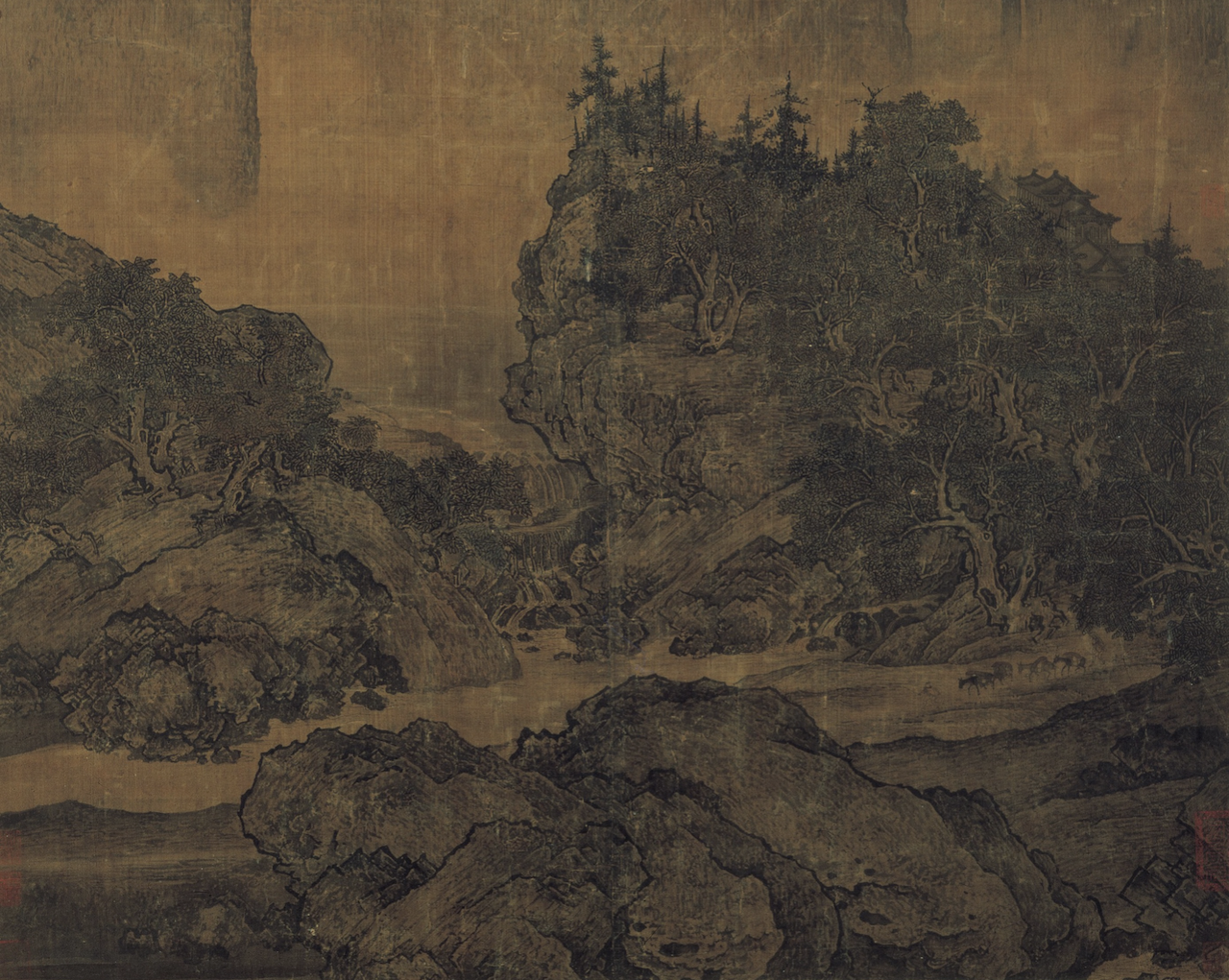
Cover image: Travelers Among Mountains and Torrents (c. 1000), by Fan Kuan.


