
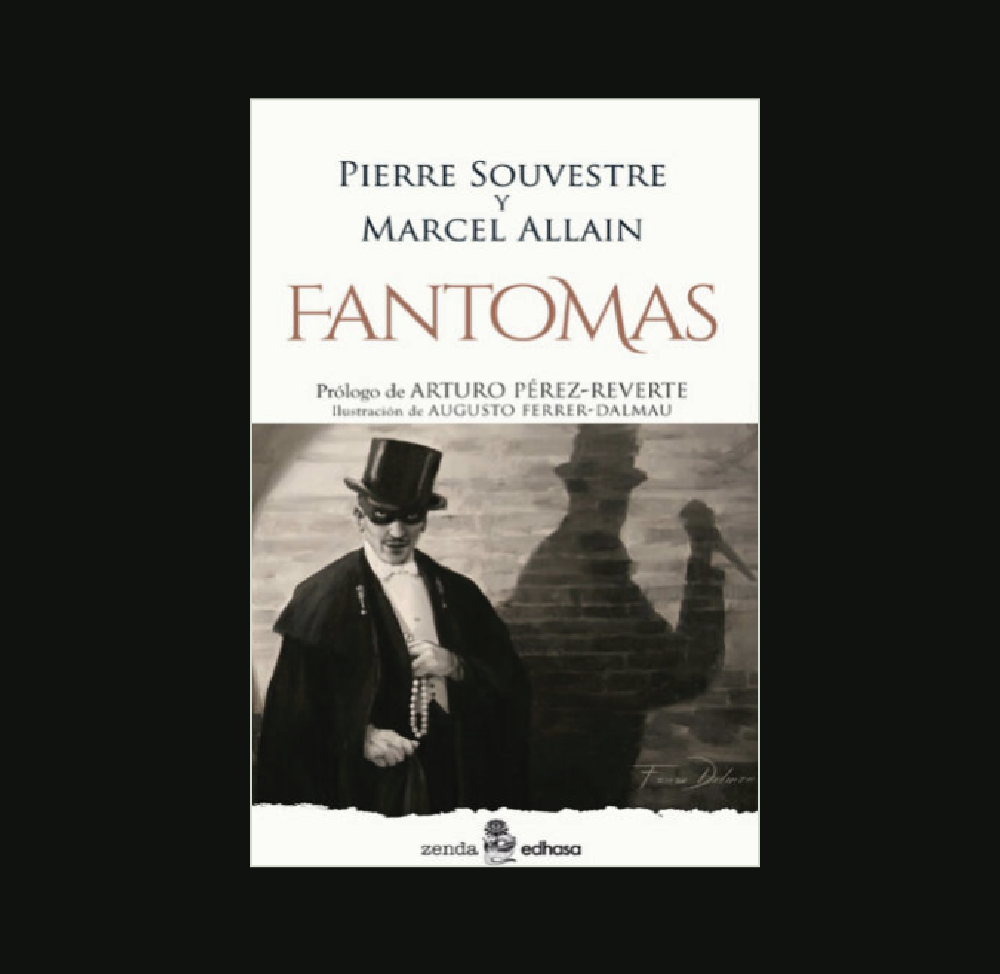
First appearing in 1911, Fantômas, by Pierre Souvestre and Marcel Allain, burst onto the literary landscape of the Belle Époque as a paradigmatic work of the roman-feuilleton, but also as a disturbing anomaly within the popular literature of its time. France was then experiencing a period of confidence in technological progress, urban expansion, and the mass consumption of newspapers and serialized fiction. In that context, Fantômas did not function as mere entertainment: it condensed the anxieties of a modernity that was beginning to perceive itself as unstable, violent, and anonymous.
Published in 1911, Fantômas also inaugurated one of the most prolific and vertiginous collaborations in European popular literature: between 1911 and 1913, Souvestre and Allain would jointly write a total of thirty-two novels, composing a series conceived from the outset as a potentially infinite narrative.
The novel appeared at a moment when the feuilleton had already consolidated its rules—accelerated rhythm, episodic fragmentation, constant appeal to suspense—but it pushed them to an unprecedented radicalism. Unlike other heroes or villains of the period, Fantômas does not embody an ambiguous ethic or a romantic morality. He is neither an elegant thief nor a rebel with a cause: he is an absolute arch-criminal, without explicit psychological motivation or recognizable ideological program. His defining trait is indeterminacy: he changes face, name, and social function, infiltrating every layer of the modern city.
Narratively, the first volume presents a pursuit that is never fully resolved. Inspector Juve, figure of institutional order, and the journalist Jérôme Fandor, mediator between crime and spectacle, confront an enemy who always seems one step ahead. The story does not advance toward closure but toward a proliferation of enigmas. Each episode is structured as a block of tension culminating in an abrupt cut, an open ending that seeks not to conclude but to relaunch the narrative. This logic of the cliffhanger is not merely a commercial device: it establishes a new relationship between reader and text, based on permanent expectation and the impossibility of definitive resolution.
From a formal standpoint, Fantômas displays a functional, direct prose, devoid of ornamentation and subordinated to the forward movement of action. Yet this apparent simplicity sustains a complex narrative machinery, in which crime becomes the structural principle of the represented world. The city—Paris, but also its suburbs, hotels, prisons, arcades, and rooftops—is a labyrinthine, fragmented space, traversed by shifting identities and invisible threats. In this sense, the novel anticipates a modern conception of urban space that would later become central to film noir and to certain strands of German Expressionism.
It is not insignificant to recall that a considerable portion of Fantômas’s earliest readers would die only a few years later in the First World War. This retrospective fact lends the work an almost spectral character: many of its initial readers disappeared along with the world the novel records. Fantômas thus preserves passages of a Paris that would vanish almost immediately after its publication, an urban sensibility foreign both to the Impressionist perception of Marcel Proust and to the initiatory nostalgia of Le Grand Meaulnes by Alain-Fournier, an author who would die precisely in the Great War. The novel remains suspended between two worlds: that of a confident modernity and that of a historical violence soon to sweep it away.
The immediate impact of Fantômas was massive. The series quickly expanded into dozens of volumes, consolidating a loyal readership and establishing a model of accelerated serial production. Yet its true historical projection manifested in its transition to cinema, particularly in the adaptations directed by Louis Feuillade between 1913 and 1914. Feuillade may be considered the finest reader of Fantômas: he did not merely adapt the novel, but grasped it in depth and translated it into an unprecedented cinematic grammar. Through the serial, he brought to the screen a conception of narrative based on the dilation of time, the accumulation of episodes, and the constant suspension of meaning.
Far from the spectacular illusionism of Méliès, the monumentality of Pastrone, the pathos of Gance, or even the foundational montage of Griffith, Feuillade’s vision incorporated time as a structural element. His prolonged shots, use of real locations, and insistence on open endings transformed Fantômas into a narrative experience that has aged with greater sobriety—and perhaps greater resilience—than that of many of its contemporaries. In this sense, Feuillade appears today as one of the great pioneers of modern cinema, precisely because he understood the internal logic of the feuilleton.
In Feuillade’s cinema, Fantômas becomes an almost abstract figure, a principle of social dissolution rather than a psychological character. This conception would indirectly influence filmmakers such as Fritz Lang—in his construction of omnipresent conspiracies and invisible criminals—and, later, Alfred Hitchcock, in his interest in false identity, the wrong man, and sustained tension beyond the resolution of the enigma. The idea of a structural, diffuse, and persistent evil finds here one of its early formulations.
Simultaneously, Fantômas exerted a notable fascination on the artistic avant-gardes. Guillaume Apollinaire, Blaise Cendrars, and other writers linked to Surrealism recognized in the character a singular poetic force: Fantômas embodies the logic of the dream, constant metamorphosis, and the rupture of classical causality. It is no coincidence that the Surrealists adopted him as an emblem: his world operates through free associations, arbitrary eruptions, and a violence that seeks no rational justification. In this sense, Fantômas exceeds the framework of popular literature and inscribes itself within an aesthetic sensibility that questions the hierarchies between high and low culture.
The legacy of the work is broad and transversal. Fantômas anticipates the modern supervillain, preceding even the superhero, and establishes a genealogy that runs through pulp fiction, comics, genre cinema, and twentieth-century popular culture. Its influence lies less in specific plots than in a conception of narrative grounded in infinite seriality, permanent threat, and the negation of closure. Against the classical novel oriented toward resolution, Fantômas proposes a narrative world in perpetual flight.
In conclusion, Fantômas (1911) should not be read solely as a product of its time, but as a foundational work articulating literature, cinema, and modernity. Its power resides in having formulated, from within the feuilleton, an aesthetics of continuous suspense, a dark vision of the modern city, and a criminal figure operating as a narrative principle rather than a psychological character. In that gesture, the novel inaugurates a tradition that continues to operate—visibly or subterraneously—in much of contemporary fiction.
It is worth noting, by way of closing, that this remains a work whose narrative vitality continues to produce immediate reading pleasure. The translation into Spanish is by Andrés Ruiz Merino. The prologue is by Arturo Pérez-Reverte.
Fantômas
Pierre SOUVESTRE / Marcel ALLAIN
Edhasa España, 2024


