
There are, then, successful ways of not knowing oneself, and beauty is one of them. It is possible, in fact, that the way in which we are able to be ignorant is precisely what defines the rank of what we are able to know and that the articulation of a zone of non-knowledge is the condition —and at the same time the touchstone— of all our knowledge.
—Giorgio Agamben
In a certain sense, the mystery of writing distributes its privileges —in mutual ignorance of its ultimate reasons— in a manner similar to that other mystery, the mystery of suicide. The suicide knows something that we, the living, quite simply ignore; he knows, or believes he knows, that which neither you who read me nor I who now write this line will ever know unless.
And perhaps we may intuit it; we may even have well-founded suspicions as to what it is about, and let us suppose we may even have fantasized at some point with the idea, imagined that threshold: the arrival, the half-light in the night of one who comes to the place where he has never been before, all of it figured as a journey in the manner of Dante and his Virgil, or in a merely instrumental manner, as a means or attempted shortcut —yes, of course: but in all truth, naturally, we know absolutely nothing. We have not seen it. We have no idea, and we have never crossed that door, nor have we yet been in that place where one knows or glimpses whatever it may be that decides one to cross it. And vice versa, because the suicide, in order to be one, already ignores what allows us, the living, to go on being so: the ignorance of the one has as its object the ignorance of the other. That was, in fact, where I was going: both zones of non-knowledge are, without further attenuation, reciprocal; each ignores itself in relation to the other.
With writing, much the same occurs: of that which moves it, we will have either a blurred, figurative glimpse or certainty, with not much in between, and for that reason its figures —reading too, the jiva of its ātman, always conditioned in the actualization of the real— are inevitably divided between a more or less strenuous effort and a trivial excess that mutually ignore each other. When writing is, let us say, luxury and rhetorical voluntas, it becomes an excess that requires no effort: a matter of elegance, courtesy, or display. In the best of cases, a carefree, moderately assertive lightness. A kind of wastefulness, an existential expenditure that awaits, like any expenditure, its grateful counterpart: recognition and visibility, applause or at least attention or, in its solipsistic version, certainty of itself —which may well be: the certainty of having explained oneself exactly as it was, just so. That certainty, to make matters worse, may be shared in both modes. If, on the other hand, it is necessity and the drive of the self, nature, then assuming writing inevitably entails an effort that is plainly excessive, at least before others: something uncomfortable or urgent that would be much better off not being there, because that necessity translates into anguish and exhausts, and at times blinds just as lack and rage exhaust, and ends, sooner or later, by losing its course —difficult to hold steady, without the hand trembling, that rudder, that infinite sentence with more of its connection elsewhere than of punctuation or consensus as it writes itself. Testimony of itself, at most. Illegible —because irreparable— to itself.
It is impossible to specify with certainty —those reciprocal zones of non-knowledge are so also in their immanence— what all the above might mean, that dialectic always in precarious balance between excess and necessity, between expenditure and lack; and perhaps for that reason suicide and writing remain mysteries, their secret always safeguarded: whoever knows —if he knows— cannot communicate to the other side what he knows, or what knowing it tastes like —a lifelong blindness, each before the other, that of those two enemy shores. And of course, for that effort, which in the end or in the final instance is an effort of translation or enactment, there are shortcuts, its concert by other means: one may traverse the lucidity that writing provides, or that we think it provides, through mushrooms, or in the contemplative life, or in the contemplation of beauty, or even in lucidity itself, or in the conscious enjoyment of excellence as such —without notes or aide-mémoire, without enthusiasm or rope. But the aide-mémoire is also concert and mandala, for oneself and in the fiction of others. And that is where the thing goes, the so-called factor of the conditioned shore: the polis, the outer world, the little political animal thrown somewhere. So deeply lodged in the schism. So dispensable and vulgar and yet so omnipresent by force. Demanding all the time, moving its little paws and asking of one time and attention and agreements, the enactment, always servile, of the word.
One could do without writing if one did without the polis. Perhaps a shortcut, but it must be said that a shortcut becomes, of course and above all, the fastest path or the one most readily at hand, unless one enjoys, or values, or believes there is some reward in making an effort for the sake of it, or for free. And one may also find the pleasure and vision of writing in something else, and it will probably arrive more safely as peace in that other thing, whatever it may be —including intensity or even, or rather above all, the blindness and truth of desire: they are the assumption or consciousness of a non-knowledge that requires no buttress or anchoring. Little layers of reality well or badly or moderately arranged. The public practice of writing, by contrast, veers either toward luxury or toward urgent necessity, which is where we were, and neither of those two things deserves it: to be there, caught in the problem and to believe that speaking it helps, or merely to visit it, to engage in existential tourism —with its symbolic expenditure, with its so-called communal agreement: to stroll downtown in new shoes that, like any fashion, promise to get ahead of their time, to sight the future in advance. To wink at the real, to comment on it. At oneself in the real, trying to explain oneself. Or offering it as a gift to others.
For that reason the best thing would be to know how to lose it or to know how to enjoy it —depending, that depends— in silence. Whatever it may be. The best thing is to forget it every day in silence, just as each day the dreams of the night before are gradually forgotten and blurred, or the memory of dinner the previous day, or of the last time in bed, and everything, by contrast, is always and without pause recycled into the present, becomes present even if remote. To live it —whatever that may mean, but without display or anguish: installed in that lucidity, exactly so: like that— in the silence of a forest or a lake, or even in the open exposure of desire, the open and fleeting —because always in the present, an Umwelt on loan— but irrevocable reality of love. But that is no longer writing nor its necessity, and it becomes something else, a third secret.
א. What does writing inevitably entail once it becomes public practice, and therefore expectation? Showing something to others. Waving a little sign that proclaims: Here I am, I see or I think or I perceive the world thus —in this singular way— and in passing it also means asking to be heard, to be taken into account: to be attended to. To seek that attention, to dance attendance upon words. Nothing more than that or, in any case —even in the best of cases!— not much more than that. If anything, something more than that. Nor less, of course —because, by contrast, and so on: the ways of enthusiasm, always so willing. No more and no less than that, whatever may be at stake: a public service or a demand for attention, at the other extreme; condescension or precariousness, whom do I attend to or who attends to me, a perpetual give-and-take of what? Probably both things, each claiming its reverse, a life postponed in the loop where each half is gradually lost in the radiance of the other, the ancient story of the moth and the light that burns it, of the flame and the moth that here —this world or these pages— in order to keep turning its wheel, constantly exchange roles. Serraud, in those notes of ultimate frankness from the Munich Diaries, surely says it better:
To give notice of being, of what matters, to others. Sometimes successfully, sometimes —almost always— with none or very little. That is what I have done all my life, after all, and I no longer know whether against my will […] Which also means making them see, although of course that was not the intention nor the idea, that they live in their sordid little cavern, hamster wheel, Platonic bubble: one cannot expect to be loved for that —something I have naively expected almost always, without success. Much less that they include one in the little bubble or the sphere, or that in return they ease one’s transit through that minor hatching where there is only shadow, and where they know very well that I know shadow and imposture, and that in the best of cases —biological entity: what can one do— I tolerate it, and in the worst I despise it or lament it or it simply inspires in me compassion and reluctance, depending.
And there is, of course, the other dimension of the matter. The one that has nothing to do with the public or with the incessant dialogue about the virtues or attributes of the real. It is not, by any means, that language organizes itself according to some code or organizes the world according to its own code —there lies the error and the confusion: even if it were exactly so, it would be so in the second degree, and the fact of being so would prove trivial or irrelevant, the least pertinent thing in the world. An exemplary accident or setback.
The issue is rather the opposite: language is the code, it emanates from it and we are it or use it in the accessible dimension of something, enactment and syntagma and wave frequency translated into a color. And as a result of the code —and from there, solely for that reason— our anomalous, unnatural relation to words and the proliferation of languages. Hence the thought that they define or describe the world in a code of their own when, on the contrary, they are the result of the world’s code, a mere emanation of the real, as color or sound are. They arrange the code of the real; let us say that when we move them, they move it. Or alter it, in the best sense. Words, when we see them, we see them and use them only for that reason: the ultimate and blind perception of what is there, metaperception like that of an eye that were to see itself inwardly, that were to auscultate itself while seeing: a Droste-like version of the aorist in a mirror, probably in enigma, which nevertheless —but who gives the growth?— may be read.
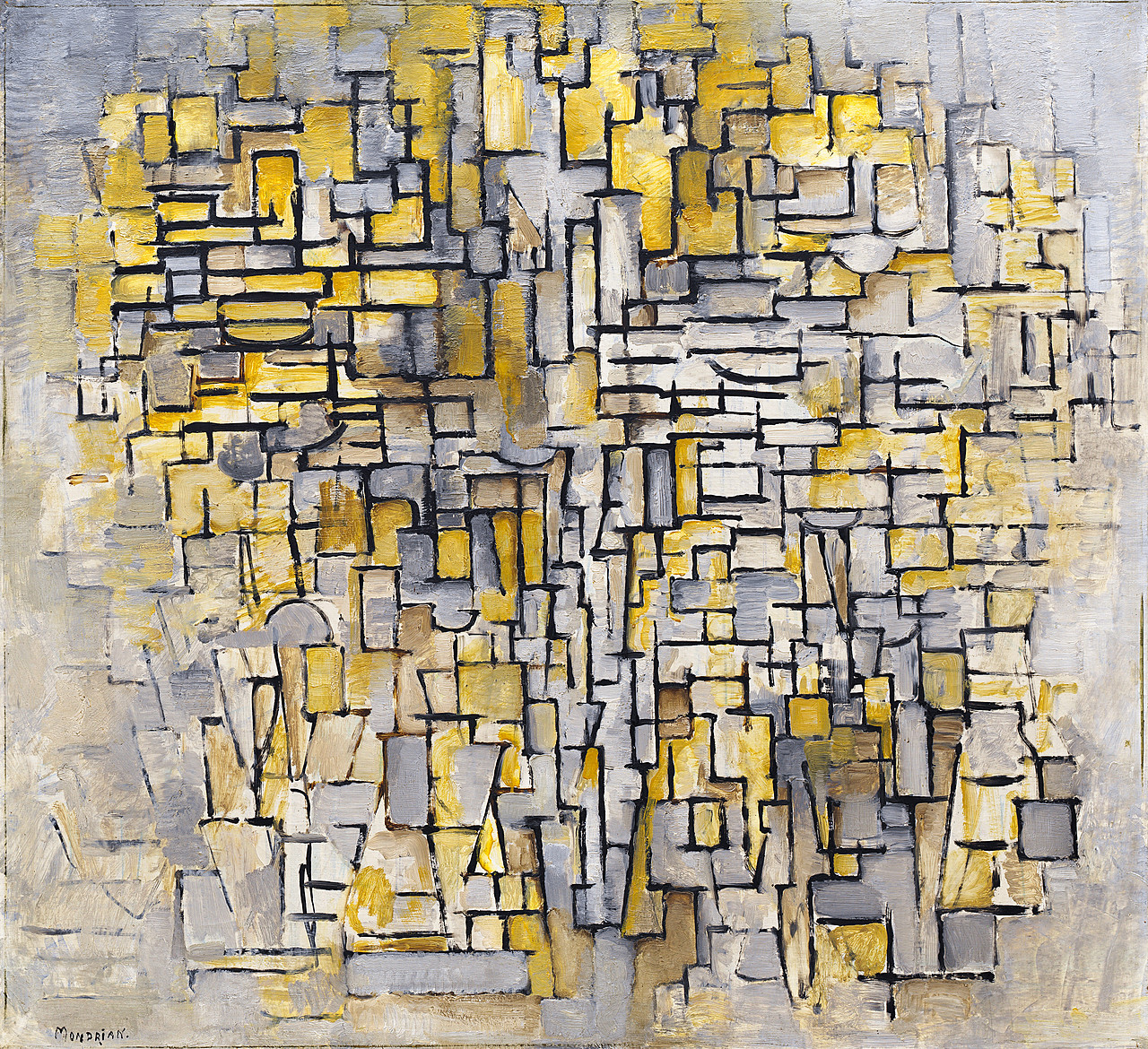
Image: Tableau No. 2/Composition No. VII (1913), by Piet Mondrian. Solomon R. Guggenheim Museum, New York, Solomon R. Guggenheim Founding Collection.


