
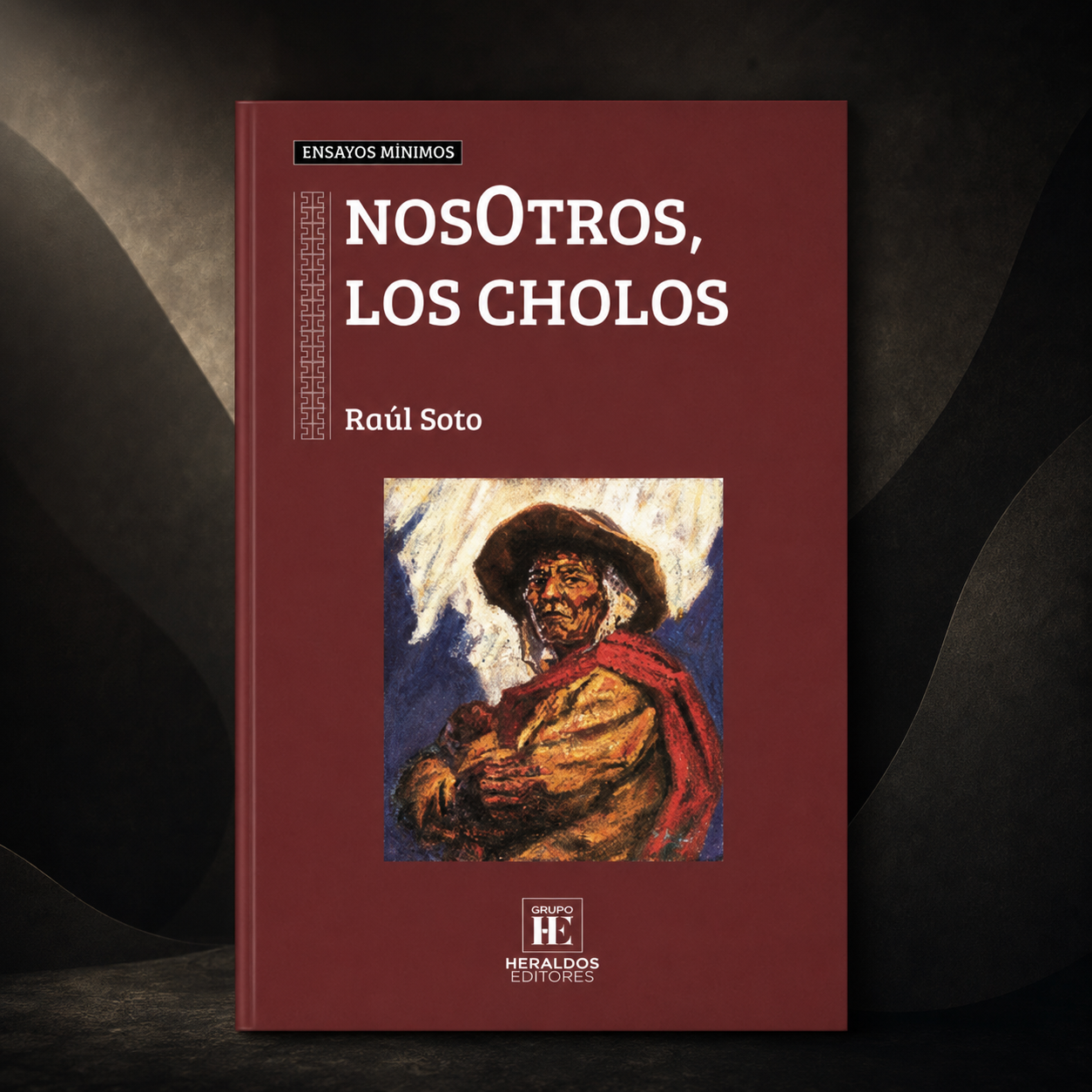
Raúl Soto’s recent book addresses a burning issue for contemporary Peruvian society. Indeed, NosOtros, los cholos(Heraldo Editores, Lima, 2026) confronts us—as readers—with a fundamental aspect of our history: the evolution of that human group known as cholo. Since the Spanish conquest of the Inca Empire—an event through which one culture, the European, dominated another, the native one—a profound mestizaje took place, a crossing, one might say, that gave rise to a new human and social type: the cholo in its earliest and most remote sense. Of course, in Peru’s general imagination, the Indian—the native, also called indigenous—is absorbed into the concept of cholo from the perspective of the dominant classes. In other words, cholo is anyone who does not come from the upper classes, basically of European—or first-world—white origin, but rather from the popular sectors, whose backbone of origin lies in the Andean and/or provincial world and who possesses non-white, but rather sallow and native features. That is, more or less, the idea that prevails and circulates in Peru.
As can be seen, the racial component is essential to this way of thinking, which implies an undeniable discrimination based on skin color and the person’s physiognomic traits. To this is added the individual’s position within the social pyramid, thus entailing the various degrees of actually existing segregation and, obviously, the economic level that, in general, represents the nuances of the exploitation of some classes by others. All of this shapes the dimension of being cholo in Peru, or of being considered as such. Of course, social mobility—widely registered in our country—makes possible the existence of innumerable variants within this panorama: from the cholo who becomes whitened through economic enrichment, for example, and is accepted by the dominant layers, to the pituco who becomes choleado, usually for reasons of bankruptcy, personal denigration, or by mixing with cholos: marrying a chola, for example.
Against this succinctly described panorama appears Raúl Soto’s book. When one reads the title NosOtros, los cholos, the first impression is that this is an act of self-recognition and a defense of the cholo condition. And this seems to be corroborated when we begin to read the memoirs and narrative testimonies, beginning with those of the author himself and then those of various characters who have made up his family. Let us see. The first memory offered to us is from 1958, when our author is three years old and is going up to Castrovirreyna, in the highlands of Huancavelica, having been born in Capillas, also in Huancavelica. His parents, María Elena Mertino Oré and Tomás Raúl Soto Zevallos, were rural primary school teachers, graduates of normal schools. They had met in Capillas. The paternal grandfather, Manuel Soto Enciso, owned the La Mejorada estate near there. In 1960 the family settles in Ica; that is, they descend to the coast. Soto writes: “siguieron diferentes rutas del desplazamiento geográfico, como ha precisado Aníbal Quijano acerca del deambular de los cholos por el Perú”. His mother, Elena, grew up in Huaytará until she was eight years old; she was bilingual, but lived and studied in Lima, which is why she spoke like a Limeña, “sin arrastrar las erres y sin motes”, Soto notes—an important indication, since this was, or is, a characteristic of Andean migrants on the coast, for which reason they were subjects of discrimination. He cites, for example, Arguedas’s testimony at the First Meeting of Peruvian Narrators, Arequipa, 1965, where he accounts for that discrimination for being serrano, a situation that Soto himself would experience, according to his testimony, when his family came down from Castrovirreyna to Ica in 1960. He even cites ironically an anecdote from within his own family, when he relates that his father liked to sing, and that his mother would jokingly tell him: “prefiero que cantes a que hables porque se te salen los motes”.
In the city of Ica, the family would prosper notably, keeping pace with the general modernity of the 1960s. In 1967 they built a masonry house in the San Isidro development, with all the comforts; various business ventures contributed to this. Soto goes so far as to say: “En esta casa amplísima viví como un típico pequeño burgués”. And also: “Mis hermanos y yo coincidimos en que esa fue la mejor etapa de nuestras vidas”, although he likewise states: “Los vecinos nos recibieron amablemente, pero eran diferentes a los de nuestro barrio antiguo, además nos manteníamos a la expectativa por nuestra condición de serranos”. This is key. Already in secondary school, our author discovers the emerging middle class of the Odría government and, beyond the fact that “La dinámica social en clase era fluida como en la ciudad de Ica”, he recalls “dos incidentes de intolerancia debido a mi procedencia serrana”. A Physical Education teacher, despite being mulatto—which adds yet more seasoning to Peru’s racist stew—would shout at him on the running track: “más rápido, lagartija de sierra”. And another incident involved a Chinese-Peruvian classmate who called him “queso porque de vez en cuando se me salía el mote”. The interesting thing is that when both realize that the classmate’s mother was from Huaytará, like Elena, Soto’s mother, they become great friends. That is, there was a sentimental, geographic-Andean identification, a fact that, without a doubt, often breaks down barriers in Peru.
The book continues with the monologue of Marcelina Oré—Raúl Soto’s maternal grandmother—who gives us her testimony beginning with a phrase that recreates María Emilia Cornejo’s famous verse: “Yo soy la chica mala de la historia”. In this way, we learn the different stages of her life, where the entire process of Andean migration to the city of Lima from the late 1920s and early 1930s becomes clear. Marcelina falls—let us put it this way—into the arms of Carlos Merino and becomes pregnant with María Elena, our author’s mother. With the scandal that breaks out in the small town of Huaytará—Merino was married—Marcelina’s father, Balvín Oré Ruiz, landowner of Pámpano and a local potentate, decides to send her to Lima with the newborn. One interesting detail for what we have been developing is Marcelina’s following confession regarding Carlos Merino: “Me gustaba escucharlo hablar muy bonito el castellano sin pronunciarlo como serrano como yo arrastrando las erres ni tenía que comerse los motes”. Handled with a skillful application of a Vargas Llosa–like technique, the monologue recounts the life journey of this Andean woman when she arrives on the coast: “El sábado sin neblina fue un día perfecto para conocer el mar para caminar por la playa sin zapatos en la arena tibia”. And the legend of the capital: “Por fin entramos a Lima por una avenida ancha adornada de árboles hasta el Parque Universitario todo iluminado con jóvenes enternados deambulando justo a las seis cuando el reloj de la Torre Alemana empezaba talán, talán, talán”. After a brief return to Huaytará, Marcelina finds herself once again in Lima: “En La Colmena sí que había más luces y nosotras caminando boquiabiertas hasta la plaza San Martín”. Later, the testimony advances through her stay in Lima with her daughter Elena, the impact of the 1940 earthquake, her life in the El Buque tenement in Barrios Altos, where she learns to dance marinera and enjoys Creole jaranas. By this point she already has a spice stall in the market and they live on the San Cristóbal hill, in the Leticia neighborhood. Elena begins working at Oechsle, but later her mother sends her to study at the new Normal School opening in Huancavelica. Finally, she signs up for a place in Piedra Liza because, as we read, “nunca había perdido las esperanzas de vivir en una casita modesta con luz y agua y un wáter”.
Now comes the testimonial monologue of our author’s father, Tomás Raúl, who begins by recalling, in turn, his father—that is, the grandfather of the writer of the book under discussion: Manuel Soto Enciso. Through Tomás Raúl’s voice we learn that he “era un ganadero próspero, pero a veces si apenas nos alcanzaba para comer bien”. The reason? “el rocambor, ese juego estratégico de naipes españoles, que una vez vi jugar a mi padre durante toda la noche, y perder varios soles de plata, en una habitación llena de humo y de botellas de aguardiente iqueño”, Tomás Raúl tells us. His grandfather—that is, Raúl Soto’s great-grandfather—was a Spaniard named Pedro José Soto, who came to Peru as a young man, bought an estate in Molinos, and became a cattle rancher. Tomás Raúl did not take to the family business, being instead interested in reading and study. Something important attested to in this section is that free secondary education was established in the country under the presidency of José Luis Bustamante y Rivero in 1945. Before that, parents had to pay for their children’s schooling. And not everyone could do so. A significant point appears when Tomás Raúl refers to his older brother Alejandro, who “era alto, más alto que yo, medio rubio y de ojos azules. Eso no lo ayudó en nada porque hablaba un castellano castizo, con el mote típico de los serranos”. This tic in articulation would become an explicit form of discriminating against Andeans—cholos of highland origin—which Raúl Soto emphasizes at certain intervals throughout his book, making transparent the violent reality of the situation. His own father, that is, Tomás Raúl, also suffered it when he was already a teacher at the San Luis Gonzaga school in Ica: a colleague called him “gringo cholo o lagartija de sierra” until one day, at a gathering, said colleague “empezó a hacer chistes porque era serrano y fue ahí cuando lo saqué al fresco y le di su lección. Santo remedio”. With all this, the psychological oppression of social and racial origin that the Andean and/or cholo being has had to suffer—and continues to suffer—becomes clear.
Tomás Raúl will undergo an itinerary that takes him to Huamanga, where he completes primary school under the care of his older sister and her husband Falconí; but in 1934, because of the Aprista revolution, they must flee to the family estate in Ayuta, where he remains until he moves to Huancayo to study secondary school at Santa Isabel. He is not accepted, however, and must then move to Huancavelica. Here one can note the intense migratory movement that took place in the Andes and—once again—a central theme of this book: the problem caused by the difficulty of expressing oneself correctly in Spanish and the consequent marginality that follows from it. The wife of the man who takes him in in Huancavelica “hablaba el castellano con un mote pronunciado y prefería contestarme en quechua”, Tomás Raúl says. In 1943 the Rural Normal School for Women is founded in Huancavelica, and he meets Carmen Rosa Alarco Merino—from a family of landowners—and through her, her cousin María Elena Merino Oré, “lindísima, alta, delgada y morocha” and—again the indication—“Hablaba un castellano sin el dejo andino”. He would later marry her; María Elena would become our author’s mother. In 1946 he begins his teaching career in Santiago de Chocorvos; the following year he is again in Huancavelica, and in 1948, working in Capillas, he begins his romance with María Elena, who is the teacher at the recently founded girls’ school. Tomás Raúl recalls of her: “si bien era serrana quechuahablante, no tenía el dejo andino al hablar el castellano. Bromeaba conmigo cuando se me salían los motes y cuando arrastraba las erres. Cholito ayacuchano, me decía”. Finally, at the beginning of 1949, they arrive in Lima, in the new neighborhood of Piedra Liza, where Marcelina Oré Criales, his future mother-in-law, lived.
The story of María Elena, Raúl Soto’s mother, is also told to us through a monologue of hers, though this time addressed to the author. We are shown the work of the grandmother Marcelina in what was then Lima’s Mercado de Abastos—later the Mercado Central—where Elena spent part of her childhood, and for which she has beautiful and emotional phrases: “A pesar de su grisura, siempre me gustó vivir en Lima. Me encanta todo el centro y el jirón de la Unión, con sus luces y vitrinas decoradas”. She then states: “Después del terremoto del 40 las cosas cambiaron”. She went on to live on Mapiri Street, where “fue la primera vez que viví en una casa con un cuarto de baño con wáter y ducha”. The El Buque tenement would be her next residence in Barrios Altos, where she would have new friends “que a veces se burlaban de nosotros, los serranos”. Because of financial hardship, they move to Leticia, “a una choza improvisada en el cerro San Cristóbal”. At the age of eighteen, Elena gets a job at Oechsle, but in March 1945 she travels to Huancavelica to study at the women’s Normal School and become a teacher. In her first year of classes she meets Tomás Raúl Soto Zevallos, whom she would marry and with whom she would conceive six children, one of whom is the author of the book under discussion. In Capillas, near Huaytará, a school for girls opens, and there Elena is appointed as a teacher. “Tu tierra natal”, she tells her son—our writer—and adds, closing the monologue: “adonde fui arrastrada a mi destino con tu padre. Cuántas veces te he contado lo que sigue y ya debes saberlo de memoria”. Indeed, that is exactly what has happened: the proof is in the book we hold in our hands, the story of his nuclear family, a text in which one sees not only the long and difficult process of internal migration, from the Andes to the coast and Lima, the social transformation and economic progress that took place in that migration, but also the vicissitudes of the discrimination suffered because of their condition as serranos, illustrated throughout the testimonies in the contempt for being motosos, that is, for not pronouncing Spanish correctly.
This general condition that we might call choledad—somehow synthesized in the opening paragraphs of this note—is extensively discussed in the final essay with which Raúl Soto’s work concludes. Indeed, we are first presented with the explanation of the title, which is not only, as it might seem at first glance, a cholo defense—which in fact it is—but also, and this is very important, a philosophical and semantic enrichment of that condition. It is a dialectical content that represents “el yo colectivo de una comunidad —sea local, nacional o global— y Otros la diversidad de quienes la conforman”. That is, “la categoría NosOtros vendría a ser los otros en nosotros”. Here Soto cites Tommaso Sgarro: “la unidad de una multitud dentro de una dimensión histórica”, and Ricardo Espinoza Lolas: “el otro constitutivo y una unidad en la distinción”, appropriating the concept and clarifying: “Cada uno y todos representamos al otro gracias a la diversidad de nosotros, los cholos”. And even more forcefully: “nuestra identidad en construcción se afirma a través de la diferencia. Por ello se hace necesario repensar el concepto de lo cholo”.
And that is what Raúl Soto does in his very stimulating final essay. He carries out an exhaustive review of different concepts put forward on the subject in Peru’s intellectual history, beginning by criticizing the supposed “primer mestizo integral”, as Inca Garcilaso de la Vega has been considered by the Hispanicist tradition, thinking of a homogeneous racial and cultural mestizaje, a non-existent situation, as our author points out, and all the more so when he maintains that such “mestizaje racial, no tiene ninguna base real ni científica. “las razas no existen”, Soto affirms, and in support of this he proposes: “las diferencias del color de la piel y los rasgos fisionómicos entre un africano y un caucasiano, por ejemplo, solo llegan a un 0.005 % del genoma humano, compuesto por 25 000 genes”. The idea of the existence of races is brought down: a “concepto biologicista inventado por la ciencia decimonónica y refrendada por el darwinismo y el positivismo”, although he recognizes: “Su uso sigue vigente en todo el mundo al igual que el concepto de racismo”. This is what entails the discrimination and exclusion of cholos by the white race considered superior—a notion coined in the nineteenth century and still existing—and even a racism based on cultural differences: for example, the motoso speech of the Andean of Quechua-speaking origin when pronouncing Spanish.
Then comes the concept of the “cholo integral” proposed by Aníbal Quijano, from which Soto maintains that “Lo cholo como sector o estrato social está conformado por diferentes grupos étnicos, resultante de la interacción entre indígenas, iberos, africanos, chinos y japoneses, principalmente”. This would be the “cholo étnico”, the majority in the Peruvian population: “la barca de NosOtros, los cholos”. However, “la pertenencia a determinado estrato económico complica la situación, es decir, la cuestión de clase”. And here lies the key point: “La economía peruana sigue dominada por una jerarquía de poder cuyo origen étnico es indoeuropeo, conformando una casta cerrada, exclusiva y excluyente”. On the other hand, “La identificación étnica entre los cholos es conflictiva y, como señaló Quijano, todavía no tenemos una plena conciencia de grupo para navegar en la barca del NosOtros”. For that reason, Soto shrewdly points to the more feasible possibility of “alcanzar una identificación nacional chola gracias a los productos culturales en proceso de emergencia y producción”. In this sense, he leans toward Aníbal Quijano’s thinking, which “identifica lo cholo como una estructura distinta, cuyo cimiento sería la cultura andina y el elemento accesorio la cultura occidental o criolla”, and then states: “La diversidad de una cultura chola emergente es el embrión de la futura nación peruana”. Thus our author maintains that a clear example of this is “la eclosión de la cumbia peruana primigenia y sus variantes actuales”. And he adds: “Esta fusión de melodías andinas, tropicales y del rock se origina en las postrimerías de la década de 1960”. Delving further into the matter, he writes: “La versión peruana de la cumbia precede a la música chicha, impulsada esta por los migrantes andinos cholificados. Y algunos críticos han llegado a proponer la hipótesis de que el arte chicha es dominante en nuestra realidad actual”. All of this would be the result of the inherent creativity of the process of cholificación.
Thanks to that process—according to Quijano—a certain group consciousness is developing. A cholo personality, that Choledad whose characteristics would be: the geographic mobility of the migrant subject, social marginality, and the propensity to take risks and face challenges. “La migración interna marcó las vidas de mis padres”, Raúl Soto affirms, and the other two characteristics have been witnessed in his family history throughout this important book, concerning the consciousness of being cholo, that is, Cholitud, in a process—citing Ángel Rama—of “pérdida, transformación y resistencia”. At the end of his essay, the author maintains that “La cholificación cultural de la sociedad peruana es parte de un proceso de transculturación vigente”. And alluding to our great tayta and amauta José María Arguedas, who “tuvo la certeza de que nuestra pluralidad de culturas lograría cierta concordancia”, he closes his work with great hope: “ahora NosOtros, los cholos, a pesar de nuestra diversidad y contradicciones, nos encaminamos hacia ese ideal -o debo decir utopía- alcanzable”. Who knows? History will tell.


