
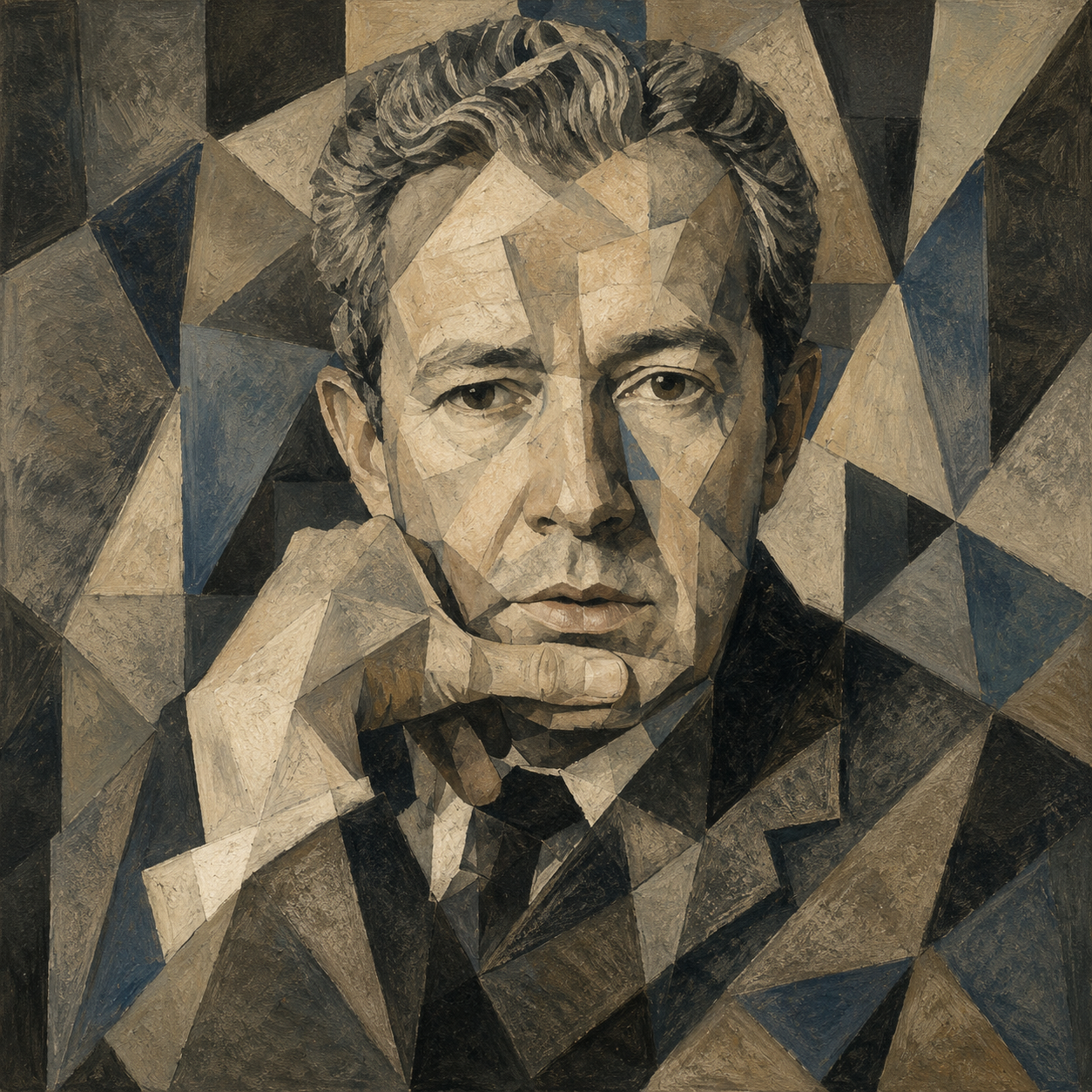
Citario. Derived from the Latin citāre (to quote) plus the suffix -ārium (repository), similar to bestiario. A 21st-century neologism coined by Spanish-speaking scholars at Bookish & Co., with roots in ancient anthologies and florilegia. «Citario» is related to medieval books of commonplaces—such as those by Erasmus of Rotterdam—and 19th-century proto-examples, such as Familiar Quotations. This «Citario Rulfo» celebrates the 109th anniversary of his birth through a constellation of critical, affective, and readerly voices on his work and his figure. The quotations gathered here revolve around the silence, the aridity, the dead, and the memory that run through El llano en llamas and Pedro Páramo: that territory where Mexican literature found one of its deepest ways of speaking with ghosts.
RULFO, JUAN (Mexico) Sayula, Jalisco, 1918–Mexico, 1985. He began publishing in Pan, a magazine edited in Guadalajara by Arreola and Antonio Alatorre. In 1953, El llano en llamas was published, a collection of fifteen stories of rare perfection, in which the already declining Mexican rural narrative reached its highest level. These are tales of exquisite simplicity, to which one could only object on the grounds of a certain paternalism: his peasants are pure and transparent like children, even when they commit (and they almost always do) atrocious acts. The novel he published shortly thereafter, Pedro Páramo (1958) [sic], is a very skillfully constructed ghost comedy that frames the story—much more conventional than the format—of an unscrupulous local strongman, with some reference to the Revolution. In just over a hundred pages, it fulfills the triple demands of the literary, the social, and the historical, with perfect economy. Later, Rulfo served as an official at the National Indigenous Institute and did not write again, except for a film script, El gallo de oro (1980).
César Aira, Dictionary of Latin American Authors
◾️
Foundational literature emerging from the unknown American tradition (of the mystery) to open a cycle that immediately closes again before our dazzled eyes.
Pedro Páramo is Mexico. It is the overwhelming and desolate landscape; it is the vernacular magnified until it takes on the resonance of a poem. It is the fear of death and its interpretation. It is death itself. But it is, above all, the profound exploration of the subconscious and of dreams, the exaltation of man and the land until they take on legendary dimensions. That is why the novel slips away. It becomes countless novels, whispers, and expressive silences. It has no chapters, no end, and no beginning, like the “life of the dead” itself, because the characters are both dead and alive, moving from one plane to another, from apparent reality to the unknown. Thanks to the author’s ingenuity, there is no time, and space is a spectral stage populated by the whisper of souls, where “one can almost hear the hinges of the earth turning, covered in moss,” and where the characters can only “console themselves with their grief.” In short, magic and poetry immortalize the desolate region of Comala, the setting of the novel.
But this work is not only beautiful, not only dazzling for its poetic expressions and magnificent descriptions of the landscape; it is also profound and offers a vision of an entire relentless universe. For within it, humanity constantly pulsates with all its tragedies, its fears, its ancestral loneliness, and its heart-wrenching attempt to find the meaning of its existence (happiness). Here, too, is the landowner who wants all the women in the neighborhood for himself and exploits the people’s ignorance. Religion with its relentless dogmas.
The country man, with his prejudices and tenderness, who strikes us in the midst of that overwhelming scene, thinking that “the only thing that makes him move his feet is the hope that when he dies they will carry him from one place to another; but when they close a door on you and the only one left open is that of hell, it would be better not to have been born…”.
A work of restraint, where nothing is superfluous, yet the economy of words does not limit expression or its vigorous poetic breath. A novel that transcends the boundaries of literature to become a legend of the Mexican people. It is one of the most effective examples of what an American novel should be. Because Pedro Páramo has achieved the rare privilege enjoyed by very few books in the world: the dimension of its characters transcends their literary conception, stepping off the pages of the work to become a myth, someone everyone knows (as has happened in Cuba, with less justification, with Cecilia Valdés). In Mexico, people talk about Pedro Páramo without knowing who Juan Rulfo is, without having read the novel. Pedro Páramo is more popular than its author and the book from which it springs. And that, perhaps, is the greatest reward a writer can hope for.
Reinaldo Arenas, Libros de Arenas
◾️
While Rulfo has employed modern techniques in his short stories, in the novel he uses cutting-edge devices to descend into a timeless realm. The narrative seems to flow in shards of ice that vanish upon contact; then, upon reading the final word and demanding an answer, a bluish map takes shape somewhere, and for a moment a faint outline becomes visible, translucent and fleeting, until in another reading and another call—like a summoned ghost—we encounter it once more.
Pedro Páramo is an elusive and inexhaustible book, an unusual excursion where the reader is led by the hand by the good soul of Juan Preciado into the depths of intuition; not all journeys to Comala are always the same; not all visitors are shown the same corners. It is therefore childish to insist on a single version of Pedro Páramo; the characters of the drama are already dead, governed by other laws they live in their graves, and all that remains is to press one’s ear to the stones and listen to their murmurs, their stories of love and hate, and their dreams.
In *El llano en llamas*, Rulfo plunges the reader headfirst into the arid, harsh life of the people of the Mexican countryside. But in *Pedro Páramo*, the perspective is reversed; little by little, one dies alongside Juan Preciado, and suddenly one is submerged in death, looking up from below, one’s thoughts fixed in an eternal reflection on life now ended.
Antonio Benítez Rojo
◾️
Emily Dickinson believed that publishing is not an essential part of a writer’s destiny. Juan Rulfo seems to share that view. A devotee of reading, solitude, and writing manuscripts—which he revised, corrected, and destroyed—he did not publish his first book—El llano en llamas (1953)—until he was nearly forty years old. A stubborn friend, Efrén Hernández, snatched the originals from him and took them to the printer. This collection of nineteen stories foreshadows, in a way, the novel that has made him famous in many countries and in many languages. From the moment the narrator, who is searching for Pedro Páramo, his father, encounters a stranger who declares that they are brothers and that everyone in the town is named Páramo, the reader already knows that they have entered a fantastical text, whose indefinite ramifications they cannot foresee, but whose pull already has them in its grip. Critics have offered a wide variety of analyses. Perhaps the most accessible and the most complex is that of Emir Rodríguez Monegal. History, geography, politics, the techniques of Faulkner and certain Russian and Scandinavian writers, sociology, and symbolism have all been eagerly examined, but no one has yet managed to unravel the rainbow, to use John Keats’s strange metaphor.
Pedro Páramo is one of the finest novels in the Spanish-language literary tradition, and indeed in literature itself.
Jorge Luis Borges
◾️
From the moment it appeared, refined literary figures accused Rulfo of writing sensationalist literature, rooted [sic] in blood, violence, and death. It would have been just as valid to accuse the Mexican countryside itself of the violent relationships that occur within it. On the other hand, Rulfo speaks of the themes that obsess him; he is a man who prefers depth to breadth and who tenaciously delves into a single subject. And, last but not least, his work draws from an inexhaustible wellspring of Mexican tradition, specifically the relationship between death and defiance found in the corrido. Thus, for example, in the corrido of Gervasio Mendoza,
(They left Gervasio alone
at the red door
and a mute man killed him there
with a horrible stab),
or in that of Cirilo Arenas,
(Fly, fly little dove,
fly if you know how to fly
and go tell my mother
that they’re going to shoot me)
one finds that same direct, simple, abrupt tone, speaking of cruelty as an everyday and common occurrence, and of death that can befall anyone, at any moment. Mexicans feel immersed in an indifferent and cruel world, in which life, as another corrido says, “is worth nothing”
. We already know to what extent this has been a cliché, exploited by the abject ranch melodramas of Mexican cinema. Rulfo revitalizes and gives depth to these clichés thanks to an honest vision, stripped of embellishments and sentimentality, and to a chiaroscuro irony that focuses on images with all the vigor of certain drawings by Orozco. At the end of “La cuesta de las comadres,” when the protagonist has killed a man, there is this precise and harrowing final image, unforgettable: “I remember that it happened around October, around the time of the Zapotlán festivities. And I say I remember it was around those days because in Zapotlán they were setting off fireworks, while in the direction where I shot Remigio, a great flock of vultures would rise with every boom of the fireworks.”
That’s what I remember.
But that sensationalism doesn’t seek the sensational for the sake of the sensational. It’s as if we were speaking of the darkness from which moments of essential humanity emerge, dazzling. In that violent, desolate, and cruel world, the sacrifice of the father carrying his dying son on his back, or the love above all else of Natalia and her brother-in-law, who take her husband to the sanctuary of Talpa to be cured of an illness, take on an unusual and moving grandeur.
José de la Colina, “Notes on Juan Rulfo”
◾️
Christopher Domínguez Michael
Rulfo, according to Sainte-Beuve’s supposed method, would not be, I would say interpreting Rivera Garza, an author of texts, but rather a writer whose biography was decisive for his creative work—as a tire salesman who traveled throughout Mexico (1946–1962), in his capacity as an employee of the Papaloapan Commission (1954–1957), and as an editor in the service of the National Indigenous Institute during his final decades.
Those early life experiences had a profound impact on him, as they would have on any other writer, I insist, but in Rulfo’s case, he himself—and not a few of his interpreters—resorted to presenting him as a victim of a succubus-muse who took him and left him defenseless. Rulfo, according to Rivera Garza, aided by that modest feat of Mexican biography that has not received the honors it deserves (Un tiempo suspendido. Cronología de la vida y la obra de Juan Rulfo, by Roberto García Bonilla), was a sort of naturalist in love with the world he saw crumbling—that of the modernization of the half-century he witnessed as a government employee—of which he left a true interpretation, as Octavio Paz said, whose *Labyrinth of Solitude* Rivera Garza contrasts with Rulfo, which is unfair to the author of *Pedro Páramo*, a man without ideas, who did not need them, moreover.
(…)
Some of us, finally—or at least I—sensed the importance of Rulfo the photographer in his work, but it was only after reading Rivera Garza that I fully understood why. Through photography, Rulfo gave visual order to his world only to later fragment it as Faulkner dictated (an absence in this book perhaps due to the author’s—a therapist’s—desire to free Sayula from the anguish of influences). The photograph was the draft of the writing and not, of course, its illustration. If that belongs, for Rivera Garza, to the realm of the multidisciplinary God, I resort once again to hyperbaton: so be it.
“Novedad de Rulfo”
In Juan Rulfo (1918–1986) lie almost all the components of the universal lottery. The relationship between man and chance is no different in the face of suffering than in the face of other forms of the undesirable: love, poverty. His hero, that Pinzón condemned to play with eternity, is not a miser. It was the laws of chance that transformed him into an ambitious man.
Following Roger Caillois, an expert on ludonomy, I would believe that The Golden Cockerel speaks of gratuitous injustice. Dionisio and Bernarda do not explain things to themselves; they simply do them. They do not seek luck; they win it. They do not yearn for life; they lose it. But they challenge chance and defeat it. They justify Johann Huizinga’s central thesis in *Homo Ludens* (1932): the game of chance is a serious, often melancholic activity that can systematically exclude smiles, laughter, and pleasure. But the Lottery redeems itself—every time we bet—insofar as it is nothing but desire. Perhaps only play and dreams are imperishable metaphors for existence. That is in Rulfo.
“Rulfo, Play, and Dreams”
I prefer a real Rulfo, subject to the defining influence of his era—Faulkner—as well as to the fortunate coincidence of having met and read the Chilean María Luisa Bombal, the author of *La amortajada* (1938), his sister in style and spirit. That Rulfo—a young writer supported by good friends like Alatorre and Arreola, a voracious reader who, in Guadalajara and Mexico City, was building his body of work with millimeter-precision—seems to me more logical and likable than that romantic reconstruction that privileges the genius over the man. Rulfo would be part of the legion of visionary poets, as I believe, provided one accepts that his inspiration comes not only from his native land and its ordinary rhythm, but from that world of books where he drew deeply from Halldor Laxness, Knut Hamsun, or Jean Giono.
Many years later, at the height of his fame, Rulfo once again cast doubt—whether on a whim or in jest—on his own authorship, declaring at the Central University of Venezuela in 1974 that his already long literary silence was due to the death of his uncle Celerino, who used to tell him stories. The curious thing is that Rulfo’s witticism hit the mark, and immediately the predictable literary scholars appeared, elucidating the oral tradition as the source of the Rulfian miracle. No Uncle Celerino, of this world or the next, could have dictated anything to Rulfo, a writer who, if one reads him closely, is scarcely anecdotal. But the matter is relevant to the insistence of Nuria Amat and Reina Roffé on linking Rulfo to Bartleby, Melville’s scrivener—an idea, it is only fair to recall, that originated with Arreola before anyone else. I believe Rulfo was Bartleby in only one sense: he preferred not to do it, that is, he preferred not to write again, even though he routinely showed up, until his death, at the office of world literature.
Entry on J.R. in the Critical Dictionary of Mexican Literature 1955–2011
◾️
JM Cohen was a highly respected critic for the Times Literary Supplement who also advised Penguin Books on which Latin American authors to translate into English. When JM Cohen read Pedro Páramo, he found it too diffuse. He said he got lost in the cross-fadings (a term coined by radio amateurs to refer to voices that overlap and fade into the ether). Some time later, Cohen went blind. The Mexican Jaime García Terrés went to visit him at his little house on the outskirts of London, and the Englishman told him that he had reread Rulfo’s book, in Braille, and was amazed: he saw everything, he saw Mexico, he saw the dead, he even saw the noise that silence makes because, as we all know, in Rulfo’s work nobody writes—everything just speaks. The Englishman Cohen needed to go blind and touch the words with his fingertips to be able to hear them.
Rulfo invented Comala when he was thirty-five years old. He was a traveling salesman of Goodrich tires and happened to pass through his hometown in Jalisco, one of those hamlets in the hot lands that are losing even their names: first it was San Gabriel, then Venustiano Carranza, then nothing; of two thousand inhabitants, not a single one remained. The houses were abandoned and padlocked, but someone had thought to plant casuarina trees along the town’s streets. With no people on the streets, you could feel the wind blowing much more strongly, a searing wind that dried out even the soul. The casuarinas howled, and suddenly Rulfo sensed: it is the dead speaking to those who are arriving, those who have just died. That is how Comala came to him, the town of Pedro Páramo. The comal is a clay pan placed over hot coals to heat tortillas. “But Comala was set upon the very embers of the earth,” Rulfo explained later, with a touch of shyness or disappointment that it wasn’t obvious to his readers. “The heat is so intense in Comala that those who die there, upon reaching hell, return for their blankets.”
Juan Forn
◾️
Juan Rulfo says that “every writer who creates is a liar: literature is a lie, but from that lie emerges a recreation of reality; recreating reality is, therefore, one of the fundamental principles of creation. I believe there are three steps: just as in syntax there are three pillars—subject, verb, and object—so too in the imagination there are three steps: the first is to create the character, the second is to create the setting where that character will move, and the third is how that character will speak, how they will express themselves—that is, to give them form. These three pillars are all that is required to tell a story.”
Rulfo was mistaken in this, of course, because the matter is not so simple; he knew this very well. But his teaching is worth recalling because few authors in world literature were as conscious of their imagination as he was; very few handled it with such intuition and wisdom.
“For me, the most essential thing is imagination,” wrote Rulfo. “Within those three pillars, imagination is circulating: imagination is infinite, it has no limits, and one must break through where the circle closes; there is a door, there may be an escape door, and through that door one must emerge, one must leave. Thus another thing called intuition appears: intuition leads one to foresee something that has not yet happened, but that is unfolding in the writing. To put it simply: when this is achieved, then the story one wishes to convey is realized. I believe that this is, in principle, the foundation of every story, of every tale one wishes to tell.”
And as María Esther de Miguel has put it more succinctly: “Imagination allows us to see what reality is like on the other side.”
Mempo Giardinelli
◾️
The young people were right about one thing: the continuators of that tradition, by abandoning the search for new forms of expression, had fallen into stereotype, into the sterile repetition of their original contributions, giving rise to the institutionalization of the tradition for demagogic purposes that had nothing to do with its original revolutionary spirit. The mistake of many of the young people—at least of the most gifted among them—was, I believe, to confuse the exhaustion of one phase of the tradition with the tradition itself. The one who did not fall into that confusion was Juan Rulfo, who, instead of abandoning the tradition, was its great renewer. And we all know what he achieved.
José Luis González
◾️
I hadn’t even finished reading the contest announcement when I was already sitting at the Remington typewriter writing a short story that, as I said, also came to me as I was writing it. That very afternoon I typed it up in one sitting and titled it “La polvareda.”
It was a story set in a rural setting, to describe it in some way, which of course imitated the much-admired Rulfo whom I had discovered for myself two years earlier, when I flew to Madrid to begin a fellowship at the Institute of Hispanic Culture. I remember that there in Madrid, during the wonderful class on Hispanic American literature taught by Gonzalo Torrente Ballester, I dared to ask the Spanish scholar what place the Mexican Rulfo deserved among those giants he urged us to devour and whom we devoured: Unamuno, Baroja, Azorín, Machado, Camilo José Cela… But Torrente Ballester had never even heard the name Rulfo, and in the disdain with which he said it, I felt humiliated from that moment on as a Mexican and as the Mexican writer I longed to be. At the end of the course, I gave Torrente Ballester my copy of *Pedro Páramo*, but I never knew if he read it at that time or if he hasn’t even read it yet. The fact is that in those years, I, like most aspiring writers of my generation, worshipped Rulfo like a god. And we imitated him.
(…)
Juan Rulfo began to mock me as soon as he discovered that I taught at a Catholic Action journalism school and worked at the magazine Señal:
“You’re the one from the sign of the holy cross,” he’d say to me
Juan Rulfo, making the sign of the cross in a sly way and letting his teeth clatter with a mischievous chuckle.
He had already stopped me in my tracks before, when, in the euphoria of my double award, I approached him to tell him everything a young man usually tells an admired writer: that I have read everything you have written, Mr. Rulfo, and I think it’s wonderful, Mr. Rulfo, and above all, Mr. Rulfo, since I admire you as much as I do, I’m so glad you were part of the jury that gave me the prize, Mr. Rulfo.
“Don’t get your hopes up,” Juan Rulfo replied. “I’ll tell you the truth if you want to know it. Do you want to know it?”
I nodded. I couldn’t guess his intentions.
“You didn’t win that contest unanimously. Did you know that?”
“Well, no.”
“There was one vote against you, and that vote was mine,” he concluded, bluntly. “I didn’t like your story ‘La polvareda’ at all. González Tejeda’s was much better.”
Of course, I no longer sought literary support or guidance from Juan Rulfo. I ran straight to Juan José Arreola.
Vicente Leñero
◾️
A few days ago, on the front page of the newspaper Excélsior, Juan Rulfo published an article in which he recounts, in the frank, direct, and simple style with which he speaks, the story of his novel Pedro Páramo, which turns thirty this year: how he wrote it, where, with a grant from whom, discussing it with whom (whose names he gives), receiving what opinions as the manuscript progressed, and, finally, the cold and unfavorable reception it received once it was finished and published. “It’s crap,” one of his colleagues had said of it; “you should read more novels before getting into this,” another; and, when the book began to be reviewed in magazines: “Don’t worry about my negative review—it won’t sell anyway,” another.
And on the very afternoon the article appears, as we shield ourselves from the blinding sun while a group of painter and writer friends bid farewell at home to Vicente and Alba Rojo (they’re heading to Spain, where Vicente will exhibit his works starting in April), I discuss all this with Juan himself, in a word or two.
What to do? The situation seems hopeless: acquaintances, close friends, the people one sees every day; those for whom one eventually becomes so familiar that one turns into something harmless, or rather nonexistent, or practically invisible—José Emilio Pacheco recalled in his obituary for Francisco Monterde that the latter became “Don Panchito,” just as Julio Torri became “Don Julio” and Luis Cernuda “Don Luis”; all of whom, I for one believe, will only recover from this—if they ever do—when all those who called them by those names catch up with them in the afterlife—all of them, intimates and close friends, always run the risk of misjudging the true value of what their closest neighbor does: that stranger.
Augusto Monterroso, “Proximidades”
◾️
…I became friends with Rulfo, a highly intelligent man with none of the weaknesses of famous intellectuals, and of enormous charm. When Gabo arrived in Mexico, I brought him a copy of *Pedro Páramo* and said, “Read this and don’t mess around.” He read it that night, finished it in a day, and was amazed: “This is wonderful.” I gave him the other volume then, *El llano en llamas*, found Juan, and introduced them. Juan said to me: “Why did you bring this friend who loves you so much to this complicated country?”
Álvaro Mutis, quoted in Aquellos años del Boom, by Xavi Ayén
◾️
Sons who turn against their fathers, daughters who go mad at their fathers’ side, fathers who corrupt their children or kill them, or are brutally murdered by them, mothers who cry out for vengeance from their deathbeds: such is the symbolic backdrop of Juan Rulfo’s world. These themes are eternal, and they are found in Greek epic and tragedy, as well as in the earliest narratives of every religion. That is why Octavio Paz can draw on the myths of Paradise Lost or analogies with the Christian tradition, while Fuentes and [Julio] Ortega turn to the mythology of Ulysses and Telemachus, of Oedipus and Jocasta. All of this is, in some way, reflected in Rulfo. In him, as in other great modern mythographers, tradition takes on the masks of the contemporary; the universal theme is clothed in the particularities of the regional. That is why, more than the remote Greek or Hebrew antecedents, what Pedro Páramo most resembles are the great novel-writing machines of the nineteenth and twentieth centuries. How can one fail to recognize in Pedro Páramo, this father besieged by the hounds of his sons (Miguel, Abundio, Juan), the old Karamazov, also fatally besieged by his sons; how can one fail to see in the filigree of the paper on which Rulfo writes the watermark of William Faulkner and his hallucinatory inhabitants of Yoknapatawpha, those Sutpens he etched forever into the labyrinthine pages of Absalom, Absalom!
If Rulfo belongs to this dual tradition—one that stems from the very origins of Western myth and the new mythology of contemporary storytellers—it is because he does so from the very heart of his experience of Mexico. Some interviews (Hellén Ferro, Luis Harss) have revealed the extent to which the creator of Pedro Páramo is himself a son in search of his origins, an inhabitant of those villages gnawed away by the wind, the moon, or the dust, yet always ravaged by horrific vengeance. With his family torn apart by the deaths of his father and mother, his possessions swept away by the 1910 revolution and the coup de grâce of the Cristero rebellion, Juan Rulfo had to plunge deeply (like Juan Preciado) into the bed of mud and death that was his Mexico, only to emerge years later in the orphanage of a nation that had lost its institutions, to rebuild his identity on a pilgrimage through his entire family, which forced him to hide under the anonymous name of Juan Pérez for several years, until he found in literature (once again, and forever) his true name. It is no coincidence that he had one of his characters say (in the story “Tell Them Not to Kill Me!”): “It is difficult to grow up knowing that the thing we can hold onto to take root is dead. That is what happened to us.”
That is why everything Rulfo publishes—the little he has published so far, which is much in terms of quality—is marked by this quest for the essential, for roots, a quest that leads him through the labyrinth of time to the central place where space and the eternity of death are one and the same, and where lies the origin but also the end of everything.
Emir Rodríguez Monegal, “A Re-reading of Pedro Páramo”
◾️
In revisiting his books, I relived two old experiences. The first was a strange fear, like that of someone entering a world that overwhelms us, that lies beyond our usual perceptions, populated by characters who are tangible yet at the same time inaccessible, fleeting, with whom we cannot engage in the kind of dialogue we have in everyday life. Entering such a world—empty, silent, filled with rumors and whispers that somehow invite us and yet terrify us—created a singular unease within me. The other experience is inseparable from that one: I was drawn to that landscape; I felt it as something of my own, something secretly desired that I had already seen on several occasions in my wanderings through streets and cities—albeit very different from Comala, inhabited by individuals who struck me as walking corpses—and no less so the surrounding reality, which I saw as uninhabited deep within its very being.
That dual experience—fear and attraction—dazzled me with the highest intensity, for Rulfo made me feel it through prose that was absolutely magnificent, inseparable from the characters and the landscape described in his texts. And I believe that this is not merely a literary harmony, nor even primarily a literary one, but something very profound, something that has to do with the spiritual life and not with artistic successes or failures, although these are of great importance and constitute a dynamic force in the stories.
Enrique Saínz, “Pedro Páramo: A Universal Novel”


