
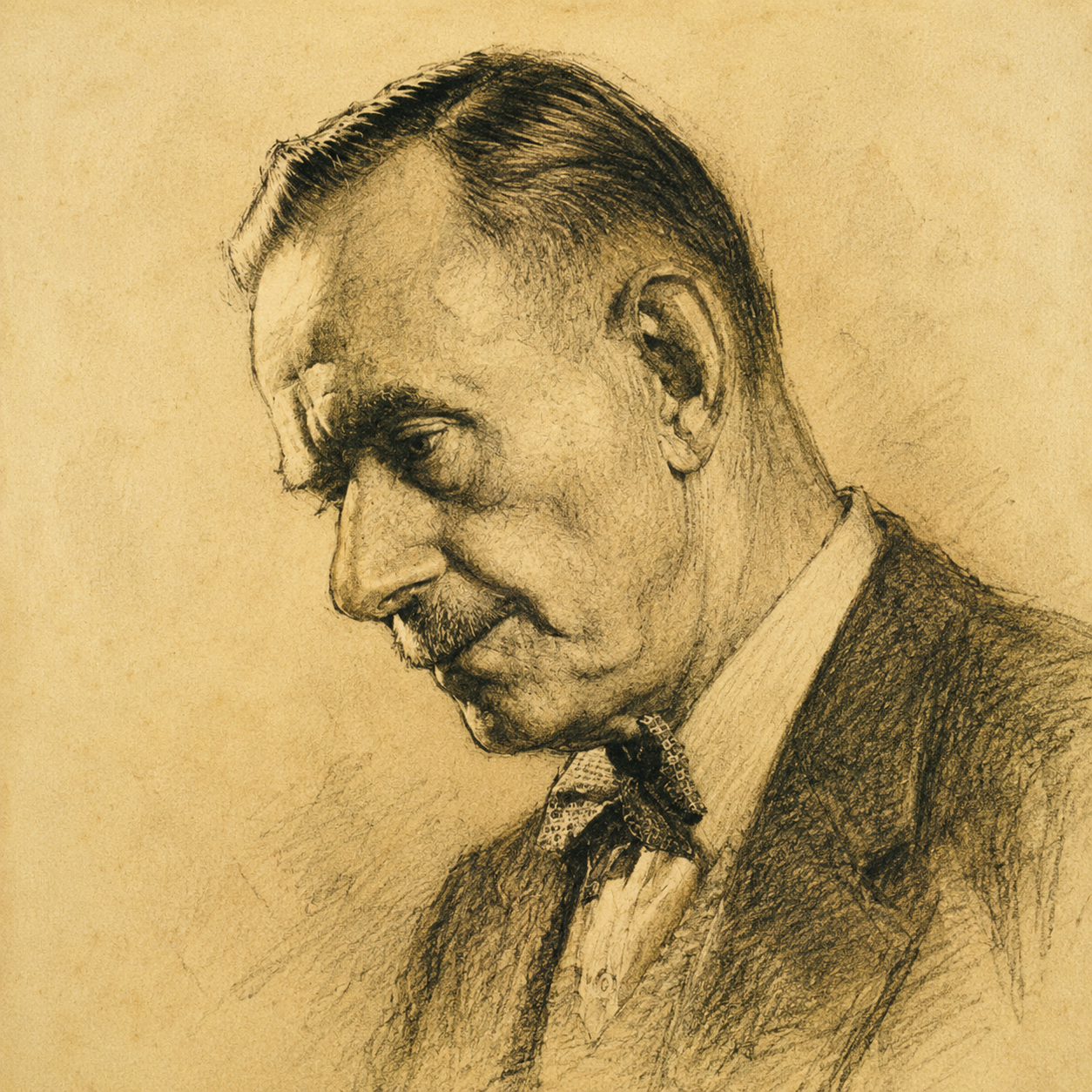
Citario. Derived from the Latin citāre —to quote— plus the suffix -ārium —repository—, similar to bestiary. A 21st-century neologism coined by Spanish-speaking scholars at Bookish & Co., with roots in ancient anthologies and florilegia. «Citario» is related to medieval books of commonplaces—such as those by Erasmus of Rotterdam—and to 19th-century proto-examples, such as Familiar Quotations. This «Citario Thomas Mann» celebrates the 151 anniversary of his birth, through a selection of voices—some dissenting—that acknowledge the vast architecture of his work and its many resonances in modern culture. Each quote opens a possible gateway to a universe full of irony, illness, music, myth, the bourgeoisie, and exile.
Los Angeles, September 26, 1943
Aschaffenburg, with respect: tomorrow evening we are invited to dinner, just the two of us, at Thomas Mann’s home. He read my Philosophy of New Music and is so enthusiastic that he wants to discuss it in detail with me and read me parts of his new novel—a novel about a musician (the protagonist is in some ways inspired by Schönberg)—on which he would like to hear my opinion. Well, perhaps he’ll be Reich President. .. By the way, although he is no longer at the height of his intellectual powers, he is very pleasant, kind, and cultured, and we enjoy visiting him.
Los Angeles, 10/20/1943
Thank you so much for the affectionate letter of the 16th with the lines from Thomas Mann. Kretzschmar, whom you ask about, is neither a reader nor an editor nor even a real person, but a character in Thomas Mann’s new novel, a novel about a musician from which he has read me a great deal and in which I advise him in a certain way as a music expert (after discussing it with me, he rewrote an entire passage, but this is strictly confidential, even from Julie, because I would by no means want it to become the talk of the town among the Jews).
Los Angeles, January 17, 1944
We see relatively few people, because we cannot invite anyone, and Gretel only goes out in very urgent cases and to the homes of people where she can lie down. One of those exceptions was an invitation from Thomas Mann—just with the Horkheimers—who read us long passages from his novel. You will be interested to know, but this must remain strictly between us, that he not only used a whole series of explanations I gave him but also took entire passages, literally or almost literally, from an article I published ten years ago on the late Beethoven. His thanks, which would not have been necessary at all, were expressed in a very amusing way: in the relevant chapter, while describing certain explanations I gave him (he also described me a bit, playing and explaining at the same time), he artfully incorporated the word Wiesengrund three times, a nice compensation for the loss of the correct Jewish name due to the authorities’ stupid scrupulousness, against which, once they had set their minds to it, I could do nothing (as you know, I always disliked the whole name change, but it is practical… and the previous name is at least expressly recorded in the naturalization document). By the way, Thomas Mann studies every piece of work I give him down to the last word and transcribes most of it, which I greatly appreciate (he’s your age, almost seventy). It seems it wasn’t just a misfortune that I didn’t end up becoming Franz Villinger… But I don’t want to drop hints; rather, I want to say frankly that I’m a little saddened by the indifference you show toward my work, while people who are comparatively more distant— and moreover precisely those who have a reputation for being particularly “cold,” like Thomas Mann, sometimes seem to me to have more sensitivity for what is specifically mine than you, those closest to me. Although on the other hand I also understand that your weary, aging minds, and especially after what you had to go through, want to have your peace. It’s just that even the simplest things in life are devilishly dialectical.
Los Angeles, July 15, 1946
All our friends have tried to comfort me in the most touching way; Luli even with spiritualism, to which she unfortunately seems to have devoted herself completely. When I told Thomas Mann—who has just had a brush with death and whom no one knows if he is actually safe—about the last few weeks on morphine, he said with an indescribable expression that he hoped that when he reached that point, they would not deny him the relief of morphine, and in connection with that he spoke of his grandmother, who died of asphyxiation due to a lung disease, in which he seems to have recognized the image of his own. But he is working on the novel again, and once more we are discussing the subject.
Theodor Adorno
◾️
The death of Thomas Mann brings a cycle of European literature to a close.
It is the end of an era that we are actually touching upon as we pay homage to the final link in a mountain range that has remained the backbone of sensibility over the last two centuries. His connection to Goethe, to Wagner on the sick side, to Schopenhauer and to Nietzsche, is not a mere racial or linguistic continuity, but a logical response to the creative—and destructive—sense of those creators. If they were the end of a race, a cultural twilight, the sum of them all, Thomas Mann was meant to encapsulate and even emphasize the feeling of disappearance.
What falls silent as this man passes away is not merely a brilliant artist, but a specific form of genius, the very genesis of genius in the European world. If one wishes, all of this can be reduced to this expression: what dies with Thomas Mann is a style; the style of an era.
However difficult it may be to pinpoint or even point toward these classifications, one can proceed; European literature had in Thomas Mann a point of arrival, a final station. Before Mann and after Mann, that is to say, a supreme form of expressing the creative will in literary art was to change its presentation and even its objective in the world. The legacies that converged in him allow us to see him as an “end of an era,” and compel comparison with the fruits that came “after Mann.” When we think of what we now call the novel, and of what the novel was up until Thomas Mann, we feel moved by that sense of chill and sorrow that comes from contemplating death. After Mann, chaos—regardless of whether that chaos arose from an undeniable decay of time.
Gastón Baquero
◾️
One of the characteristics of Thomas Mann’s great novels—and The Magic Mountain is a good example of this—is that narrative and essay on specific themes coexist closely. There is action and there is dialogue, and I would even say there is “suspense”: in *Doktor Faustus*, for example, as Adrian Leverkuhn’s descent into madness progresses. Thomas Mann can write pages as vivid as those in which Hans Castorp in *The Magic Mountain* makes his bold, erotic, and—I would say—almost paroxysmal declaration of love to Claudia Chauchat, but in the meantime the characters talk a great deal, argue, debate, and sometimes treat one another with the slightest regard. However, in the following chapter, in dense and impenetrable paragraphs, we are spoken to, in a transcendental manner, about life, illness, death, and the different categories of time in relation to Space—a major concern of Thomas Mann—within a prose that, without being obscure or convoluted, though somewhat baroque in the manner of Dürer, reveals to us a wealth of philosophical, biological, linguistic, and artistic knowledge, the equivalent of which we could find, so far this century, only in the works of authors of the stature of Proust, Joyce, Hermann Broch, or Ernest Jünger. And all this without losing touch with reality: while we witness Hans Castorp’s inner maturation in *The Magic Mountain*, we also know he was quite fond of dark beer and even know the brand of cigarettes he smoked. One can speak frivolously in a chapter by Thomas Mann. But no one ever says anything foolish, and if they do, it is to better highlight the value of an intelligent idea. And when Claudia Chauchat talks about love with Hans, she expresses unusual ideas about the relationship between morality and physical impulses that clash with all the bourgeois taboos of the time.
Alejo Carpentier
◾️
July 2 [2005]
I’ve gathered a few notes with the intention of using them for the novel. And I’ve been reading. Among other things, a biography of Thomas Mann written by Hermann Kurzke. I found it tedious (to use a very Extremaduran expression) and simplistic.
According to his biographer, almost all of Mann’s novels are little more than excuses to recount his homosexual fantasies, wrappers for an obsessive single theme. If we add to that the fact that Kurzke’s book is written in a flat, uninspired prose (or poorly translated—I don’t know German, so I can’t compare), I think the reasons for my boredom are justified. It picks up in the final section, when it breaks away from the central axis of the thesis—the novelist’s doubts between the masculine (father) and the feminine (mother)—and introduces elements of historical drama into the novelist’s personality. To explain the character, his era suits him better than his gender.
Rafael Chirbes
◾️
Superimposed on the doubts that always assailed him regarding his aptitude for fatherhood (“people like me shouldn’t bring children into the world,” he notes in 1918 in his diary), the feeling of disappointment was constant in Thomas Mann’s experience as a “family man,” understood as a fundamental institution of the bourgeoisie, the class whose values Mann adopted as his own, acknowledging with admirable lucidity its irremediable crisis and twilight condition.
As early as 1905, when Erika, his firstborn daughter, was born, Thomas Mann wrote to his brother Heinrich in these terms: “It is a girl; for me a disappointment, for I had so much desired to have a son and I do not cease to desire it… I feel the son as something more poetic, as a continuity and a new beginning of myself in new circumstances.”
The long-desired son—Klaus—would arrive the following year (two more would follow, as well as two more daughters), but that sense of renewal Thomas Mann speculates on fails to make headway amid the many preoccupations that keep him absorbed, even less so as grave events unfold around him in every sphere. By then, things had changed radically, and his own son Klaus was increasingly revealing himself to be a depressing product of those changes.
Like a late-blooming flower, an intense, almost unhealthy love for the newborn Elisabeth, his fifth daughter, then blossomed in Thomas Mann’s heart (it was the year 1918, and he was forty-three years old). But as she grew, the little girl’s “rebellious” and “stubborn” nature would thwart that affection and bring her father new disappointments.
This is the situation in which Thomas Mann finds himself when, having just finished *The Magic Mountain*, he writes, in April 1925, the novella *Disorder and Early Sorrow*, published that same year on the occasion of his fiftieth birthday. He himself refers to this story as “the product of a self-ironic cultural conservatism and of paternal love for a new world.”
In it, he draws on his own family environment to compose a narrative tableau in which the peaceful existence of Professor Cornelius, a prestigious historian, is disrupted by a party organized at his own home by his older children, causing a “disorder” in which one recognizes the imprint of that in which, the Weimar Republic was immersed in those years, buffeted by rampant inflation. As for the “premature pain” alluded to in the title, it is that of little Lorchen, who, spurning her father’s consolations, takes a fancy to one of the young guests at the party, an attractive boy for whom she suddenly feels a strong attachment.
Ignacio Echevarría
◾️
Goethean ozone, the sifting, the Leonardesque aerial perspective, the lofty air of the fir tree, the resilience of the most towering conifers; and the Wagnerian crescendo, which cannot be separated from the moment when the most typical Germanic development manages to introduce into its current the whirlwind and the void—these are the hallmarks in which Mann’s work finds refuge and moves forward. The great blocks he handles, the demigods of the bourgeois era, the exhalations of his situations and men as they become symbols, his arias where love and death conclude in vast laments, make him the last great representative of the Wagnerian era. And in fact, all the great creators of our time—a Proust and a Claudel, a Valéry and a Joyce, a Spengler or a Mann—that entire family of great Europeans whose extinction our generation has watched with some perplexity—belonged to those final echoes emitted by the Wagnerian chorus. The entrance of the guests in Tannhäuser and the chorus of pilgrims, the astonishment at the arrival at the house of spells, and the joy in the chorus’s transformations—a certain titanism that exchanges the impossible for fulfillment—seem to be its filters and incantations, its laments and its volcanic outbursts.
José Lezama Lima
◾️
Thomas Mann is the last great writer of the bourgeoisie. In his work, objective reality does not dissolve into subjective impressions or empty formal experiments, but remains held together by an iron will to comprehend social totality. His characters, from the merchants of Hamburg to the patients in Davos, suffer the contradictions of an era in decline; yet Mann endows them with a unique intellectual dignity. He achieves what few do: he elevates the conflict between the decay of the soul and the need for social order to the stature of a monumental symphony.
György Lukács
◾️
The legs that had carried his light body to so many places and with such fidelity, and one of which now lay, however, wrapped in alcohol compresses, beneath the small latticework set up to support the weight of the blanket, in place of the diseased limb. It is true that there was not the slightest need to think of an “amputation.” Moreover, he was feeling better every day; the swelling subsided a little almost daily, and there was already talk that he might be able to get up, which did not mean moving from the bed to the armchair—something he had already done several times—but taking a real little walk down the hallway.
But that terror would not leave my mind, and certain impressions and reflections caused me even greater anguish.
For example, the numerical symmetry in my father’s life. The fact that he had been born on June 6, 1875 (a Sunday), in the middle of the year that marked the beginning of the last quarter of the century; that he was 25 when *The Buddenbrooks* was published and was in his fifties (that is, 49 years old = 7×7) when he finished writing *The Magic Mountain*; the fact that he was awarded the Nobel Prize at age 55 and would have died—as he had prophesied—at 70, had Doctor Faustus not preserved his life; the fact that he had built his house in Munich immediately before the outbreak of World War I and the one in California immediately before America’s entry into World War II; that he had six children—a group arranged in a very symmetrical manner, composed, so to speak, of pairs: in 1905, a girl, and a year later, a boy; in 1909, a boy, and a year later, a girl; in 1918, a girl, and a year later, another boy; the man who was now 80 years old, exactly ten years older than the age at which he had predicted he would die.
Erika Mann
◾️
He believed it was very good that he had written the Considerations, because otherwise, The Magic Mountain would have turned out to be too politically and ideologically charged, and its author would not have introduced a character like Settembrini into it. In this respect, the book owed a debt to the Considerations.
Thomas Mann wrote very slowly.
But what he wrote was then set in stone. One could say he never changed a thing. He always prepared extensively before writing. Heinrich also wrote at night, but my husband never did. The only thing he ever wrote at night—and even after having a little to drink—was *The Wardrobe*. Apart from that, he only worked in the mornings. He could only work when his mind was still completely clear. His day was very disciplined, simple, and always the same. From nine to twelve, more or less, he wrote, then took a walk, ate, read the newspaper in the afternoon, smoked a cigar, and later rested. After tea, he would go for another walk, read, and do preparatory work—reading for his own writing—and fulfill what he called the “demand of the day.” Only the three hours in the morning were set aside for productive work. He wrote everything by hand, and if he wrote two pages in a day, that was already a lot.
As for writing by hand, I want to tell you the following. Once he had finished *The Buddenbrooks*, without having made any copies, he sealed the manuscript—which burned terribly [sic]—and took it to the post office. He told the clerk that he wanted to insure the package, because it was a manuscript.
The clerk replied:
“Do you want to insure it? For what amount?”
“Perhaps for a thousand marks.”
“What? A thousand marks? All right, as you wish.”
This is what happened.
Katia Mann
◾️
Our father was more reserved and had less contact with our daily lives. On the other hand, he had an even greater power of suggestion when he spoke to us or personally led some undertaking (for example, a visit to the theater). His sayings quickly became classic quotes for us, because they were so rare. Thus, on one occasion, at the table, he gave Erika—only Erika—a date, and explained this cruel arbitrariness to us as follows:
“It’s good for you to get used to injustice early on”—a remark that struck us as astonishingly frivolous and yet worthy of consideration.
While Mom was capable of doing most things, he knew how to do only a few, but with such skill that he made them legendary. For example, he knew how to beat egg yolks with a fork in a bowl with such perfection that they became completely stiff, and he had a knack for spraying us with the garden hose that simply made him a master in that field: two skills for which, as he said, a loose and light hand was required. He also had a knack for making our long walks in Tölz—which we didn’t like one bit—seem appealing and new, because he turned them into a breeding ground for legends. He spoke of the Seven-Mile Forest and all sorts of magical meadows when we had to walk the old path that wound through the grape pickers and past the chalet of the glove manufacturer Roeckel. Otherwise,
he spent most of his time in his study, which we were not allowed to enter. We were ordered not to make a sound, and if we forgot, we were reminded by the dry clearing of his throat that we heard behind the closed door. Mom took care of all the daily matters; so in a way she was more powerful than he was. On the other hand, we felt a much deeper fear in his presence. Against Mom’s decisions or orders, there was always the intimate possibility of resistance, of rebellion. But he was the final authority. There was no one else to turn to.
Klaus Mann
◾️
Javier Marías
It is to be feared that Thomas Mann, far from the humor and irony attributed to him by some of his readers and acquaintances, was always afflicted by melancholy, indolence, nervous breakdowns, panic, and psychological torments of various kinds, among which irritation occupied a prominent place. With the exception of Proust (but in such a different way), no one like him exploited the association between illness and artistry, and in that sense it can be said that he was always old-fashioned, since that link was at least a century old when he published his first novel, Buddenbrooks, in 1901. The curious thing about the case is that his ailments and anxieties were of the most persistent kind: they never left him in any of the places where he was forced to live, exiled from Germany since before the start of World War II, though after the Nobel Prize, which he received in 1929 quite naturally. What makes his figure most noble is, in the end, his unequivocal opposition to Nazism, from the beginning to the end, even though his political or apolitical ideas were never very clear or perhaps very commendable: what seemed most desirable to him, in opposition to both fascism and liberalism, was an “enlightened dictatorship,” an expression in which the adjective is too vague and connotative for the noun not to prevail in any case.
The problem with Thomas Mann is that he believed he didn’t take himself seriously, when if anything is glaringly obvious—in his novels, essays, letters, and diaries alike—it is that he was fully convinced of his own immortality. On one occasion, to downplay the merits of his *Death in Venice*, which an American had praised to the point of embarrassment, he could think of nothing better than to diminish them by saying: “After all, I was still a beginner when I wrote it. A genius of a beginner, but a beginner nonetheless.” Once he was no longer a beginner, he considered himself capable of the greatest achievements, and in a letter to the critic Carl Maria Weber he spoke with self-assurance of “the magnificent story that I may one day write, after all.” His admiration for Don Quixote is well known, as he took advantage of reading it aboard the steamship Volendam, which was carrying him to New York, to write a little book, A Sea Voyage with Don Quixote.
However, the sober and masterful conclusion of Cervantes’s work not only disappointed him, but he judged it to be improvable: “The end of the novel is rather languid, not moving enough; I intend to do better with Jacob.” He was referring, of course, to the Jacob of his tetralogy *Joseph and His Brothers*, which in Spain only the patient (and resentful for it) Juan Benet. It is surprising that Mann believed that great works were the result of modest intentions, that ambition should not be at the beginning nor precede the work, that it should be united with the work and not with the self of its creator.
“Thomas Mann in His Suffering”
I was interested in watching the 2001 German television series The Manns, which has now been released on DVD. Thomas Mann did not distinguish himself by anything too striking or unusual. He suffered exile during the Nazi era, but all in all led a life without too many setbacks or hardships, and a reasonably respectable one. More scandalous was the life of his son Klaus, also a notable writer, who ended up committing suicide like his brother Michael—though Klaus did so after their father had already died. So to speak, there was almost nothing about Thomas Mann as a person that lent itself to the excesses and self-indulgence that no artist escapes when portrayed in film or literature. “Let’s see if for once there’s someone I actually like,” I thought. “Someone I might actually want to spend time with.” But it wasn’t to be. Thomas Mann does not come across as irascible or hysterical; he is not seen tormenting himself or peering into the “abysses of creation.” He almost seems like a notary or a factory owner, and his only whim—for a father of a large family—is an abstract homosexuality that manifests itself only in semi-furtive glances at handsome young men. Not very flashy; finally, a certain sobriety. And yet his character doesn’t invite us to follow him either, but rather to shun him: a sort of pumice stone, rough and brittle, who doesn’t even flinch at his son Klaus’s first suicide attempt. A solemn, self-important man who receives the news of the Nobel Prize with jarring nonchalance, as if it were something to be expected or owed to him. Someone aware of his celebrity, who seems to share his wife’s attitude when she interviews a potential secretary for the writer and warns her:
“Well, absolute confidentiality will be required. You know, it’s Thomas Mann!” Judging by this dignified and interesting series, the author of The Magic Mountain might have gotten up in the morning and, looking in the mirror, exclaimed with reverence: “I am Thomas Mann! Good grief.” I don’t know if we will ever be able to see or read about an artist without it leading us to wonder whether our admiration for the work of such a person might not necessarily be a mistake.
“Peste de artistas”
◾️
Buddenbrooks, a novel written in the early 20th century when its author was twenty-five, is the most painful and critical portrait of the 19th-century German bourgeoisie. The first generation of patricians and merchants of the Buddenbrook family in Lübeck, in northern Germany, embraced work as an evangelical and perpetual duty. The most rigorous and feared prohibitions were no longer religious ones; the secular world of work gradually took over private life, which was removed from the control of the state and the church. The Protestant ethic—that is, the sanctification of work—had been transformed centuries earlier, as Weber had observed, into the spirit of capitalism; but by the mid-19th century, none of Thomas Mann’s characters lived torn by the antagonism between freedom and predestination. The Buddenbrooks were a walking paradox: the morality of money and the commerce of their emotions. In this exhaustive family chronicle, the last generation crumbles in the face of the impossibility of understanding the new century; the clarity, moral audacity, and intellectual sobriety of the Buddenbrook House have been left behind. The typhus that ends the life of little Hanno, the last of the Buddenbrooks, is not only a metaphor for the decline of a family but also an almost perfect metaphor for the misery of human beings.
José María Pérez Gay
◾️
Ever since the days when such formidable mediocrities as Galsworthy, Dreiser, Romain Rolland, and Thomas Mann were accepted as geniuses, I have been both perplexed and amused by the fabricated notions surrounding so-called “great books.” That, for example, Mann’s idiotic *Death in Venice* can be considered a ‘masterpiece’ is, to me, an illusion as absurd as when a hypnotized person makes love to a chair. His style is pretentious and verbose, his images turn out to be mere accumulated clichés, and his sense of humor is reminiscent of the most elementary comic strips.”
Vladimir Nabokov
◾️
Thomas Mann is criticized for having aspired to be a witness of his time for too long. Thus, it is asserted that it is not possible to confront a historical period such as the present one by judging it with the standards and preconceived notions typical of the turn of the century. They say: every era has its own atmosphere, its own sensibility, its own ideas, which make up a worldview, and it is only possible to interpret it with the sensibilities and methods characteristic of that era. Hence they have sensed the musty stench emanating from some of Mann’s works.
In any case, the only thing to reproach Mann for is that he immersed himself too deeply in his own time, forgetting the time of others. That is why they insist: the merit of a work lies in withstanding the test of time; the work must stand on its own, asserting itself equally to contemporaries and to their grandchildren. Literature is not Archaeology. Shakespeare is that neighbor of ours who wakes up in doubt and who, in the wee hours, alone in his bed, torments himself, seething with jealousy over the absent woman who was taken to her family’s village by a friend who was heading to the same place in his car.
Hamlet? Othello? They’re right there, just around the corner, having a beer at the bar with some friends. We know them with all their foibles and their greatness. But what remains for those grandiloquent writers, bearers of words—only words—enormous, like blocks threatening to crush us, and not exactly saying anything in common to both him as a writer and the one who reads him?
Jaime Sarusky
◾️
The surviving photographs of Thomas Mann, of the villas and surroundings in which he lived, show us the image of an impeccably dressed representative of the wealthy upper class, a famous and highly successful writer, married to a beautiful woman and with a family of six children. Only the publication of his diaries—partly destroyed, partly kept in Zurich in sealed packages and made accessible in 1975, twenty years after his death—revealed how Thomas Mann needed the protective wall of his bourgeois and representative facade to overcome his own doubts, his weaknesses, and his ambiguous sexual identity, to maintain a fragile balance that was often on the verge of collapse.
His marriage to Katja Pringsheim, whose father—a Berliner of Jewish origin—was a wealthy and respected professor of mathematics at the University of Munich, is revealed in the diaries as an exercise, sustained over fifty years, in the service of this necessary order, yet one constantly endangered, not least by their children—individualistic, brilliant, and yet psychologically fragile children. The marriage thus serves as a refuge from the unsettling dynamics of both the unconscious and political conflicts. For Thomas Mann, the bourgeoisie signifies not so much a social or political category as the attempt to become part of a whole that can embody concepts such as humanity, ethics, discretion, skepticism, work ethic, but also the New Deal or humanist socialism…
In accordance with his humanist self-understanding, and consciously anchored in tradition, Thomas Mann saw, in the years leading up to World War I, a fundamental contradiction between spirit and politics, between culture and civilization. The democratic aspirations of the nineteenth century revealed to him a clear tendency toward total leveling, toward the regulation of the spirit, which he rejected: “The human being is not only a social being, but also a metaphysical being.” He set forth these thoughts in Betrachtungen eines Unpolitischen (1918), where he defended the culture of old Germany and set it against civilizational democratisms. However, these thoughts do not arise from political mistrust but rather as a serious warning against any form of state totalitarianism. Thomas Mann would eventually become a “literary figure of civilization,” defending the Weimar Republic against totalitarian ideologies and even becoming its unofficial intellectual representative.
Marisa Siguán
◾️
Thomas Mann is the evil eye of Venice, its sinister Doctor Faustus, its reverse Goethe,
its black mountain, its cursed prophecy. Death in Venice (1912) may have played a hidden role in his winning the Nobel Prize in 1929. This doomed melancholic, the pride of German literature in times of barbarism (and rightly labeled a “noble goy” by Freud), has long poisoned the air of the lagoon. His accomplice, as is well known, was Luchino Visconti in 1970. Death in Venice, Death in Venice, Death in Venice.
Deep down, two visions of Venice are almost constantly at odds. One, Bonapartist and German-Austrian (the thesis of inevitable decline); the other, dazzled, French (paradise and resurrection, Proust, Manet, Monet).
It is easy to understand. German-Austrian version: I found a treasure, then I fall, and therefore this treasure must disappear with me. Sensual “French” version: they lied to me and hid a marvel from me, so I open my eyes and ears, and I speak out.
Death in Venice, 1912: this date speaks volumes. Europe is heading toward carnage and destruction, a situation that would worsen in 1939. Hemingway realized this in 1950: his hero, in love but still active, dies of a heart attack in the lagoon after a duck hunt. Undoubtedly, the curse and the spell are present; they weigh heavily.
Gustav von Aschenbach, a celebrated and disillusioned writer, moves to Venice in search of calm, rest, and inspiration. What he finds, in a city where cholera lurks, is its decadence and ruin. The city sinks; he sinks. This twilight has a god: Tadzio, a young Polish boy of angelic and inaccessible beauty, a messenger of a pantheistic and mystical passion that can only lead—fatally—to nothingness. Proust dreams of young girls in Venice, Mann of a young boy: it is strange, since Thomas Mann is not known for being homosexual. Sentimental, in any case: Venice reveals.
Philippe Sollers
◾️
German writers who settled in the United States fleeing the Nazi regime had to face a social dilemma even as their aesthetic priorities lay elsewhere. In Spain, meanwhile, the defenders of “pure poetry,” trapped in the spider’s web of Ortega y Gasset’s avant-garde, witnessed a transformation of their own texts influenced by the experience of exile and a new geographical environment. In both cases, the cultural consequences of the war led to an almost total paralysis in the evolution of the intellectual process. Exile caused not only the fragmentation of groups and movements, but also that of individual writers whose previous existence was as aesthetically distant from the present reality as the geographical distance separating them from their homeland.
Thomas Mann is one of the most typical examples of this phenomenon. His intellectual journey spans from the subjectivism of his early novels to the testimony he presented before a U.S. congressional committee on behalf of his German compatriots in exile. His experience also permeates the pages of one of his most important works, Doctor Faustus, written in Los Angeles at the end of World War II. This exceptional work is of great philosophical and ideological complexity and takes on even more complex overtones when analyzed within the context of exile. Although the work cannot be understood as an autobiography in the strict sense, Mann himself suggests that the portrait of the protagonist contains some autobiographical elements: Dr. Serenus Leitblom appears to be a facsimile of the author. The narrative achieves an autobiographical effect through the use of first-person narration, shifts in perspective, and an omniscient first-person narrator. The work cries out for an answer to the question: who is the subject of this autobiography? For Mann, the literary and ontological problem of autobiography is of great importance, as a German narrating the decline of his country at a time when everything was already literally lost, including his own way of life.
Michael Ugarte
◾️
The writer is, without a doubt, another moralist, just as Von Aschenbach was before his downfall. In Thomas Mann, too, just as in his character—it is well known that, in addition to Gustav Mahler, the author of *Death in Venice* himself served as a model for Von Aschenbach—there is an instinctive fear of pleasure, that realm of experience that nullifies rationality and where all ideas are shipwrecked. These are two romantics disguised as classicists, two men for whom the passion of the senses, the euphoria of sex, is a supreme exaltation that man must experience, aware, however, that it will plunge him into decadence and death. There is not a trace in these licentious puritans of the cheerful and playful eighteenth-century view of sex as a world of play and fun, perfectly harmonious with the other pursuits of life—those of the body and those of the spirit—two orders that the eighteenth century conflated and that the nineteenth, the Romantic century, would render incompatible.
The symbol is inherently ambiguous and contradictory; it always admits interpretations that vary depending on the reader and the times. Although less than eighty years have passed since Death in Venice was written, many of its allegories and symbols already seem uncertain to us, for our era has emptied them of content or rendered them unrecognizable. The rigid bourgeois morality that surrounds Thomas Mann’s world and lends Von Aschenbach’s fate a tragic aura appears, in our day, that of permissive society, as a picturesque anomaly, no more and no less than that Indian cholera with medieval overtones that contemporary chemistry would swiftly subdue. Why was it necessary to punish so cruelly the poor artist whose only sin is to discover carnal pleasure belatedly—and, to make matters worse, only in concept?
Mario Vargas Llosa


