
I remember Havana’s carnivals as an explosion of violence and lust. On humid nights, our dampness reaffirmed us in the face of fear and deprivation.
Despite strict security measures, thousands of police officers, and the rounding up of undesirables, the volcano erupted and spewed rivers of fiery saliva, blood, and semen over the anguished city.
For a few nights, something resembling freedom roamed among the unrestrained crowds.
It was like delving into the guts, into the reproductive and digestive systems of the city. Its acidic juices, its creamy shit. The crowds, divided into two recognizable camps: the pepillos and the guaposos or thugs. The pepillos dressed in the latest fashion, bell-bottom pants, long hair, tight jeans; the guaposos with their T-shirts, religious necklaces, sharp, close-cropped sideburns, and baggy pants, so wide that they looked like figures from Japanese theater from the waist down.
The music blared and the orchestras perched on the floats, which despite having names of battles and revolutionary heroes, continued to speak of times of abundance, joy, and excess. The dance troupes swept through rivers of sweat. The beer pipes couldn’t keep up, the floor stank of urine, ejaculate, rum, and blood.
Every so often, a fight would break out in the sea of moving heads and bodies.
The guaposos achieved rank and notoriety in their clans by cutting the dancers who followed the floats. To do this, they used extremely sharp barber’s razors that cut through clothing and flesh without the victim noticing the attack. Only when they felt the flow of blood and the first stinging sensations did they realize they had been wounded.
Juan Abreu
◾️
The first morning I went to Lezama Lima’s house. It happened a little by chance: I went out for a walk to see the city, and since there isn’t much to see because everything is in ruins, everything is dirty and sordid and you try to get through it as quickly as possible, I left Old Havana behind, suddenly I was in Prado and it occurred to me that Trocadero Street couldn’t be far away. I asked someone, and although they gave me some (well-intentioned) nonsense, I found it a few steps away. I had known the address by heart since I was a child: Trocadero 162. So, I took that mythological passageway, that royal road that is now a broken little street, with puddles and piles of garbage and old men sitting on doorsteps smoking smelly cigars. A sign at 162 indicated that it was the Lezama Lima House Museum. I snooped around for a moment through the half-open shutters, without much hope of getting in; it was ten in the morning and everything looked dead. The house where Lezama lived is a ground floor apartment, one of two perfectly symmetrical ones; the building has four or five floors. It looks like a construction from the first quarter of the century.
(…)
Realistic painting is not practiced on plates or cases, but rather oriental or rococo fantasy, or fantasy pure and simple. And the exotic has an intrinsic relationship with its narrative, with the stories attached to distance: the participation of language distorts the character of the image itself. It is as if the image itself were always life-size. For example, Havana for me these days, when it rises before my eyes in its perceptible reality. Passed through memory, the image becomes miniature and exotic. It must be because of that previous stage in which I experience it that Havana is so discouraging: dilapidated, worn out, full of tourists, with that very sad cheerful music playing everywhere.
César Aira
◾️
We went through Immigration and Customs. They stamped my passport and were about to let me go. Havana was behind us. After having placed itself ahead, drawn in the air with the charcoal of delirium; and after having moved alongside us, like false identical bodies, the city had run aground in that definitive place. But behind what? Behind life, perhaps?
On no map of time, on none of the future routes, not even in the plans for escape or flight, did Havana reappear as it had once been: a promise of rescue, a temptation, or an intimate discovery. It was a place precariously situated between the fog of melancholy and the trap of indifference. Only the salt line of its suffocating political situation, which at another time would have degenerated into disgust or contempt, made Havana still make some sense to me. A contingent and fragile one, but a sense nonetheless, that of postponed justice.
Carlos Manuel Álvarez
◾️
England arms its fleet. This time it will not make the mistake of attacking Cartagena, whose fortresses it now considers impregnable, but instead sets its sights on Havana. The governor of Cuba does everything he can to repair the forts and walls, but when Sir George Pockoc appears with his ships, hopes of resistance are almost nil. Women, children, and the elderly flee in a hasty pilgrimage to the interior of the island. Inside the plaza, there are only about five thousand men, and Pockoc has 12,000 infantrymen he has brought from England, 3,000 sent from New York and Jamaica, 4,000 blacks, and 15,000 sailors to carry out the assault. It is more or less the same proportion as during the siege of Cartagena, with this difference: here, Admiral Pockoc and General Albemarle are in agreement, and the defenses of Havana are not like those of Tierra Firme. The siege lasts for sixty-seven days, thanks to the heroism of those under siege. The defenders of the Morro castle perform prodigious acts of courage. But in the end, the English enter, and this time with the intention of staying on the island. In 28 ships, the 900 soldiers and officers who survive the catastrophe and request their return to the mother country set sail for Spain, thanks to a gracious surrender. The booty is estimated at 736,000 pounds, which is happily distributed, with the generals receiving a little more than the troops.
(…)
And so began English rule in Havana. At first, the people resisted. The Cabildo refused to swear allegiance to the new king, with these words from the president: “My lord, we are Spanish and cannot be English. Dispose of our goods, sacrifice our lives, but do not demand that we swear allegiance to a prince who is a foreigner to us…” The ladies sign a manifesto to the court of Madrid considering that the surrender of the city was cowardice on the part of the governor: The bishop refuses to hand over to Albemarle the lists of clergymen, with details of their benefits, and to give him a church for Protestants to worship in. Albemarle settles these differences with a firm hand, and sometimes with tact.
(…)
But, on the other hand, Cuba suddenly experiences “all the sweetness of commercial freedom.” In the ten months of the English occupation, nearly a thousand ships enter the port of Havana: before, only six arrived per year. The stores are filled with goods that have never been seen before. It is a pleasure to go shopping, where the activity seems like a continuous party, and money flows freely. It is a pleasure to watch the black people sweating as they unload ships at the dock. Agriculture is reborn with supplies arriving daily from England. The trading company founded by the Basques is the first to suffer the onslaught of the invaders. On the ruins of its extinct monopoly, free trade now boils, and business multiplies. It is a lesson that Cubans will never forget.
Germán Arciniegas
◾️
In 1960, I went to Havana. On July 26, Fidel Castro was giving a huge speech and needed an audience to fill the Plaza de la Revolución.
More than a thousand of us young people were put on a sugar cane train and arrived in Havana after a journey that lasted more than three days.
(…)
We arrived in Havana. I was fascinated by the city; a city, for the first time in my life; a city where no one knew each other, where you could get lost, where to a certain extent no one cared who you were. We stayed at the Habana Libre hotel, that is, the Habana Hilton hotel, suddenly converted into the Habana Libre hotel. Six or seven of us young people slept in each room.
Of course, the “crazy women” of Havana had a field day with those scholarship students, who had not had sex for about six months and suddenly arrived in the very center of Havana.
(…)
The fact is that that first trip to Havana was my first contact with another world; a world that was, to a certain extent, crowded, immense, fascinating. I felt that that city was my city and that somehow I had to find a way to return to it. In any case, in the short time we were there, our job was to parade, and of course, we paraded in front of the Plaza de la Revolución for a whole day, applauding, chanting the typical slogans of the moment, enthusiastic to a certain extent.
Reinaldo Arenas
◾️
From the Hotel Rosita de Hornedo we moved to an apartment in Vedado, just around the corner from one of Havana’s great cafés, El Carmelo, famous for its mantecados. The entrance to El Carmelo was very pleasant, and one was intoxicated by the aroma of tobacco that permeated the entire room. I would go to buy garlic and onion bread and a few cans of chorizo de cantimpalo, which every two or three months were brought to the port of El Morro by a beautiful ship, the Spanish freighter Covadonga, which was black and white.
After the invasion, almost everything began to become scarce. Sara cooked with the exquisite lard that came as a gift in the chorizo cans; for us, it was a delicacy to cook with that lard, which was used drop by drop. When that ran out, because that day had to come, we had no choice but to switch to Russian lard, which drove all Cuban housewives crazy. Soon the taste of Cuban food changed because of Russian lard: chicken fricassee, chatinos, petit pois, and sweet potatoes were no longer the same. The only soft drink you could have was Materba. There was a very cruel advertisement that said: “Everyone in Cuba drinks Materba, cold Materba is easy to digest.” Another radio ad said: “That little drink at three in the afternoon, make it Pilón coffee.” Every day Sara listened to the songs of Barbarito Díez. When Orso could no longer go to Ciudad Libertad, I sent him to take a “cursillo” with an old mulatto woman who cooked and ironed clothes while teaching children.
Sara panicked when she found out there was no soap. We had to comb through all the stores in the area looking for some, no matter the cost. All we wanted was soap. (1961)
Orso Arreola
◾️
Thanks to its geographical location and the magnificent bay next to which it had been established, Havana became the mandatory meeting point for Spanish ships engaged in commercial traffic with the American colonies. Promoted to the island’s capital in 1603 (until then it had been Santiago de Cuba), it would have the privilege of being for many years the only Cuban port authorized to trade with Spain.
Its continuous development—demographic, economic, military, urban, administrative—had created the conditions for the expansion of agriculture and livestock and poultry farming, an increase in the number of fortifications, the emergence of an active naval industry, and a guaranteed supply of water through an aqueduct connecting the city to a nearby river called La Chorrera (today Almendares). At the end of the 16th century, there was no more suitable place on the entire island for the establishment of sugar manufacturing, which had already begun in Hispaniola a few decades earlier.
(…)
Due to the failure of the conspiracies and the economic boom, the idea of independence was almost unthinkable in Havana in 1830. Benefiting first from tobacco and then from sugar and coffee, and having already achieved free trade, the city was one of the busiest ports in America. Already visited by international tourists, it consumed ice imported from the United States, English beer, Westphalian hams, Spanish wines, Italian operas, and Parisian fashions. Speculation, legal disputes, gambling, and extravagance made and broke fortunes overnight.
Antonio Benítez Rojo
◾️
It was the first time I had ever climbed a staircase: in the village there were very few houses with more than one floor, and those that did were inaccessible. This is my first memory of Havana: climbing a staircase with marble steps. There is the intermediate memory of the bus station and the market in front, the Plaza del Vapor, both arcades, filled with columns, but there were also portals in the village. So my first real memory of Havana is this luxurious staircase that becomes dark on the first floor (so much so that I don’t remember the first floor, only the staircase that turns once more after the landing) to open, after a baroque volute, onto the second floor, to a different, filtered, almost mauve light, and to an unusual spectacle. Opposite (by this time my family had disappeared to my amazement) was a long hallway, a narrow tunnel, a corridor like I had never seen before, onto which many doors opened, perpetually open, but the rooms were not visible, the interior hidden by curtains that left a long space at the top and another short section at the bottom. The air moved the curtains of different colors that did not allow a view of the domestic functions: although it was midsummer, early in the morning it was cool and a draft came from inside. Time stood still before that vision: with my access to the house marked Zulueta 408, I had taken a momentous step in my life: I had left childhood behind to enter adolescence.
Guillermo Cabrera Infante
◾️
Humboldt complained, in his time, about the poor layout of Havana’s streets. But today, one wonders if there was not great wisdom hidden in that poor layout, which still seems dictated by the primordial—tropical—need to play hide-and-seek with the sun, mocking its surfaces, snatching shadows from it, fleeing from its torrid announcements of twilight, with an ingenious multiplication of those monk’s corners that are still so highly prized, even now, in the old city that was intramural until the beginning of the century. There was also a lot of mud—in dark saffron, sepia blue, light brown, olive green—until the beginning of this century… The streets of Havana visited by Humboldt were perhaps poorly laid out. But those that remain, however poorly laid out they may have been, give us an impression of peace and freshness that we would hardly find where conscious urban planners exercised their science.
The old city once called intramuros is a city of shadows, made for the exploitation of shadows—a shadow itself, when contrasted with everything that germinated and grew to the west from the beginning of this century, when the superimposition of styles, the innovation of styles, good and bad, more bad than good, created in Havana that style without style which, in the long run, through a process of symbiosis, of amalgamation, has become a peculiar baroque style that serves as a style in its own right, inscribing itself in the history of urban planning. Because, little by little, from the motley, the intermingled, the interwoven between different realities, the constants of a general aura have emerged that distinguishes Havana from other cities on the continent.
Alejo Carpentier
◾️
Our man in Havana balances social commitment with sex, espionage with lust, and perceives Havana as a place where people come to feel important. Any tourist leaves there as a music entrepreneur, publisher, curator of an exhibition of Afro-Cuban artists, initiated priest of Ifá, deliriously loved by a beautiful teenager, “friend of his friends” (that absurd phrase), trafficker of relics or revalued paintings by Sorolla, expert in the world revolution…
In Greene, on the other hand, the Havana that points to the future is also a Havana where time stands still. British tea time is replaced by Cuban daiquiri time, the time for reading the morning paper, drinking cocktails, and acquiring a notion of minutes. The cocktail, precisely, sets the pace for these intrigues, and as a good bartender knows, everything depends on the skill of the mix, the precision of the shake, the exact wielding of the cocktail shaker, the rhythm of the ice cubes wielded by the waiters.
Iván de la Nuez
◾️
But here, my daughter, the city is already beginning to merge with the neighborhoods. Here it is. It is the city, with its balconies, its shops, and its rooftops, with its beautiful low-rise middle-class houses, houses with large carriage doors and huge barred windows; the doors and windows, everything is open here
open; you can see right into the intimacy of domestic life, from the watered and flower-covered courtyard to the little girl’s bedroom, whose bed is covered with linen curtains with pink bows. Beyond are the aristocratic one-story houses, surrounded by galleries that announce themselves in the distance by their long rows of green shutters.
I can already make out the balcony of my father’s house, which extends opposite the castle at La Punta. To one side is a smaller balcony… That was where, as a child, I used to gaze at the starry, sparkling sky of the Tropics. There, to the dull, regular sound of the waves breaking into foam on the beach, my soul exhaled its first perfumes and lost itself in religious contemplation. There, restless, troubled, moved, with my eyes fixed on the immense expanse of the sparkling blue sea, I sensed in the candid impulses of my heart that there was something as vast as the sea, as changeable, as great, as powerful! I already felt this lower world moving outside of myself, where all human joys and sorrows bubbled in the distance, but whose first rumblings reached me accompanied by such pure delights and such delightful harmonies!…
María de las Mercedes Santa Cruz
◾️
How can I describe my impression of the first streets of Havana, as we chatted our way to the hotel in a new Spanish car, which stood out from all the others around us? It seemed to me to be a clean air and a poor world. And more. Everything seemed ravaged, desolate, as if there had been a war—I would say—a few months earlier. It was sunny and hot—Camus said that everything is less poor in the sun—but it didn’t seem like a bright world. There were few cars, and almost all of them were old, American models from the 1950s. There were quite a few bicycles. Later, I think there were more. The people—their clothing, although summery—had an ordinary air, as they say in Spain. That means, in reality (and once again the word springs to mind), scarcity and poverty. That can hardly be denied. No one can deny it.
Luis Antonio de Villena
◾️
Old Havana, with its historic center, its squares, its fortresses, its cathedral, should have been the city’s main tourist attraction, but at that time it was only the destination of a few daring tourists. As for the cuisine, it was as barren as in the rest of the country. There were a few dollar restaurants where we couldn’t go even if we had hard currency, because its mere possession was illegal and punishable. And even if it weren’t: if you managed to get a few dollars in those days, you wouldn’t commit the extravagance of eating in a restaurant. With what a coffee cost in places like that, you could buy a week’s worth of food on the black market.
(…)
My real luck in terms of lunch was discovering that on Muralla Street, about ten blocks from where I worked, there was a dining hall for workers from various state institutions in the surrounding area. One of them was the Museum of the History of Science, where almost all the historians from the graduating class after mine ended up, several of whom were friends of mine. The solution is simple: for the first few days, they pass me off as part of the group so that the guards there can get used to my face. After a while, I’m like one of the family and can go without my friends to eat the watery red beans and a little rice which, thanks to not having the breadth of experience of the city historian, taste like heaven to me.
Traveling, that’s the problem. As soon as you set foot in the outside world, the big concern when it comes to food is to restrain yourself. But with accumulated experience, the mere idea of leaving food on your plate becomes unbearable. You don’t eat to satisfy your hunger, but to avoid the slightest waste. In Cuba, I weighed fifteen or twenty pounds less than my ideal weight, while outside I have weighed up to forty pounds above it: I gained a good part of those pounds thanks to the food I didn’t dare throw away after I had eaten my fill.
As I said, my current obesity is made up of a guilty conscience and a good memory.
Enrique del Risco
◾️
The lobby of the Meliá cannot be compared to that of the fabulous Riviera, Capri, and Deauville, or even to that of any cheap motel on Sunset Boulevard. The Moctezuma on Calle Ocho, back when I used to go there in the nineties, is the only equivalent I can find for that little place. Everywhere there are brutal people, drinking and talking loudly.
In the corridors on the second floor, they have crammed in an art gallery.
At a relative’s house, I met a dog that was nursing a cat. The dog was old when the cat arrived, and then she started to give milk. The owners told me the story as if it were the most natural thing in the world. To me, it seemed like a sign of the end of times, or at least the end of the country’s capacity for horror.
I walk through the Cohiba gallery. Cuban art is like the dog that nurses a cat. The harpy of Castroism latched onto its teats and forces it to produce black milk. I think that, possibly, it all ended with Wifredo Lam’s La jungla (The Jungle) or Antonia Eiriz’s La anunciación (The Annunciation). The rest is overproduction, the meager udders of a nation that gives birth to artists out of exhaustion.
Nevertheless, Cuba is a country of artists, that is, of “inventors,” a nation of climbers. But true art should not be given away, it cannot be delivered unrestrictedly to all beings. There is an excess that is a curse, an overproduction that is witch’s milk.
Néstor Díaz de Villegas
◾️
During the 19th century, starting at Zanja Street and Dragones Street, Chinese immigrants began to expand into Central Havana. They reached 250,000 before the Revolution, and after it, others arrived for political reasons. Today, there is barely a pedestrian passageway with restaurants left, a tiny ghetto where a dozen Chinese people wander around as if they owned the place. The surrounding streets have been peeling away until they have almost completely lost those fanciful Eastern coatings. Except for the islands rescued by Eusebio, the city’s historian, the same thing has happened throughout Havana. It is a capital in ruins, with the beauty that ruins possess. The buildings in Centro Habana are more or less the same height and have continuous facades. Sometimes there are galleries with Doric and Corinthian columns and arches in which styles are mixed, once colorful, now entirely faded. Time has gnawed away at the material of these buildings, exposing their iron skeletons, like bodies with leprosy. Barefoot children run along these sidewalks, young black men with a wide variety of hairstyles and caps pass by; a Caribbean Bronx, with little clothing and little fear of violence. Havana must be one of the safest cities in the world. Its people live outside their doors because inside it is very hot and there is no air circulation. Men chat over beer leaning against columns, sitting on steps, or directly on chairs placed on the sidewalk in front of their homes. Not many cars pass by, and on some streets very few, so children invade them chasing old balls or broken toys. The trappings of modernity are rarely seen in this neighborhood. Some of the apartments are large, but never luxurious. They have almost no furniture, and most of them are lived in like villages, if not camps, completely ignoring the history of the building, like cats in the Parthenon. The former living rooms are used as clotheslines, some have painted the friezes in different colors and replaced the ceramic tiles with extraordinary handmade designs with plastic floors, “easier to clean.”
Patricio Fernández
◾️
Eusebio Leal is the last jukebox left standing when the bars in the port of Havana closed. Opinions are divided about his work as the city’s restorer: there are those who accuse him of building a Disneyland in memory of Cecilia Valdés, and those who see how much worse Old Havana would be if he hadn’t gotten involved.
From this last point, they jump to comparing him to the country’s military authorities. His advantage is that, within a gang of criminals [sic], he managed to complete high school. Of course, he is the best speaker of the whole gang. He said this in 2014, referring not only to his properties in Old Havana, but to the entire capital: “The city is intact, sometimes run down, but when you lift the veil of that apparent decay, its splendor appears in every building, in every place. What you need is eyes to see the wonder and a heart that never falters.” In other words, what the residents of Havana’s dilapidated houses and those housed in state shelters lack are the kind of eyes Leal talks about, as well as a tireless heart. Havana is, at heart, an ophthalmological and cardiac problem. Once that double problem is solved, all those whose roofs have collapsed (and who are still alive) will be able to appreciate how intact the city is. Its people are a different matter, and the Historian of Havana complains: “We must take care of the city’s appearance, its cleanliness, its decorum. How is it possible to go out on the street in a T-shirt?” According to him, the city is intact but the people of Havana are not, and there is no eye of any kind or heart beating steadily that can bring out the intact Havana of old from a person in a T-shirt.
Fermín Gabor
◾️
Santos Suárez was a neighborhood that had never had much residential appeal, but it did have an aura of quiet relief and cordiality. The area still retained something of those old virtues, despite the general deterioration that had prevailed in the capital for years. Many other neighborhoods in the city were semi-dilapidated, as a result of the countless components of the urban environment that were broken or worn out never being repaired or replaced. But the buildings in Santos Suárez seemed to be of more recent construction and did not look so bad, to be honest. There was none of the abysmal deterioration or street dirt that proliferated in downtown Havana, where I lived.
Reinaldo García Ramos
◾️
[February 28] But there is also a Havana that appeals to me. That Havana of afternoon visits to churches. (And I think this is one of our most Havana-like features); those churches submerged in the noise of car horns, amid the waves of their chiaroscuro; and there, that pitiful face—again that dry tenderness I spoke of as an intuition of our characters—of Cuban frustration.
Lorenzo García Vega
◾️
Havana can prove that it is faithful to that style and to the style that defines a race. Its loyalties remain intact. Shaken, stretched, dismembered by legs and arms, it still shows a rhythm. A rhythm that, amid the surrounding diversity, is predominantly Hispanic saffron. It has a lively, vivacious rhythm of growth, of quick brilliance, of the breath of a city that did not emerge in a week of plans and equations. It has a destiny and a rhythm. Its assimilations, its demands as a necessary and inevitable city, all that conglomerate that has been formed through a thousand doors, still maintains that rhythm. A rhythm of slow steps, of stoic indifference to the passing hours, of sleep with a marine rhythm, of elegant tragic acceptance of its port decay because it knows its tragic durability.
That rhythm—an unchanging lesson from the Pythagorean constellations—is born of proportions and measurements. Havana still preserves the measure of man.
Man walks its contours, finds its center, has its areas of infinity and solitude where the terrible reaches him. That classic and clear measure of man leads him to abhor nightlife. Havana, fortunately, after midnight, closes its flower and its curiosities. Quote from the Gospels: He who walks by day does not stumble, for the light of the sun shines upon him. But he who walks by night stumbles, for the light of the moon shines upon him. The morning light and the twilight are the play of lights in Havana. The cold moon comes to our chest and there it scratches and retreats.
José Lezama Lima
◾️
We left the dock through a small iron gate and continued on our way through some narrow, dirty streets, where some men, who were in no better condition than the streets in terms of cleanliness, unloaded beef jerky from some carts while others reloaded them with sugar.
From aboard the brig, Havana seemed more beautiful, more lovely, although from there our illusion of finding forests of palm trees and seeing tribes of Indians laden with feathers and gold dancing near the shores had already vanished. The large warehouses we now saw, with their greasy, sticky floors, dirty, damp walls covered in black cobwebs, sacks and boxes piled up to the ceiling, from which hung henequen ropes, hams, buckets, and hooks in a crowded confusion; those deep, dark warehouses, lit at the back by a faint bluish light that looked like twilight at midday, filled us with deep sadness.
We came to a pretty little park in the center of which stood a white marble statue surrounded by gardens full of plants with painted leaves and leafy trees lined up behind the long stone benches that also circled the park, on which many ragged people slept soundly.
“This is the Plaza de Armas,” Domingo warned us. “There, in that palace, resides the highest authority on the island of Cuba.”
Ramón Meza
◾️
I know, travel journals are not my forte. And yet, I always try to fool myself: I use endless reasons, or at least endless arguments, which is not the same thing, to convince myself that this time it will be different. Cuba, I tell myself, is not the same as Rome or Paris, about which everything has already been said. And it’s true. In Cuba, as seemingly backward as any other Spanish American country, everything is new, the spirit is different, things have a different meaning; and the sea, the sea is also new, this Caribbean sea, from which the current history of this continent has radiated for five centuries, just as the ancient and somewhat worn history of the old world radiated from the old Mediterranean thousands of years ago.
Augusto Monterroso
◾️
My strange behavior in Havana in January two years ago, impressed by my encounter with Virgilio Piñera. I brought him a letter from Pepe Bianco. V. P. came to see me at the hotel, a thin, lucid man whom I admire greatly. He said to me, “Let’s go to the garden, it’s full of microphones in here.” Out in the open air, he quickly told me that he was being harassed by the political police, that they had isolated him, that he had no work, that they were spying on him, etc. A fragile, kind, very polite person, interested only in literature, but who happily accepted the revolution and did not go into exile. Why is he being persecuted? “Because I’m inverted,” he said with a smile, resorting to an old-school term. The inverted, the reverse, the one who is turned upside down. They see him as a political danger; these are the delusions generated by those who believe themselves to be imbued with a political truth by history. Later, at Casa de las Américas, I asked for the book of short stories Así en la paz como en la guerra (In Peace as in War) by G. Cabrera Infante. There was hesitation, beating around the bush, but they surely preferred to avoid a scandal if they denied me access to a book published by the Revolution. We went down a staircase that seemed to sink endlessly into the bowels of the earth, and finally, down there, they found the book and gave it to me with a furtive and disapproving look. In the library of the Casa de las Américas, there was a notebook hanging from a cabinet with a pencil inside. Those who wanted to read Tres tristes tigres, G.C.I.’s novel published in Spain in 1967, had to write down their name and details there. Many readers took the risk of showing their faces in order to read a novel they admired. I imagine that all of this, apart from the discussions and encounters, led me to a state of great nervous excitement that lasted until the end of my stay in Cuba. It was the brutal presence of a reality for which I was not prepared. I fell out of the bush, as the Cubans say.
Ricardo Piglia
◾️
(Calle Obispo, Old Havana)
It’s my street. If one can claim ownership of a street even without having a business or a house on it, without having a lover’s or a friend’s house on it either, Obispo is mine. In an encyclopedia from the beginning of the century, I discovered an old photograph of it: the street with shops and striped awnings on both sidewalks looks like a souk, an Arab market seen from above. Some time ago, I wrote that it has something of a beach about it. It begins with bookstores and ends open, in the square and the port. One of the bookstores sold Russian volumes at the time. Soviet ships passed through the port. Obispo was marked by two signs in Cyrillic: the title of a book and the name of a ship.
Now its nature has changed greatly. I no longer see it as a beach, but as the dry bed of a river, the river of the 1980s.
Over time, even the geography of a street becomes austere. Obispo is the bed of an extinct river. The water passed and left two jagged masses, two lines of facades.
Antonio José Ponte
◾️
We had rented a house to spend a few days at the beach (it was the first time we would spend a few days at the beach, together). But the girl—five years old at the time—told me she didn’t want to go to the sea because she was afraid of finding something: a leg, an arm, a heart, something torn or mutilated among the seaweed. I thought a lot about that “watermark” in the sea. Also about the bathers and the fragile wall where we sat with our backs to the smell of the surf. The city is what we see, and what is submerged is double its transparency. The water that delimits the other shore is always behind and below, penetrating. It is a sea that we do not look at, but which reappears at every street corner. It reappears and hides, demanding our attention. I thought of the seaweed entangled with human remains in a landscape, and I felt the demands of that sea, its tidal wave. Since then, I have not looked at it again.
Reina María Rodríguez
◾️
I’ve only been here twelve hours, and it’s hard to find a calm way to describe what happened, because, accustomed to the uneventful life of Calle del Conde de Xiquena, a city like Havana and a country like Cuba necessarily leave us speechless and bewildered. One looks everywhere, not wanting to miss a thing, like a child who is taken into a toy store and told to take whatever he wants.
Havana, along with Venice, is the most beautiful city in the world because of its unpredictability. We already know that Paris, Rome, and Florence are what they are. But neither Venice nor Havana could one suspect of being… so much, although, of course, each in a very different order of things. For example: in Venice, you could live for two, three, six months; in Havana, you could also stay that long, but in Havana, if you’re not from there, you don’t live for two months, you pass through. Havana will always be a city of passage. Venice and Rome are cities of arrival. Paris is a city of departure. Havana is a city of passage.
Andrés Trapiello
◾️
He had been out on leave twice and had wandered alone through Havana, his hands in his pockets and the wary gaze of a fugitive; on one occasion he had walked around the park in front of the Capitol four times, until some queers had whistled at him from a bench (it sounded like a compliment) and at that moment he had decided to return to school, even though there were still four hours left before his leave permit expired. Although he didn’t dare admit it, the truth was that Havana had disappointed him. Cities are just people, he told himself, and in this one he was at a disadvantage: he didn’t know anyone. The unfamiliar faces only reminded him of other faces, painfully framed in a foreign landscape. Nor could he forget his hometown; that is, he could not forget the illusion, the naivety with which he had given so much and expected so much in return; nor could he forget the intricate passage of his childhood and adolescence, which had come to an end. And now he wondered if his escape was not merely running in circles, if every escape does not also entail a desire to return to the starting point.
Carlos Victoria
◾️
When she was a child, my maternal grandmother would go to her family’s ice cream shop in Progreso, Yucatán, in the afternoons. At dusk, she would go to the boardwalk to watch the only spectacle of those years: the glow of Havana.
Today, the capital that dazzled my grandmother’s childhood, and which at the beginning of the 20th century boasted of being the second “city of light,” is plunged into darkness. “I have two homelands: Cuba and the night,” said Martí, who now would not be able to distinguish one from the other.
The unquenchable good humor of the Cuban people continues in the dark. Laughter and songs come from the houses as the traveler walks cautiously through the thick darkness of a street. Someone plays the cajón with a Caribbean rhythm, someone else shouts to a neighbor on the roof opposite (his white basketball jersey floats above like a bodiless garment). Even though the houses have electricity, people try to use as few light bulbs as possible. Outdoors, street lighting is a thing of the past, and the only glimmers of light come from the occasional match lighting a cigar or the solitary headlight of a motorcycle, like a ship adrift. Suddenly, surrounded by rusty car bodies, a white bust of Martí appears, like a specter peeking out at the wrong time. Night is no longer a sought-after condition. The light seems to have fled on a raft.
Juan Villoro
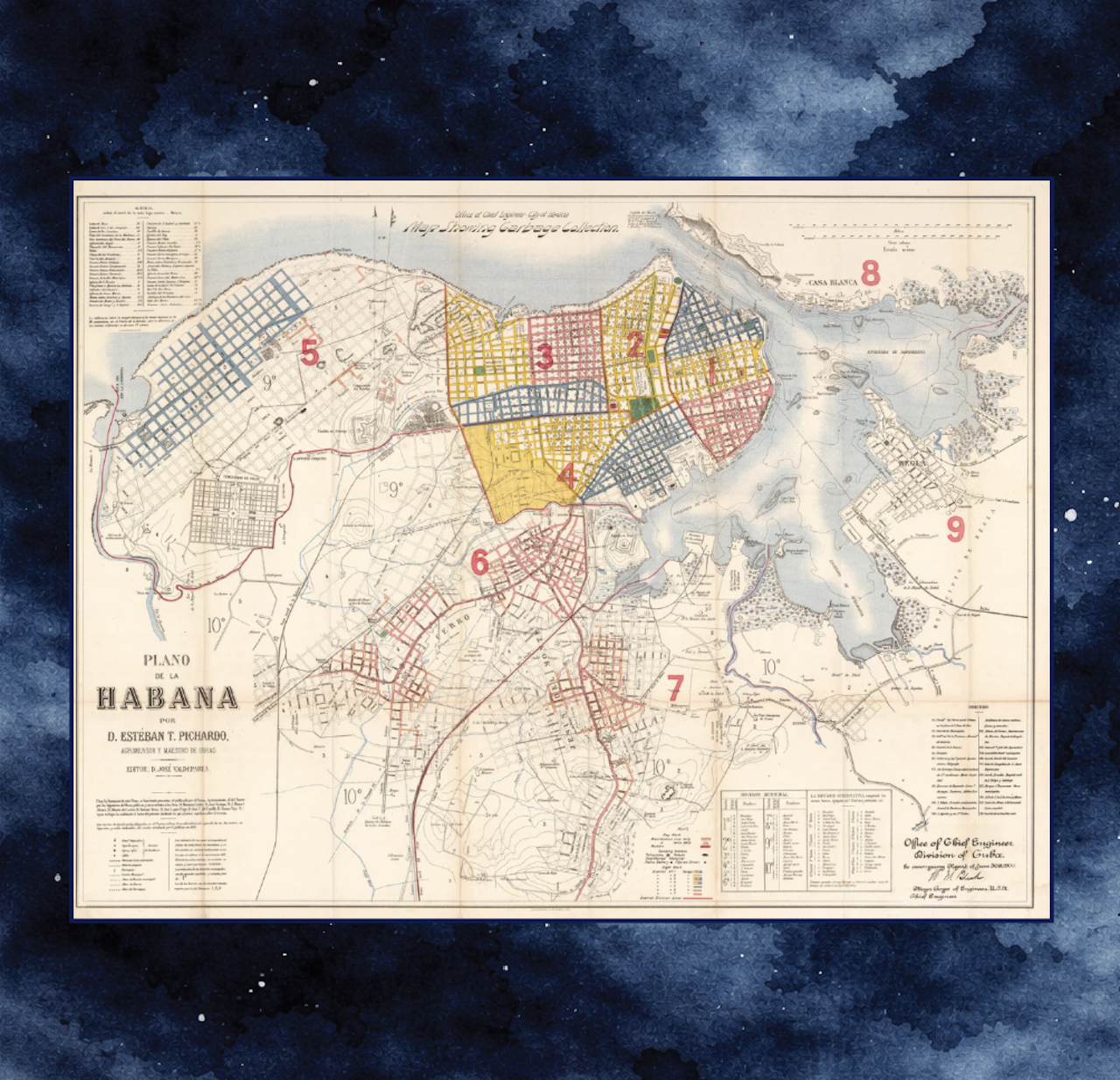
Image: Map of Havana (1900). Digital archive of the University of Miami.


