
That is the dilemma that’s heightened for adopted children, yes. But it’s not unshared by the rest of us. There’s an ambivalence in every relationship. The ambivalence is what makes the relationship intense. You love, you hate. Growing up is a process of learning to accept that ambivalence.
It is as though my chest had filled with air and I no longer knew how to release it, how to empty my lungs in order to expand them once again. Reading moves through the body: it crosses it, tightens it, wounds it, and then hands it over—almost casually—to whoever might claim it. This does not always happen, but it only needs to happen once for one to keep reading, waiting for that surrender, for the abduction of a life arbitrarily assigned by others, chosen by a careless eye.
I have a poor memory—very poor, to be fair. I forget the names of characters, plots, even where or how a book is structured, the chain of events that holds it together. When someone asks me what I am reading, I often do not know how to answer. And yet I possess another kind of memory, one tied to sensations and to the places I visit while reading—places that remain within me, as real as any others. If I could choose between the two, I would choose the first: the memory that names and orders things. But it is far too late for that kind of complaint. So why read? All those silent hours before pages saturated with ink. The only reason I have found so far is this: reading serves me only to feel, never to remember. And that seems to be enough.
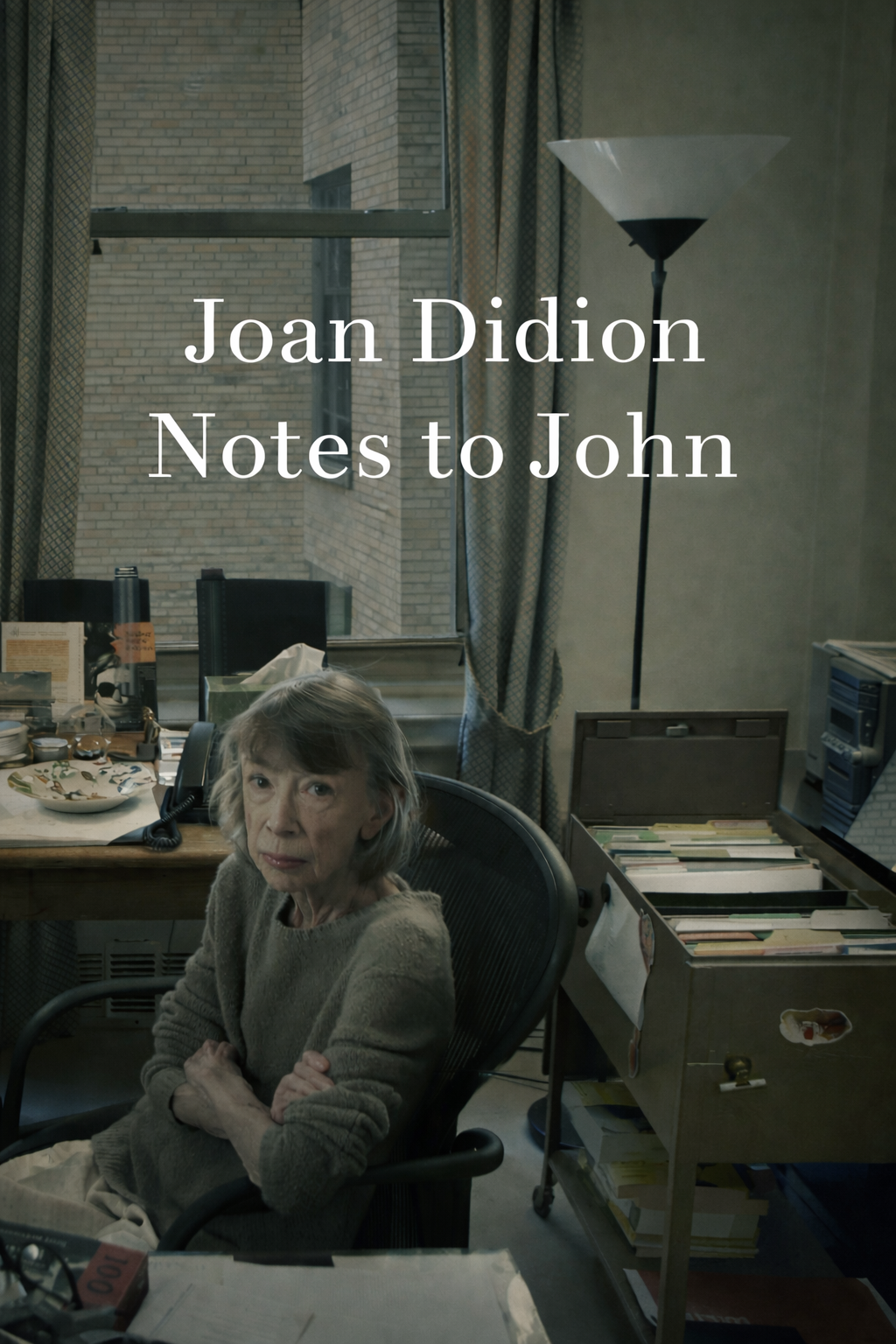
Because I want to linger longer with Joan Didion’s Notes to John, I sit at my desk and underline passages that had been left behind, moments the rhythm of reading allowed little pause for. I return to these broken dialogues, to the movements of a light, shifting self—Didion’s—around which orbit her husband John, her psychiatrist, her daughter Quintana’s psychiatrist. Between fears and doubts, each carries the shadows of their own past, perpetuating ways of inhabiting a world that remains barely intelligible. In that mystery—the one that shapes and deforms us—we are perhaps all more or less the same.
This is a notebook not meant for publication, uncomfortable to read because of its structure, fragmented and hard to digest. Behind it looms the ethical question of whether it is right to publish a text never authorized by its author, especially one so personal: notes born from conversations between Didion and her psychiatrist. Here, childhood trauma, Quintana’s alcoholism, and guilt collide again and again with an impenetrable wall that never quite dissolves. It is not that Didion had not written from this place before; it is that she had never done so in this way, through these intimate notes recovered from her archive after her death. Setting that aside, what I feel is a nervous text, clinging to life—dense, and yes, strange too, slightly crooked, but still moving forward.
The fact that there is no true beginning—as there would be in a narrative shaped to be consumed as narrative—and that the ending simply fades away because no further entries were made, grants the book a peculiar naturalness. It arrives from nowhere and dissolves again, like a breath that never quite settles. Added to this is an anguish that is difficult to ignore: many of us who read this notebook know that only months after these medical visits, John and Quintana will die; that September 11 will divide the world into a before and an after; and that Joan will later write two extraordinary books about the husband and daughter whose absence she here anticipates—The Year of Magical Thinking (2005) and Blue Nights(2011). To read it now—or simply to read it at all—is to remain in the suspension that follows the written word, when what has been read becomes proof, evidence that something—of the one who wrote or of the one who reads—is still alive.


