

Anyone who passes by a library without looking at it or stopping is not ignoring it: they have been expelled by it.
♣
Like in a poem by Shelley, in which a moth is burned by the light, libraries today are like dead leaves of civilization, but still in some corner of some suburban neighborhood, that vine of a reader’s ambition appears. No one asks about it or comes to visit it; it is like the empty moment of an old conversation that no longer finds ears or attention.
♣
Before an author dies, he has already been declared ineligible by libraries. Some have even arrived before him.
♣
Constipated if you write little. Diarrheic, incontinent if you write a lot. A scatological taxonomy has haunted writers since the beginning of time (modern times, that is) as if the right measure of what one is to some and ceases to be to others could never be achieved. There are authors with boundless imagination who never cease to produce (note the verb) vulgar, disposable fiction, soon forgotten. Posterity, always capricious, does not grant favors by shelf space, does not compromise on quantity. Melville considered Hawthorne his master. But one great story by Hawthorne is enough for us: Wakefield. None of his novels aspires to compete with a white whale.
♣
A reader is always someone who doesn’t know things. Not knowing what to do with what you read is part of knowing how to read. Reading, moreover, is not the first step toward writing, but merely a disposition toward the act of writing.
Sontag: My library is an accumulation of unfulfilled desires.
♣
A lost library is like a graveyard of human blots. With age comes the reckoning of those we have lost through moves, migrations, separations. Why are you taking all those books? The origin of this essay lies in that question. It was asked by a Cuban customs officer when he checked my luggage. They’re my books, I stammered. Many had to go into exile with only the clothes on their backs, it’s true, but I had the possibility of taking some luggage with me, especially since there were three of us. The question and the way I answered it. The idea of the lost library was only in my mind. The astonishment of my family and acquaintances also indicated this. No one could conceive of moving a library to another country. But of course, it wasn’t the entire library, just a part of it. A tiny part. Many of the best books, I must remember, ended up in the hands of friends who took their share. I let them take them, knowing that I was going to live somewhere else, where I believed I could recover those volumes. It will soon be twenty long years since then. In all that time, I have managed to quintuple the number of books, but I have not yet been able to recover several of those.
♣
The library is my map of the world and the story of that world, which is always foreign. However, on my shelves, it is always mine. My library is the shape of the world and its events.
The attribution of a geography that sometimes contains me and sometimes expels me like an illiterate. It is my inner landscape. My timeline.
♣
According to Montaigne, when the Goths ravaged Greece, one of them saved the libraries from being burned, saying that it was better to leave them to the enemies as something suitable for distracting them from military exercises and turning them to sedentary and idle occupations. When King Charles VIII, almost without drawing his sword, found himself lord of the kingdom of Naples and much of Tuscany, the lords of his entourage attributed such an unexpected ease of conquest to the fact that the princes and nobles of Italy strove more to be ingenious and wise than vigorous and warlike.
♣
The library is the alibi of meticulousness.
♣
D’Alembert: The greed that comes from accumulating books can be very sordid. I knew a madman who had developed an extreme passion for books on astronomy, even though he did not understand a word of the subject. He went so far as to buy volumes at exorbitant prices and then locked them in a chest without even glancing at them. He wouldn’t let anyone near them. (…) Another man kept his books so carefully, for fear of damaging them, that when he needed to consult them, he borrowed them from his friends. He hung a sign in his library saying “Go to the booksellers” in case someone absent-minded asked him for a book. (Encyclopedia, Article: Bibliomania)
♣
Owning a private library is a daily reminder that you have to start over. Look at the shelves and think: today is definitely my first day as a reader. And as a reader, I have no past; it doesn’t count. Every day is a new beginning.
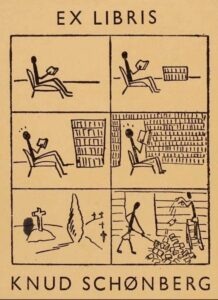
Cover picture: Martha Ma. Montejo, Dunaway Books, St. Louis MO.


