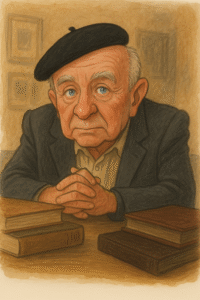
—Why the reversals, why the minimalist distillations, why the asceticism of visions—words—that crumble away? Well, for an ecological reason: to clear the air.
Flaubert spoke of “a book about nothing.”
I would like a book about nothing that was based solely on: the vicissitudes of visual perception; the organic as inorganic, or vice versa; the relationship between two images that have no basis in reality; the pure analysis of an image that seduces us; the establishment of a space for the phantom (a space that would be the void left behind when reality is removed).
I cannot forget this observation by Pasolini in an interview with Pound: “Instead of imagining it spread out across a linguistic territory, I see it stuck at the bottom of a well into which you have reduced the world to a few elements, that is, to a group of quotes that are always the same, to a group of friends who are always the same, x, y, and so on. As if you were working at the bottom of a very narrow well, where you constantly remember and reflect on your life.”
Reducing the world to a few elements of this Playa Albina, to a group of identical quotes, to a group of friends. This is what I have been doing for many years, when I had no choice but to climb into a well. But the problem is that I am not Pound.
Until silence comes, photographing the familiar, playing with photographs, or even becoming a photograph oneself (“I would have liked to be an anonymous portrait,” said Gómez de la Serna). Perhaps by playing one can achieve satori.
Perhaps playing… with photography, with plastic arts, until, as Benjamín Jarnés said, “painting returns a little to its state of innocence, with its cubism turned upside down.”
Throw away the pieces, throw away the words. Then turn the words into pieces. And, in the end, put it all in little boxes, following a game of machinery, thinking of Raymond Roussel.
But don’t forget that before you start, you can throw everything away: words, dreams, quotes. Make a mess.
I remember this quote: “Jacques Scherer claims that Paul Valéry confided in him: Mallarmé began some of his poems […] by throwing words onto the paper, here and there, like a painter throws brushstrokes onto a canvas, and then devoted himself solely to linking them together to make phrases or poems, following the strictest rules of composition.” I dream deliriously about this quote, because I would like to throw words onto paper and then, once they have become pieces of a game à la Roussel, put them inside a little box.
Then you start struggling to turn the words into pieces, then you start struggling to come up with a construction project. And most likely it won’t go any further than that, most likely it will all remain a trail that cannot be composed. But then, my delirium with superimposition leads me, against all odds, to not want to abandon the failed project, and to want to build a little box where the composition that orders the pieces consists of a superimposition of pieces that cannot be integrated into the game. In other words, it would be like the game of the unachieved game. This, I confess, is pure delirium, but I like it. What can I do? One is as one is.
—And as for quotes, above all, I am fond of this one by Umberto Eco: “The reader has to understand that I am playing with ideas, and that is why I have to use an enormous amount of material, much of which I myself do not know.”
I think it was Tablada who said: “Adanic like surprise and wise like irony.” But is irony always wise? Is it wise when, as in Tablada’s case, it has a playful flavor?
And why do writers almost always pretend that playfulness is wise? Why do they pretend that playfulness dictates rules? Isn’t it enough for them that it’s just a game?
And above all, along with the awareness of my playfulness, I cannot help but remember, when I look in the mirror, what was said about Ferenczi in a letter from his stepdaughter: “Every time he passed in front of a mirror, he would exclaim: ‘I don’t know why I’m so pale… I suppose it’s old age,’ and he would laugh.” And indeed, an elderly author of Playa Albina must be aware of the literary potential that may lie in his old age.
I had thought of weaving together all these quotes that have come my way over the years of Playa Albina, but then I realized that the best weaving or story I can do is to leave the quotes as they are. So, to justify leaving things as they are, I have clung to this quote from Dr. Johnson: “Perhaps one day man, tired of preparing, linking, explaining, will come to write only aphoristically. If we wait to weave the anecdotal into a system, the task may be long and less fruitful.”
“This, then, is what we were seeking through shrewd reasoning: that which is mixed with things, that which we call emptiness.” Lucretius.
“For the longer I live, the less I am interested in wit, in the intellectual and literary sense of the word, in its own right. Such wit has been thrown into the gutter. There was a time when, by syllogizing, Socrates was able not only to épater le bourgeois, but even to give a serious impetus to human progress; by leading it to recognize its own laws, he gave intelligence a sense of responsibility; hence all our science. Today, however, intelligence, having become much more differentiated and now established, has become very sure of itself and feels responsible for nothing (…) In the same vein, many poets who twenty years ago would have lived a bohemian life and anathematized the bourgeois order now do an excellent job as department heads in ministries and even as ambassadors. The fact is that literature no longer commits to anything. In the worst case, intelligence manifests itself as purely destructive.” Count von Keyserling.
—And as for the figures, it wouldn’t be a bad idea to relate them, through bandages, to Death. Remember The Book of the Dead.
For the construction of the figure, it would be good to bear in mind this observation by Boris Vian: “He raised a disembodied, foul-smelling gaze toward Chick.”
And it is also good, in this construction of the figure, to pause on an observation such as this one made by Proust: “He was a tall, thick man, very dark, studious, somewhat sharp. He looked like an ebony paper knife.”
—And as for memory… The mnemonic device of the boxes. What world of memory can the boxes reconstruct? Or could it be that the boxes destroy memory?
—And, as for emptiness, I don’t know why I explain it through this vision of Gómez de la Serna: “I was wasting my time. Success would be to be run over by a tram and ipso facto become the yellow hat in the hat shop near the place where I was run over.”
Also, as for emptiness, it is a piece of light that can be seen inside a shadow, or a piece of shadow that can be seen in the light. One knows that there was something, and one knows that there was nothing (but in the latter case, it feels like a weight of non-existence). And what I am saying—an experience?—happened on the floor—of the terrace? But perhaps this experience also happened in childhood.
[Material from the author’s unpublished digital stationery.
Provided in August 2012 by Marta Lindner-García]
Cover photo: Diane Rolnick