
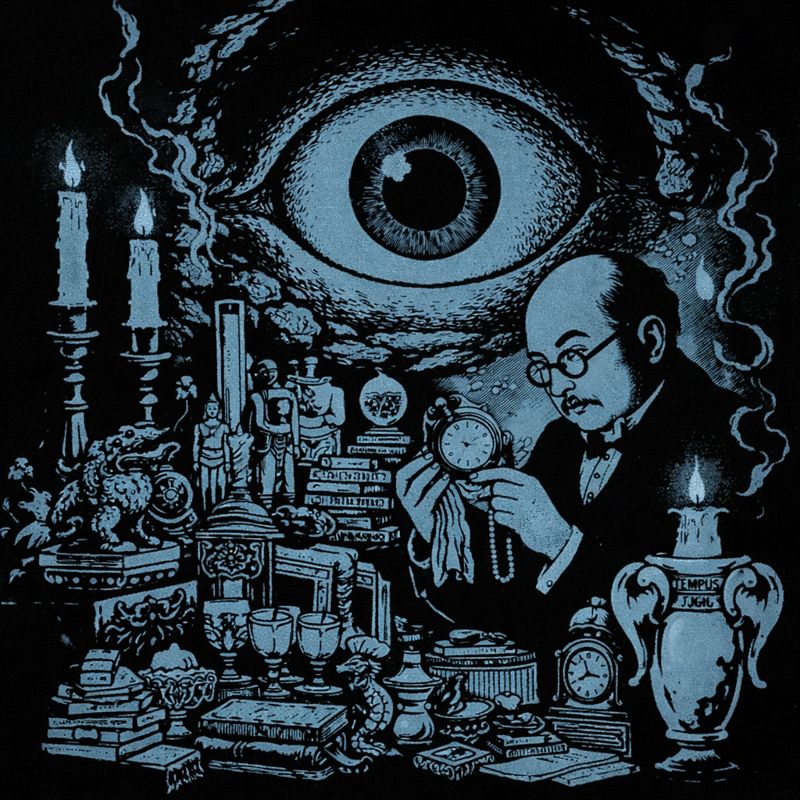
Every Sunday for twenty-five years, Victoriano Masdéu locked himself in the secret room of an old coffered house on Trocadero Street. That part of the Cuban capital is known as Old Havana. For others, it is nothing more than the old walled city, the city of shadows.
The room measures no more than ten square metres. Its only window is a narrow skylight that, although it does not provide sufficient light, at least allows for ventilation. Its walls are rough and unfinished, but they wisely shield the room from the tropical heat, and twisted hook chandeliers with thick tallow candles hang from them. For three generations, the room was a secret passed down from father to son. Then, finally, they decided to tell the rest of the family. They could know about it because the pirate fears for which it was created had long since been dusted off: the island was a quiet and promising tourist emporium. Thus, exposed to all, without secrecy, the room gradually disappeared again. Only when the first revolutionary movements arose and the country became uncertain did Victoriano Masdéu warn his family and friends not to talk about the room to anyone. It was a secret whispered with a certain faithful complicity, but it never left the intimate circle of which Victoriano became the centre.
One night, Victoriano invited his old comrades from San Bernardino College to celebrate another year of their graduation. But one of the guests and friends, Carlos Cowley, was not in the mood to celebrate. He knew about the stronghold and was uneasy. At the end of the dinner, Cowley took Victoriano aside, took a tiny object wrapped in a handkerchief out of his pocket and handed it to him.
‘Keep it where they can’t find it,’ he said to Victoriano. ‘It’s very valuable. Anita, my wife, doesn’t know I have it. It will be useful when she needs money to leave the island. I’m leaving tomorrow.’
Surprised, Victoriano didn’t mention it to anyone that night. He decided to keep it in his room, as he had no use for it. Three days later, word spread throughout Havana of Carlos Cowley’s escape.
On the fourth day, locked in his room and alone, Victoriano opened the handkerchief. He found a pocket watch with a gold chain, a Breguet, mounted in a gold case and encrusted with onyx and diamonds. The watch was a jewel because of the materials used, its craftsman and its first owner, as stated in the inscription: faite par Breguet pour m. le Duc d’Orléans en 1.780. But Victoriano did not realise the value of the commission until his neighbour, who was also his best friend and one of the most cultured men on the island, told him.
And so it was that, on the fifth day after Cowley’s escape, the poet Luis Leoncio Luna entered the room in the Masdéu house.
‘Breguet watches,’ Leoncio Luna explained with his oppressive asthmatic breathing, “were often counterfeited in their day.
For this reason, most genuine Breguets display, apart from the normal signature, a particular mark traced according to a secret procedure and only recognisable under certain lighting, and also, almost always, a registered number.
They checked. Indeed, when they placed it at an angle and under candlelight, they found the mark.
‘I’m afraid, Victoriano,’ Leoncio Luna declared, “that you are in the singular fortune of possessing one of the most coveted objects and one that arouses the most rivalry among international collectors today. However, aside from the piece itself, I am concerned about the combination of onyx and diamond. They are stones with opposing virtues.
The first instils fear in its owner. The second gives courage. It is a strange Zoroastrian balance.
Victoriano, oblivious to Luis Leoncio Luna’s impenetrable musings, told him how the watch had come into his possession and asked him not to reveal it to anyone. The poet nodded with a smile.
But the Breguet was just the beginning. Then came a tiny Pi-Hsieh dragon, an archaic reddish jade amulet from the Han dynasty, which, according to Chinese belief, served to scare away demonic spirits. The Pi-Hsieh was no more than thirteen centimetres tall, but it came in a marble box five times its size that served as a temple for the amulet. Its owner, another friend of Victoriano’s, warned him that the amulet and the box should not be separated. As he could not take it with him, he asked him to keep it for when he returned to the island.
The collector agreed. But he did so without any joy: two of his best friends were leaving at almost the same time. A premonition told him that he would never see them again.
Thus began to arrive more objects of all sizes and types, and more than one for each friend or acquaintance who knew that faithful and secure warehouse on Trocadero Street. A kneeler and a Fischer mat rocking chair made in Bohemia arrived, as did three Egyptian shawabti statuettes made of cedar wood with gold accents, a bush with lively birds made of colourful, static Murano glass, a Mexican kneeler with a hidden carving of La Malinche, twenty-seven Mosser crystal glasses, a tea set made of Peruvian silver with a continuous shine, a Hindu ivory vase with two elephant head-shaped horns, a folder of articles that José Martí wrote during his stay in New York, a pedestal clock with the inscription Tempus Fugit, three fierce knives… The rarities were endless. They were never rejected, except for two or three voluminous exceptions, such as that of a musician who brought a Pleyel grand piano with alabaster keys. He surely assumed that the secret room had inexhaustible dimensions.
From those days on, Victoriano Masdéu and Luis Leoncio Luna shared every detail, every novelty, every story of an incipient museum that, little by little, grew to the amazement of the collector and the delight of the poet. Amazement because Victoriano would never have imagined that his friends and acquaintances could have objects of such a varied and expensive nature. How had the Duke of Orléans’ watch and an amulet from the Han dynasty ended up in Cuba? Who had brought them? While Victoriano delved into these questions and the nostalgia of his friends, for Leoncio Luna there was no greater satisfaction than receiving surprise invitations to decipher the details of each new consignment. He sharpened his bookish curiosity by shining prodigious rays of light on the pieces in the room, so that his erudite speech made them transparent and dazzled the collector’s ignorance. Thus, the meetings were ritually arranged for Sundays. Victoriano cleaned the objects with the relish of a numismatist and repeated the curious facts from his friend’s casual teachings. Leoncio Luna pleasantly contemplated the antiques and recalled others from his own family. From time to time, he would talk freely about the piece Victoriano was dusting and polishing, while filling the few square metres of the room with the smoke from his cigars.
Cuba became more isolated. Time stood still along its splendid coastline. Luis Leoncio Luna achieved continental fame for his books, but it was a sad fame, and the collector added ten thousand objects to the crowded and almost impassable room. Victoriano’s nostalgia also grew, although to an extent that could not be measured. As his private museum grew and he received no news from his friends scattered throughout the United States, Mexico, and Europe, he believed a reunion was impossible. He even thought about leaving the island. More than his family, he was held back by his responsibility to his friends’ commissions. Luis sensed Victoriano’s state of mind, although he never asked him anything.
Both shared the condemnation of never leaving Cuba, the collector to meet his friends, and the poet to overcome his withdrawal with the fascination of other landscapes and the joy of belated fame.
‘We cannot leave Cuba,’ Luis declared. ‘Ananké, fate, is there, with her fixed Cyclops eye.’
And it was true. Luis Leoncio Luna, the friend and neighbour and great Baroque poet, died two years later of heart failure. A week earlier, he had given Victoriano the manuscripts of several books of poems, both published and unpublished.
The collector was as surprised as he had been that first time with Carlos Cowley. He naively asked him if he was leaving the country. Luis replied with a mandarin smile but without the exalted breath:
‘I’m going to the Last Thule, dear Victoriano.’
As always, Victoriano did not immediately understand his friend’s erudite reference. But when he heard the gloomy commotion in the neighbouring house caused by the poet’s death throes, a flash of insight tormented him until he translated, blurred but accurate, the resonances of what Ultima Thule meant.
Increasingly lonely, the collector continued to ritually shut himself away on Sundays. He cleaned the jewels, preserved the relics and rummaged through his memories, placing everything in a furtive jumble that served to anchor him in disorder to a world encrypted in the past. We never knew how he felt about the memory of those who had placed those objects in his hands. He believed in heirs and sudden widows who would come to thank him for his loyalty, and that single gesture would have been enough to compensate for the years of adventurous silence shared with his friend. But only Anita Cowley came to collect the Breguet, in a hurry and without reminiscences.
This story is part of the book La luna nómada (Algaida Editores, Fundación Municipal de Cultura, Ayuntamiento de Cádiz, Spain, 2004).
It is reproduced with the author’s permission.


